I Tested 5 Top-Tier AI Token Plans: Which One Is Actually Worth the Money?
After testing 5 top AI token plans, multi-account OpenCode beats them all on speed, concurrency, and price.
A heavy AI coding user tested five top-tier token plans: GLM MAX, MiniMax Ultra, ChatGPT $200, Alibaba Bailian Premium, and DeepSeek pay-as-you-go. Each had clear drawbacks — GLM burns out in 4–5 days, MiniMax is unstable, DeepSeek can cost ¥1,200/month after its price hike, and ChatGPT is slow in China. Cheap relay services were also ruled out due to throttling. The winner: a multi-account OpenCode strategy using multiple GitHub accounts, totaling ~¥350 for five accounts — the best balance of speed, concurrency, and cost.
As a power user who relies heavily on AI coding tools, I've purchased five of the highest-tier token plans available across major AI platforms — both domestic and international. After putting them through intensive real-world use, I have firsthand experience with each plan's speed, quota, and pricing. Here's my honest take, along with the solution I ultimately settled on.
Head-to-Head Comparison of 5 Top-Tier Plans
Let me cut straight to the conclusion: when evaluating an AI model, you need to consider three dimensions — intelligence (model capability), speed, and price. And the most critical factor is almost always speed, because it directly determines the user experience. Just like a buffering video, a slow model response is genuinely painful to deal with.
GLM MAX Plan: Quota Can't Keep Up with Heavy Use
GLM's MAX plan runs over ¥1,000 per month, or roughly ¥860/month when purchased quarterly. The weekly credit allowance is 140,000 points, equivalent to approximately 1.3 billion tokens. That sounds like a lot — but under extreme high-intensity use, you'll burn through it in about four to five days. Once the quota runs out, if you don't have a backup, you're simply stuck waiting.
One important caveat: the Fresh version of GLM offers a terrible experience — it's painfully slow. If you're considering this plan specifically for the Fresh version, I'd strongly advise against it.
MiniMax Ultra: Affordable but Unstable
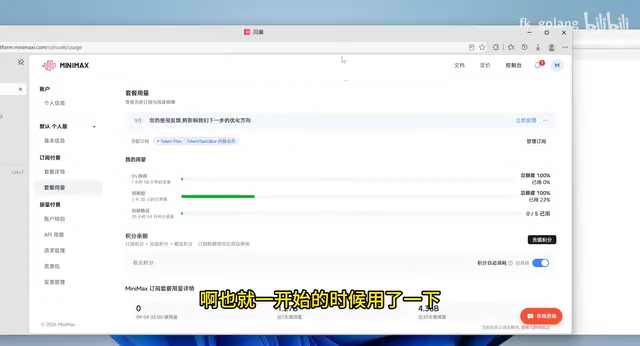
MiniMax's top-tier Ultra plan is priced at around ¥469, which is relatively reasonable. I consumed roughly 4.3 billion tokens on it, though most of that happened in the early period — I barely touched it after that.
The reason is stability: sometimes it's fast, sometimes it's painfully slow, with noticeable fluctuations. The general pattern is that mornings are faster and evenings slow down considerably. For users who prioritize efficiency, this unpredictability is a dealbreaker.
ChatGPT $200 Plan and Alibaba Bailian Premium
ChatGPT's $200/month plan speaks for itself in terms of capability. However, using it in China requires a VPN, and real-world response speeds weren't great — noticeably sluggish.
Alibaba Bailian's top-tier Premium plan is priced at ¥1,400 with 250,000 credits, which also gets burned through quickly. The overall experience felt roughly on par with GLM's ¥800-something plan — not particularly impressive value for money.
DeepSeek Pay-as-You-Go: Fast, but Expensive
DeepSeek uses a pay-per-token pricing model. From August 6th to August 25th — roughly 20 days — I spent ¥800. There was a notable turning point: DeepSeek raised its prices on August 17th.
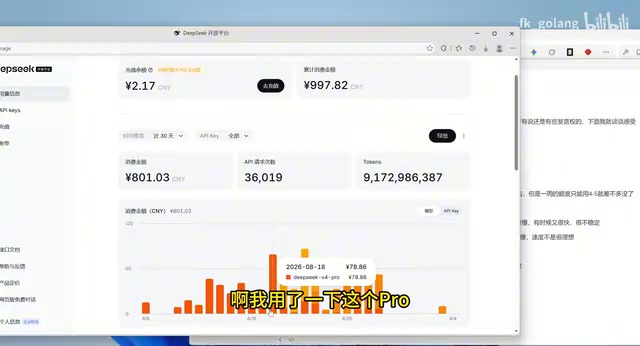
After the price hike, I tried the Pro version for two hours and burned through ¥78 — which scared me into switching to the Fresh version immediately. Interestingly, the current Fresh version actually performs slightly better than the old Pro version, at a marginally higher price — both hovering around the ¥40+ range.
When you do the math, paying per token at normal usage intensity could run you around ¥1,200 per month. That's genuinely expensive, and not sustainable for most everyday users.
DeepSeek's pricing structure bills input tokens and output tokens separately, with different rates for cache hits vs. cache misses. "Pro version" and "Fresh version" aren't fixed official terms — they may correspond to different model versions or service tiers depending on the platform or time period. Pro typically refers to a version with stronger reasoning capabilities, while Fresh refers to a lighter variant optimized for response speed. The August 17, 2025 price adjustment raised output token costs for DeepSeek's flagship models, directly impacting the monthly bills of high-frequency users. Pay-as-you-go is relatively flexible for users with variable usage patterns, but for consistently high-intensity daily use, the predictable cost of a fixed plan is often more advantageous — which is the core rationale for the cross-plan comparison in this article.
Why I Don't Recommend Cheap API Relay Services
A lot of people ask: why not use a cheap relay (middle-man) service to save money? Given how many top-tier plans I've purchased, I've naturally tried plenty of relay services too.
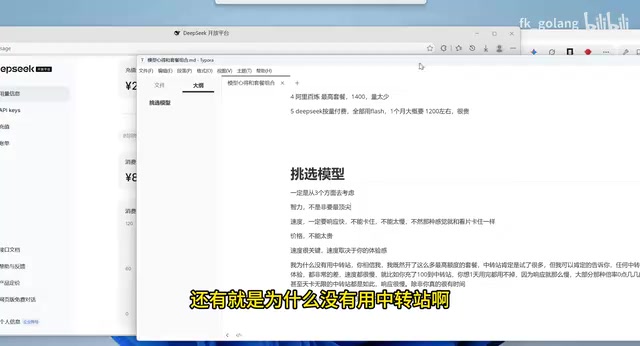
My verdict is clear: those ultra-cheap relay services with multipliers of 0.0-something are absolutely terrible — the speed is absurdly slow. You could top up ¥100+ and still not be able to burn through it in a single day because the responses are so sluggish. To be clear, I'm talking specifically about low-multiplier relay services; legitimate relay services that charge at or near official rates are a different story. Unless you're a student with plenty of time to spare, I genuinely don't recommend touching these cheap relays.
"Relay services" (中转站) refer to third-party platforms that bundle API access to multiple large language models and resell it to users through a unified interface. Users top up the relay service, which then calls the official APIs of OpenAI, DeepSeek, etc. on their behalf, earning the price difference. The "multiplier" is the key pricing metric: official pricing is 1x, so a 0.1x multiplier means the same tokens cost only one-tenth of the official price. The reason low-multiplier services perform so poorly comes down to how they cut costs — through overselling, rate limiting, and sharing low-priority API keys. Users appear to save money on paper, but in reality their requests sit in heavily congested queues, with individual calls sometimes waiting tens of seconds or timing out entirely. For AI coding workflows that demand rapid iteration and frequent calls, the time cost of latency far outweighs whatever money is saved.
The Final Answer: Multi-Account OpenCode Strategy
After this full round of testing, the only relay service I'd recommend is OpenCode — and it's the real star of this piece.
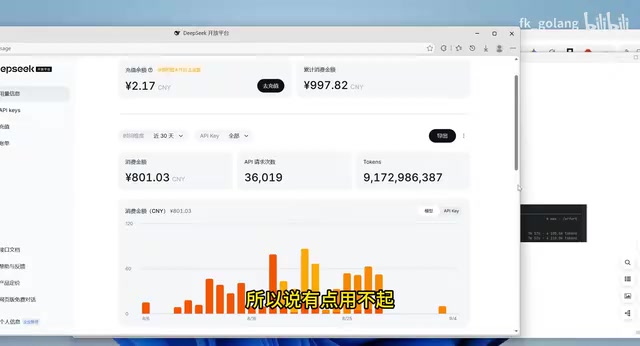
Using OpenCode to call DeepSeek is extremely fast — you can blow through 100k tokens in about 3 to 5 minutes, essentially on par with the official API. But fast also means expensive-fast, which is why I burned through ¥800 in just 20 days.
OpenCode only offers a $10 plan. If you want maximum response speed and concurrency while keeping costs down, the strategy is simple: open multiple accounts.
The process is straightforward: register multiple GitHub accounts and use a single Alipay account to authorize auto-renewal across all of them. Five accounts costs roughly ¥350 in total — which you'll barely exhaust — and that's cheaper than any of the individual plans listed above. Per account, if you're using DeepSeek Flash, the official quota is listed as 37,000 requests (my 36,000-request usage came to ¥800, so I suspect that number is inflated).
My advice: open as many accounts as you can justify. I'm currently running three accounts as a test to see if I can actually max out all three. If I can't, I'll post a follow-up. All things considered, the multi-account OpenCode approach strikes the best balance between speed, concurrency, and cost — it's the only clear winner from this entire round of testing.
OpenCode is a developer-focused AI coding assistant platform that provides high-speed API access to leading large language models through a subscription model, with DeepSeek among its underlying providers. Its core advantage lies in its server infrastructure and near-direct connection to official APIs, offering latency and concurrency performance close to native API access — unlike the shared, rate-limited model of cheap relay services. "100k tokens" refers to 100,000 tokens, the basic unit of text measurement for large language models, roughly equivalent to 75,000 English words (or fewer Chinese characters). Burning through 100k in 3–5 minutes indicates an extremely high generation rate, well-suited to long-context, large-code-block programming scenarios. Running multiple accounts in parallel is fundamentally about distributing concurrency limits across multiple independent quota pools, avoiding rate limit (Rate Limit) bottlenecks that cause wait times on a single account — a widely used, compliant speed optimization strategy in the developer community.
Purchasing Recommendations Summary
If you're a high-intensity AI user, keep three principles in mind when choosing a plan: you don't need to chase the absolute top-tier model (you won't be able to afford it long-term), speed must be fast (it defines the experience), and the price can't be unreasonable. For most users chasing value, rather than spending thousands on a single official top-tier plan, you're better off going the multi-account OpenCode route — lower cost, better speed, and better concurrency.
Related articles

Three AI Researchers Debate: How Far Are We from Recursive Self-Improvement?
Three AI researchers including former OpenAI co-founder John Schulman debate recursive self-improvement and intelligence explosion, dissecting continual learning, distillation, RL success, and ASI timelines.

AI Recursive Self-Improvement (RSI): How Far Are We from the Real Thing?
How close is RSI (Recursive Self-Improvement) to reality? We analyze Acer AI's RSI Agent, a Shotcut watermark task, OS World 20 results, and OpenAI's automated researcher goal.

AI Coding Platforms Are Exploding in Popularity: Can Non-Technical People Really Build Money-Making Products?
An AI coding competition unexpectedly drew 1,000+ signups, sparking debate on whether non-technical people can build profitable products with AI. We break down the opportunities and the hype.