ICLR 2027 Is Still Sending Rejection Letters: Academia's Long Struggle with AI-Generated Slop
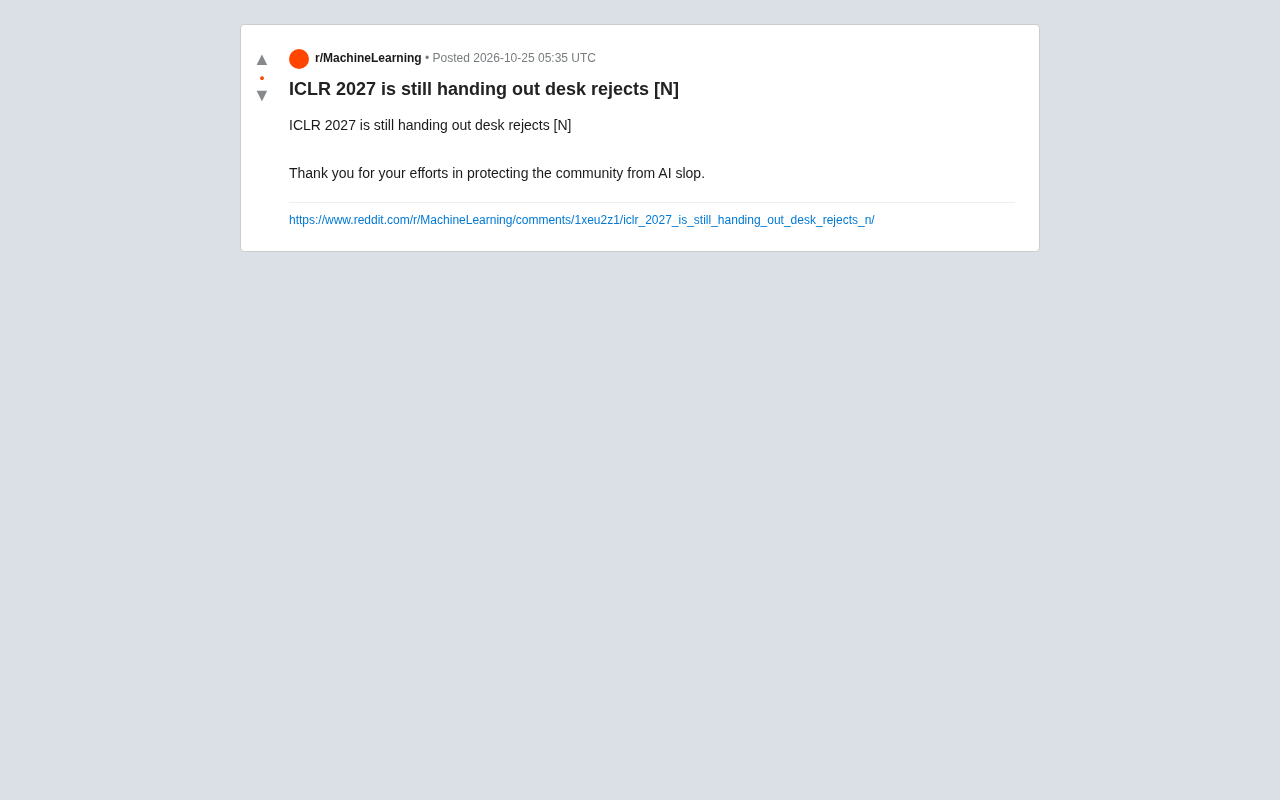
ICLR 2027 keeps using desk reject to block AI slop, reflecting deep dilemmas in academic evaluation.
ICLR 2027 is still intercepting low-quality, suspected AI-generated submissions via desk reject, and the Reddit community supports this. The article notes that generative AI greatly lowers the barrier to producing well-formatted but hollow papers, causing submission surges and diluting reviewing resources. Desk reject has expanded from traditional format checks to content-based initial screening, becoming a gatekeeper for the review ecosystem. However, the deeper driver is the paper-count-oriented academic evaluation system—tools only amplify existing incentive distortions. The arms race between conferences and submitters continues to escalate, with no consensus on AI use boundaries. For researchers, real experiments, solid arguments, and accurate citations are the hard currency for passing initial screening.
A Quiet "Cleanup Operation"
A short post on Reddit struck a chord across academia: "ICLR 2027 is still handing out desk rejects," with the poster adding, "Thank you for protecting the community from AI garbage." A few words, yet they lay bare a shared predicament facing top machine learning conferences today—surging submission volumes, a flood of low-quality AI-generated papers, and program committees forced to deploy the extraordinary measure of desk reject (editorial rejection without review).
As one of the most influential conferences in deep learning, ICLR has seen its reviewing pressure climb year after year. When generative tools can churn out a well-formatted, jargon-stuffed "paper" in a matter of hours, the conference's organizational defenses are forced forward: rather than waiting for external review, obviously substandard submissions are filtered out right at the editorial desk. This isn't a rejection of any single paper—it's an emergency intervention in the entire submission ecosystem.
Why Desk Reject Has Become a Standard Weapon
Desk reject wasn't invented by ICLR, but its normalization at top AI conferences is worth pondering. Traditionally, this mechanism handled hard violations: formatting errors, page limit overruns, double-blind breaches. Now the rejection reasons point more to content itself: no real experiments, hollow logic, patchwork citations, or entire papers generated by models without substantive revision.
Reviewer resources are finite. According to community discussions, a conference's reviewer pool often must cover thousands of submissions, and a qualified review of each paper requires domain experts to invest several hours. When "AI slop" pours in by orders of magnitude, allowing it unfiltered into external review damages not only reviewers' time but also the risk of drowning out genuinely valuable work. Desk reject plays the gatekeeper here, blocking the most obvious noise at the lowest cost.
Interestingly, the poster used the word "still"—indicating this practice has persisted for multiple cycles, and the community isn't surprised but rather adopts a tone of "thank you for still holding the line." This reveals a subtle consensus: at a time when technical means cannot yet perfectly identify AI-generated content, human-and-rules-based initial screening remains a necessary evil.
Desk reject is a pre-screening mechanism in academic publishing: manuscripts are returned directly by editors or program committees based on hard criteria before entering peer review, without being sent out for external review. At machine learning conferences, common triggers include exceeding page limits, formatting that doesn't match the template, violations of double-blind review rules, duplicate submissions, or obvious deviation from the conference theme. Unlike formal rejection, desk reject typically provides no detailed review comments, with short processing times and low costs. In recent years, as submission volumes have surged, some conferences have extended this mechanism to intercept manuscripts lacking basic academic elements—such as no real experiments, data fabrication, or content generated entirely by language models. This has sparked discussion about the boundaries of program committees' discretion: on one hand, pre-filtering protects limited reviewing resources; on the other, overly broad desk reject criteria may unfairly harm borderline but still valuable work.
The Incentive Distortion Behind AI Slop
It's unfair to lay all the blame on the tools. The real driver is the academic evaluation system's preference for paper quantity. Graduation requirements, assessment metrics, grant applications—all make "publishing one more" have tangible benefits. Generative AI happens to lower the barrier to "cobbling one together," so the supply side expands rapidly.
The consequences of this distortion are twofold. For authors, investing energy in low-quality output damages their own research taste in the long run; for conferences, inflated submission volumes dilute reviewing resources and lower overall review quality; for readers, literature searches are disrupted by slop, raising screening costs. ICLR's desk reject is just one interception at the end of this chain—treating symptoms, not the root cause.
Some community members have suggested that conferences could require authors to declare the scope of AI tool usage, or introduce stricter structured submission templates. But others worry that excessive restrictions would unfairly harm researchers who reasonably use AI-assisted writing. Where the balance lies remains undecided.
The "publish or perish" culture in academic evaluation is key background for understanding the flood of AI slop. At most universities and research institutions, graduation conditions, promotion, grant review, and performance assessments are directly tied to paper counts and the prestige of publication venues. This quantitative orientation makes "publishing one more" have calculable real-world benefits, while paper quality is hard to measure precisely in the short term. The emergence of generative AI significantly lowers the marginal cost of paper production: literature reviews can be patched together, experimental descriptions can follow templates, and even reviewer responses can be auto-generated. The supply-side expansion isn't driven by technology alone but by technology叠加 distorted incentives. Research has shown that the correlation between paper quantity and long-term academic influence is far weaker than intuition suggests, yet at the institutional level, quantitative metrics remain the easiest management tool. Therefore, any effort to curb AI slop that doesn't simultaneously address the evaluation system itself will struggle to solve the problem at its root.
The Arms Race Between Conferences and the Community Is Escalating
From a broader perspective, this is an evolving arms race. Conferences are strengthening initial screening rules, introducing automated detection, and expanding area chairs' discretion; the submission side is probing boundaries, seeking more "presentable" generation methods. The value of that Reddit post lies in recording frontline researchers' genuine sentiments: support for the cleanup operation, and cautious skepticism about its long-term effectiveness.
For ordinary researchers, the practical takeaway is clear—use AI as a writing assistant, not a paper factory. Ensure experiments are real, arguments are solid, and citations are accurate. These fundamentals are the hard currency for passing any initial screening. Desk reject stops opportunism, not earnestness.
Technical methods conferences use to counter low-quality submissions are iterating rapidly, including perplexity-based AI-generated text detectors, citation network anomaly analysis, modeling of authors' historical submission behavior, and requiring reproducible experiment logs or code repository links. However, each has limitations: detectors' accuracy drops significantly on human-polished or adversarially rewritten text, citation analysis may unfairly harm emerging interdisciplinary fields, and stricter structured templates may burden legitimate authors. Meanwhile, the submission side is also evolving—some authors deliberately adjust the statistical features of generated text to evade detection. This arms race resembles the long-term game between spam filters and spammers; there's no one-and-done solution. There are calls in the community for conferences to publicly release desk reject statistics and typical reasons to improve transparency and create deterrence, but others argue that excessive disclosure could be exploited by opportunists to reverse-engineer "qualified" AI slop.
Conclusion
ICLR 2027 is still sending rejection letters, which means the problem persists. This is both a defense of the bottom line of academic integrity and a push for reforming the evaluation system. When "protecting the community from AI garbage" becomes a phrase for which people express gratitude, behind it lies the entire research community's collective anxiety about quality—and an open question about how future review mechanisms should evolve.
One-line Summary
ICLR 2027 continues to use desk reject to block AI slop, reflecting deep dilemmas in the academic evaluation system.
Paragraph Summary
ICLR 2027 is still using desk reject to intercept low-quality, suspected AI-generated submissions, and the Reddit community supports this. The article notes that generative AI greatly lowers the barrier to producing well-formatted but hollow papers, causing submission volumes to surge and reviewing resources to be diluted. Desk reject has expanded from traditional format checks to content-based initial screening, becoming a gatekeeper protecting the review ecosystem. However, the deeper driver is the paper-count-oriented academic evaluation system—tools only amplify existing incentive distortions. The arms race between conferences and submitters continues to escalate, with no consensus on the boundaries of AI use. For researchers, real experiments, solid arguments, and accurate citations are the hard currency for passing initial screening.
Related articles
Claude Code Beginner's Guide: Desktop Setup and 6 Key Settings to Avoid Pitfalls
Claude Code desktop tutorial: paid tier, Opus planning and Sonnet building, workspace folders, approval rules, claude.md, compact sessions, and four project demos.

Anthropic Safety Restrictions Spark Outrage: Developer's TV Reverse Engineering Request Denied, Community Shares Workarounds
Anthropic's safety restrictions block a user from reverse engineering a TV, sparking Reddit debate. Developers share workarounds and discuss AI safety vs. open source.

Local Deployment of the Flint Model: A Guide to Running on Ollama and Integrating with Claude Code
Recursive's Flint is a 40B-parameter, 2.5B-activated open-source coding model. This guide covers running Flint locally on Ollama, integrating it with the Claude Code terminal assistant, and analyzing benchmark limitations and practical usage caveats.