If Models Are So Powerful, Why Doesn't OpenAI Just Start 100 Companies?

An HN question reveals the gap between model capability and commercialization; for OpenAI, selling APIs is more rational than starting companies.
The article examines a sharp Hacker News question: if large models are powerful enough, why doesn't OpenAI start 100 companies to disrupt industries instead of selling APIs? It argues model capability is not organizational capability, starting companies requires decision-making and tacit industry knowledge, while selling APIs is a high-margin platform model that lets others experiment and avoids competing with customers. OpenAI's real strategy is to focus on R&D and wait for the ecosystem to mature.
A Question That Set HN Ablaze
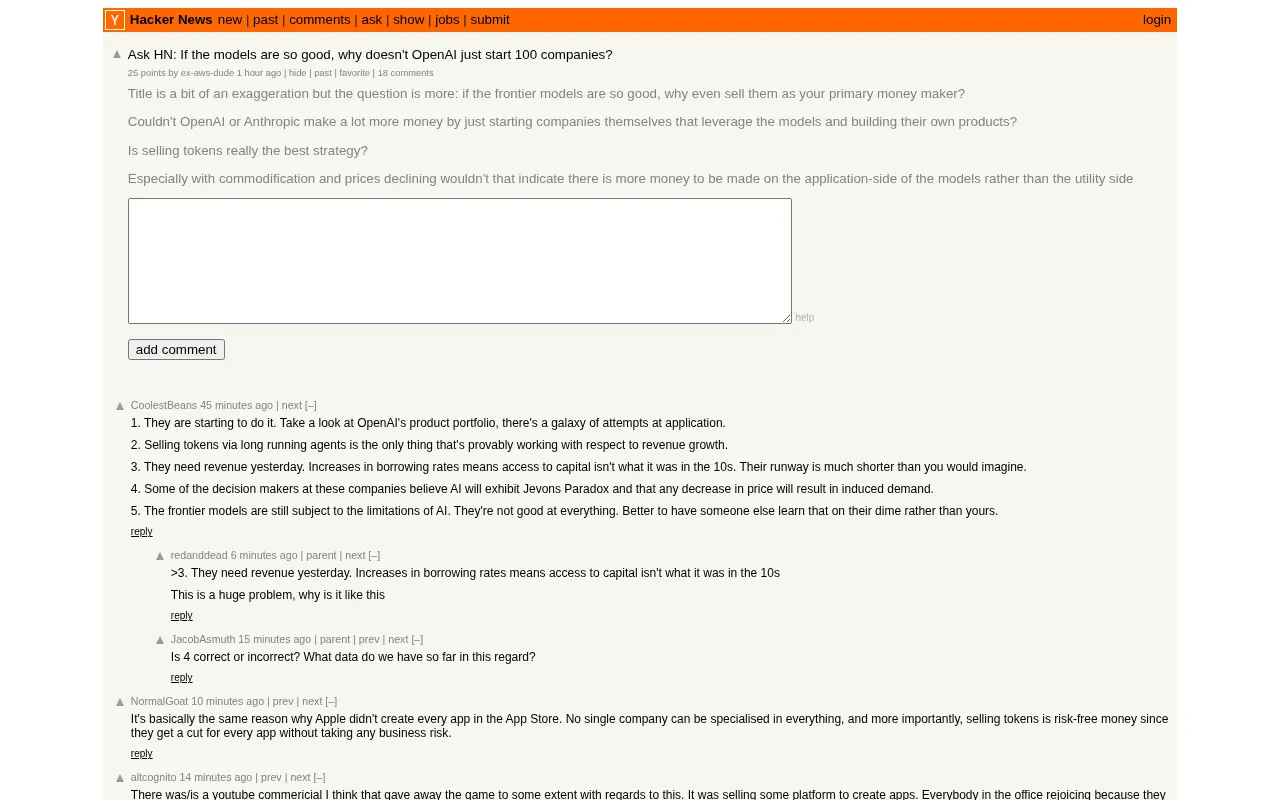
A seemingly simple yet sharply pointed question recently appeared on Hacker News: if large models are truly as powerful as advertised, why doesn't OpenAI just use them to start 100 companies and disrupt entire industries directly, instead of painstakingly selling APIs and subscriptions? The question quickly garnered 23 points and 16 comments—modest in scale, but it strikes at a core contradiction in the current AI boom: the enormous gap between model capability and commercial execution.
The asker's logic is straightforward: if the GPT series can write code, do analysis, and generate marketing copy, then OpenAI could in theory mass-produce startups—from SaaS to consulting to content production—all automated. But the reality is that OpenAI remains a company whose primary revenue comes from model licensing and subscriptions. That contrast alone is worth digging into.
Why Is "Starting Companies" So Much Harder Than "Selling Models"?
Model Capability Is Not Organizational Capability
A recurring point in the HN comments is that models can generate code, but they cannot replace market judgment, commitments to customers, or accountability for failure. A company exists because someone is willing to take risks, make decisions, and coordinate resources. Models can be tools, but they cannot be decision-making subjects. If OpenAI really went out to start 100 companies, it would need 100 CEOs, 100 sales organizations, and 100 sets of supply chain relationships—none of which can be solved by API calls.
Tacit Knowledge in Vertical Domains Is Hard to Automate
Even if a model can write a first version of industry software, the real moat often lies in the undocumented experience within an industry, the details of regulatory compliance, and long-term accumulation of customer relationships. Commenters pointed out that the complexity of many traditional industries lies precisely in the "dirty, hard work," while models excel at "clean work." Using models to mass-start companies might result in 100 shells that look runnable but cannot actually turn a profit.
The Economics of Selling APIs: Lighter, Steadier, More Scalable
Marginal Cost and Risk Sharing
From a business-structure perspective, selling APIs is a high-margin, low-marginal-cost model. OpenAI doesn't need to be responsible for each customer's success—only for providing foundational capabilities. Starting companies itself, by contrast, means bearing all operational risk, from hiring to inventory to customer churn. Someone on HN did the math: if models are truly good enough, the best strategy is precisely to let ten thousand companies use your API to experiment and make mistakes—you collect the "shovel money" rather than going into the mine yourself.
Platformization Is Greater Leverage
OpenAI's positioning is more like that of an infrastructure provider. Historical experience shows that during gold rushes, the people selling shovels tend to be more stable than the people digging for gold. Some commenters noted that if OpenAI started its own companies, it would immediately enter competitive relationships with its own customers and undermine ecosystem trust. Maintaining a neutral platform identity instead attracts more developers to build applications on top of it.
The API business model centers on packaging model capabilities as callable services and charging by usage (such as token count). The advantage of this model is that revenue naturally expands as customer usage grows, while OpenAI only needs to maintain one set of model infrastructure and does not bear responsibility for each customer's business success or failure. Historically, AWS became Amazon's most profitable business by providing cloud infrastructure rather than running its own applications; Stripe empowers countless e-commerce businesses through payment APIs while not having to bear inventory and marketing risk itself. OpenAI's API strategy is similar—it sells "intelligence" as a foundational factor of production, letting downstream developers match it to specific scenarios. The leverage effect of this platformization path is that one successful model can serve tens of thousands of applications simultaneously, whereas self-operated companies require duplicating management teams and operational processes one by one.
Where Are the Boundaries of a Model Being "Good"?
The Gap Between Impressive Demos and Production Reliability
A key point of divergence in the HN discussion is that there is a significant gap between how models perform in demos and how reliable they are in real production environments. Some commenters pointed out that a model can write a beautiful piece of code, but long-term maintenance, edge-case handling, and security vulnerability prevention still require human engineers. Mass-starting companies means confronting the complexity of production environments at scale, and models currently cannot independently shoulder these responsibilities.
Production environment reliability refers to a system's ability to run stably under real, continuous, and unpredictable conditions, including handling edge cases, coping with data drift, ensuring security and compliance, and long-term maintenance. Large models are often tuned for curated cases in demos, but in production environments, input distributions are broader, more adversarial, and the cost of errors is high. For example, a code-generation model may write a syntactically correct function while ignoring concurrency safety or resource leaks; a customer-service model may perform well in most conversations but make incorrect commitments when refunds or legal terms are involved. Commonly used industry evaluation metrics such as pass@k (at least one success in multiple attempts) do not reflect the failure rate of continuous operation. Therefore, mass-starting companies means mass exposure to these long-tail risks, and current models do not yet have the ability to independently provide a safety net.
The Issue of Liability Attribution
Another point raised is liability. If a company driven by models runs into legal or financial problems, who is responsible? Models do not have legal personality, and OpenAI as the parent company would inevitably bear joint liability. This risk would be dramatically amplified at the scale of 100 companies. By contrast, under the API model, the boundaries of liability are much clearer.
Legal personality is the subject status granted by law to an organization to enjoy rights and assume obligations. Large models themselves are software systems and do not have legal personality; they cannot sign contracts, own property, or bear tort liability. If OpenAI uses models to drive company operations, legally these companies must still be registered and assume liability by natural persons or legal entities, and OpenAI as the parent company may bear joint liability due to control relationships. Especially in areas such as product liability, data privacy (such as GDPR), and financial compliance, regulators will trace the actual controlling party. A scale of 100 companies means 100 times the legal risk exposure, and each industry has a different regulatory framework, causing management costs to rise exponentially. By contrast, under the API model OpenAI only provides tools, the boundaries of liability are defined by terms of use, and risk is dispersed among customers.
OpenAI's Real Calculation
Focus on Core Capabilities Rather Than Fighting on Many Fronts
From a strategic perspective, OpenAI's core competitiveness lies in model R&D and iteration speed. Starting 100 companies would mean extreme dispersion of management attention, which runs counter to the positioning of a frontier AI lab. Some commenters believe OpenAI is more likely to participate indirectly in the application layer through investment or partnerships rather than entering the field itself.
Waiting for the Ecosystem to Mature
Another view is that now is not yet the time for models to directly start companies. Only after model capabilities improve further, agent systems become more reliable, and legal frameworks become clearer might this model become feasible. Until then, selling APIs and subscriptions is the more rational choice.
Implications for Entrepreneurs
On the surface, this question is teasing OpenAI, but in fact it gives all AI entrepreneurs a reminder: powerful models do not equal commercial success. The real opportunity is not in "using a model to do something," but in "using a model to solve a problem others cannot solve." Someone in the HN comments summed it up: if you think models are already good enough to start a company, then think first about why you yourself don't start one. The answer is often hidden in the very reasons you hesitate.
Models are leverage, but leverage needs a fulcrum. OpenAI chooses to be that fulcrum rather than personally prying up every stone. This may not be because the models aren't good enough, but because the complexity of the business world has never been something model parameters can fully cover.
One-line Summary
An HN question reveals the gap between model capability and commercial execution; for OpenAI, selling APIs is more rational than starting companies.
Paragraph Summary
The article revolves around a sharp question on Hacker News: if large models are powerful enough, why doesn't OpenAI directly found 100 companies to disrupt industries instead of selling APIs and subscriptions? By reviewing the comments, the article points out that model capability is not organizational capability; starting companies requires decision-making subjects, risk-bearing, and tacit knowledge in vertical industries, while models excel at "clean work" but struggle with "dirty, hard work." Economically, selling APIs is a high-margin, low-marginal-cost platform model that lets ten thousand companies experiment while OpenAI collects "shovel money," while also avoiding competition with customers and undermining ecosystem trust. There is a gap between demo and production reliability, and liability attribution issues are amplified when starting companies at scale. OpenAI's real calculation is to focus on core R&D and wait for the ecosystem to mature. For entrepreneurs, the opportunity lies in using models to solve unique problems rather than simply replicating companies.
Related articles

Mistral Large 4 Open-Sources a Trillion Parameters, Microsoft Offers Voluntary Severance to 60,000 Employees
Mistral Large 4 open-sources a trillion-parameter multimodal model with a coding agent score of 48; SanDisk earnings show AI inference reshaping NAND demand; Google Gemini adds in-app file editing, OpenAI raises Codex quotas, and Microsoft offers voluntary severance to 60,000 employees.
Mistral Large 4 Opens Its Weights: AI Morning Brief Roundup of Models and Ecosystem Trends
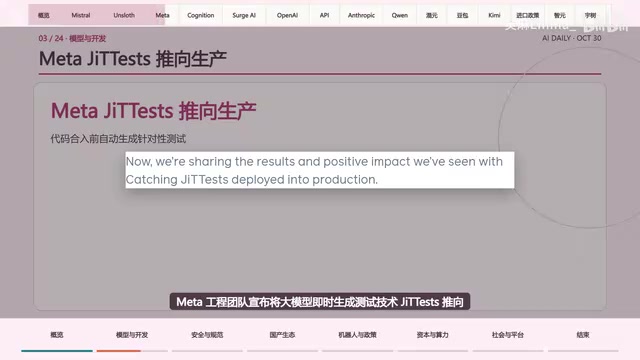
Mistral Large 4 opens its weights, a 1-trillion-parameter MoE architecture that can run locally on MacStudio; Meta's test-generation technology enters production; top tax benchmark pass rate only 10.8%; Canadian government takes a stake in Cohere; Doubao Work opens third-party model calls. This AI Morning Brief rounds up model, ecosystem, capital, and policy developments.

Mistral Large 4 Goes Open Source: A 1T-Parameter European Qwen Challenging DeepSeek
Mistral Large 4 is now open source: 1T total parameters, 52B activated, focused on coding and cybersecurity, with ~610G NVFP4 weights. We analyze its comparison with DeepSeek V4 Flash, API pricing, demo realism, and local deployment value.