iKanban 0.5.0 Update Analysis: Preceder Reproducible Agent Mechanism and iPaper Academic Collaboration

iKanban 0.5.0 introduces Preceder for reproducible Agent runtime and previews iPaper for AI-assisted paper writing.
iKanban 0.5.0 brings the Preceder mechanism that locks down all Agent runtime dependencies—system prompts, tools, Skills, and MCP—enabling true environment isolation and reproducibility. The update also adds conversation rollback, Git change views, and sound notifications. Additionally, the team previews iPaper, an AI paper writing tool using Skills for style constraints and MCP for fetching upstream publications.
From AI Programming to AI Papers: iKanban's Dual-Track Strategy
As AI Agents become increasingly mature in the programming domain, how to make Agents truly "understand" an entire project environment while ensuring behavioral reproducibility has become a focal point for the developer community. Recently, a Bilibili content creator released an update breakdown of iKanban 0.5.0. Built upon merging multiple upstream patches, this version introduces the "Reproducible Agent" (Preceder mechanism) and a new collaboration direction for academic paper writing.
Notably, this update isn't merely a feature stack—from 0.4.3 to 0.5.0, over a dozen intermediate versions were consolidated. The core focus is a systematic restructuring of Agent Runtime controllability, while clearly defining the product's dual development paths: iKanban for programming, and iPaper for academic paper collaboration.
The Preceder Mechanism: "Locking Down" Agent Runtime
What is Preceder
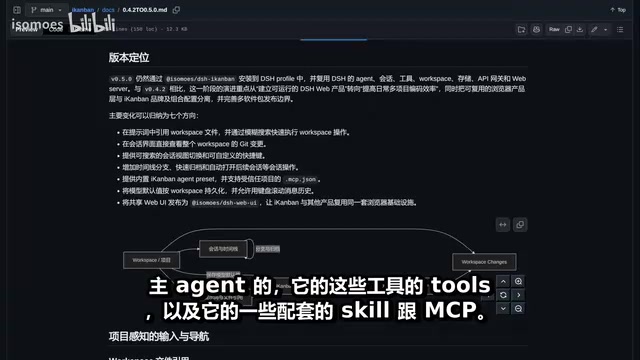
The most technically significant update in iKanban 0.5.0 is the enhancement of Agent Procedure (understood as Preceder). At its core, a Preceder represents the complete dependency set of an Agent's runtime within a single session conversation.
As the creator explains, once a session's Preceder is defined, it effectively determines the complete Runtime of the Agent in that environment—essentially "putting a lock on it"—thereby ensuring environmental reproducibility. This is particularly critical for scenarios that require stable reproduction of experimental results or execution of specialized tasks at specific stages.
To appreciate Preceder's value, one must first understand the "environment drift" challenge facing AI Agents. In most current Agent systems, Runtime encompasses all variables affecting Agent behavior: model configuration, available tool sets, contextual memory, system prompts, and more. The same Agent executing identical tasks at different times or with different configurations may produce entirely different results. This is conceptually similar to how Docker containerization solves the "it works on my machine" problem in traditional software engineering, but Agent complexity goes beyond code environments to include soft factors like prompts, tool chains, and even conversation history. Preceder is a systematic solution targeting this exact pain point.
The Fundamental Difference Between Preceder and Traditional SubAgents
Here we need to clarify a commonly confused concept. Traditional role-based SubAgent approaches essentially only modify the SubAgent's system prompt, while the Agent's underlying layer still inherits the main Agent's tools, associated Skills, and MCP.
SubAgents are a common pattern in multi-Agent systems, where the main Agent decomposes complex tasks and delegates them to specialized sub-Agents for execution. The fundamental limitation of traditional SubAgent approaches is "pseudo-isolation"—while sub-Agents have different system prompts (playing different roles), they share the main Agent's tool set and runtime environment, essentially being variants of the same Agent under different Prompts. This is like the same person wearing different hats, rather than true professional specialization.
Preceder goes much further—it encompasses:
- The active System prompt
- The complete tool set (including MCP)
- Built-in multi-Agent and SubAgent tools
- All Skills within the environment
In other words, Preceder locks down all dimensions of Agent runtime, achieving genuine environment isolation and reproducibility. This is closer to the microservices architecture concept where each service has its own independent runtime environment—each Preceder-defined Agent is a complete, self-consistent execution unit that can be independently deployed and verified. The creator also revealed that future plans include customized training (train) based on Preceder, optimizing for tasks in specific scenarios. This means Preceder isn't just a runtime snapshot, but foundational infrastructure for future customized Agents.
Practical Feature Upgrades: From Conversation Rollback to Shortcuts
Beyond the underlying Preceder mechanism, version 0.5.0 also includes extensive interaction experience refinements. While individually small, these improvements directly address daily developer pain points:
- @ File References: Merged the official version's file reference capability. The team had previously implemented this feature independently and has now aligned with the official version.
- Workspace Change (Git Diff View): Enables developers to review code changes—a capability missing from the original project.
- Drawing Toggle and Custom Shortcuts: Improves efficiency when switching between multiple scenarios.
- Conversation Rollback Timeline: For example, after three rounds of conversation, you can roll back to the state at round two, providing fault tolerance for experimentation and iteration.
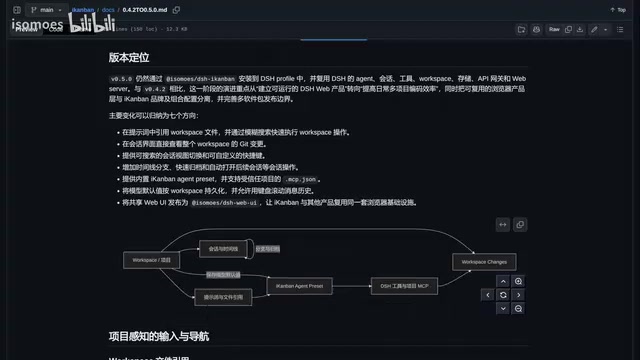
These features may seem trivial, but they constitute the "feel" difference of a mature AI programming workbench. The Rollback Timeline deserves particular praise—in multi-turn conversations, Agent output doesn't always hit the mark on the first try. Being able to precisely revert to a specific round avoids the cost of starting over. This design borrows from the core philosophy of version control systems (like Git): every operation should be reversible, and every state should be recoverable.
Independent Web UI: Paving the Way for iPaper
This update also includes a key architectural decision: publishing the Web UI separately as an independent DeepSeekAd Web UI. Behind this separation is the team's clear product line planning.
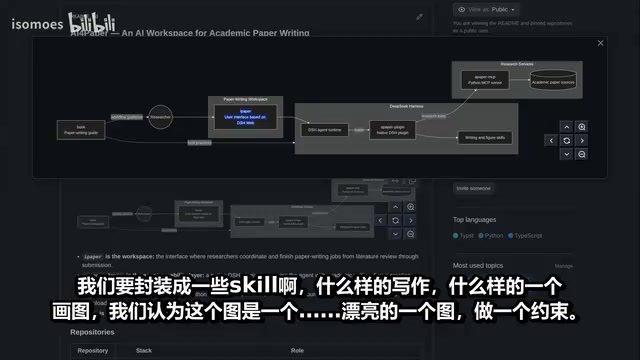
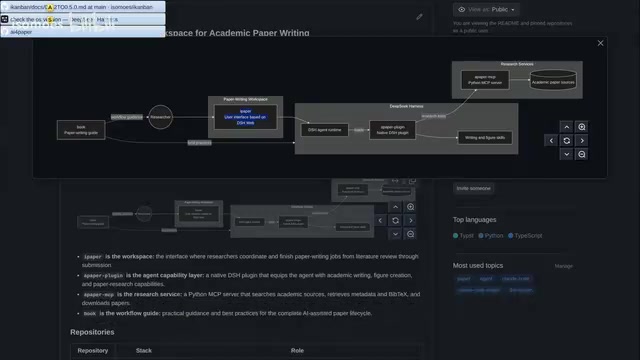
iKanban focuses on Coding scenarios, while iPaper—another project in the team's roadmap—is positioned in the AI4Paper (AI-assisted paper writing) domain, serving as the user-facing interface. The two face fundamentally different usage scenarios, making UI-layer decoupling a sensible engineering choice.
iPaper: An Engineering Exploration of AI-Assisted Paper Writing
Using Skills to Constrain Writing Style and Illustrations
iPaper's approach is quite inspiring. The team is already working on foundational layers that are "invisible to users but indispensable for AI paper writing." For example:
- What constitutes good writing style is encapsulated as Skills for enforcement;
- What qualifies as a "beautiful figure" is similarly standardized through Skills.
The Skill mechanism here warrants further explanation. In Agent frameworks, a Skill is a mechanism for packaging domain-specific knowledge and operational workflows into reusable modules. Unlike simple Prompt templates, Skills typically contain complete execution logic, constraint conditions, and quality assessment criteria. In traditional software engineering, this is analogous to codifying design patterns or best practices; in the AI Agent context, Skills solve the problem of "making implicit knowledge explicit"—for instance, a senior scholar's aesthetic judgment on paper figures, or their control over writing rhythm. These experiences that are difficult to exhaustively enumerate through rules are structured into constraint conditions that Agents can follow via the Skill mechanism.
This approach of making "implicit experience" explicit and engineered is one of the core challenges in current AI application deployment. Writing papers isn't just text generation—it involves formatting standards, chart aesthetics, citation logic, and extensive domain knowledge. The Skill mechanism provides a reusable encapsulation method.
MCP for Fetching Upstream Paper Information
On the data acquisition layer, iPaper plans to use MCP tools to pull the latest published articles and their PDF content from various publishers.
MCP (Model Context Protocol) is an open standard protocol proposed by Anthropic in late 2024, designed to establish a unified communication interface between AI models and external data sources and tools. Before MCP, each AI application needed to write integration code separately for each data source, resulting in massive duplication and a fragmented ecosystem. MCP's core concept is similar to what USB ports are to peripherals—providing a standardized "socket" that allows any tool or data source to connect to AI systems in a unified manner.
The creator specifically explained the architectural considerations: while it's possible to register such tools directly with DeepSeek Harness, doing so would tightly couple the implementation with Harness.
Therefore, the team chose to separate it out and merge it via MCP—only those components that are strongly coupled with Harness runtime functionality receive deep secondary customization of Harness's System prompts and Tools, to improve effectiveness in specialized domains.
This "loose coupling first, tight coupling for customization" layered strategy reflects deep thinking about ecosystem compatibility. Loose Coupling is a fundamental principle of software architecture, referring to maintaining minimal dependencies between system components so that modifications to one component don't cascade to others. In the AI Agent ecosystem, this principle is especially important because underlying models, tool interfaces, and data sources are all rapidly iterating. Implementing paper data retrieval as an independent MCP service rather than directly integrating it into Harness specifically avoids breaking changes when upstream systems upgrade—this layered strategy is key to maintaining long-term maintainability in the rapidly evolving AI open-source ecosystem.
iKanban's Quality-of-Life Features
Finally, iKanban itself has added several practical small features:
- Change View: Since the original project lacked file modification visualization, this capability has now been added.
- Sound Notifications: When a session completes, user authorization is needed, or a conversation finishes and requires attention, users are alerted via audio cues.
These notification features are extremely useful in long-task scenarios—developers don't need to constantly watch the screen. When the Agent completes a task, it proactively "calls for attention," significantly improving human-machine collaboration efficiency. This design philosophy is known as "asynchronous collaboration mode" in human-computer interaction: humans handle decisions and approvals, Agents handle execution and waiting, with both staying synchronized through notification mechanisms rather than requiring humans to monitor in real-time. The creator also mentioned that this is a gap the official project hasn't fully covered yet.
Conclusion: Reproducibility is Becoming a Core Agent Challenge
iKanban 0.5.0's update reveals a noteworthy trend: as AI Agents move toward production environments, "reproducibility" is shifting from optional to essential. The Preceder mechanism makes Agent behavior predictable and reproducible by locking down all Runtime dependencies—a critical step from "toy" to "tool."
Behind this trend is the overall maturation of AI engineering. Just as software engineering evolved from "it works" to best practices like CI/CD, containerization, and Infrastructure as Code, AI Agents are undergoing a paradigm shift from "usable" to "reliable." The Preceder mechanism is essentially "Agent Environment as Code"—declaratively fixing all runtime dependencies to make them versionable, auditable, and shareable.
Meanwhile, the dual-track layout from iKanban to iPaper demonstrates how the same Agent foundation can adapt to different vertical scenarios. Though programming and paper writing appear vastly different on the surface, they share a highly common methodology of "tool encapsulation + Skill constraints + MCP data integration." For developers interested in AI programming and academic assistance, this open-source practice is well worth following.
Related articles

Workbuddy for Absolute Beginners: How a Desktop AI Agent Fits Into Real Workflows
A beginner's guide to the Workbuddy desktop AI agent: installation, claiming credits, file management, and building automated workflows—compared with CodeX for fit and cost, helping professionals shift from AI question-askers to AI managers.

OpenAI's New Agent Stack: Computer Use, Decisions API, and Ultra-Fast Workflows
OpenAI Dev Day unveiled a new agent stack: Computer Use outperforms humans, Decisions API delivers ultra-low-latency classification via Luna, Agents API opens the same Computer Use capabilities, and GPT-6.1 Sol costs only one-seventh of Astra. Core updates, benchmark data, and developer insights.

Liang Wenfeng Open-Sources DeepInfo Inference Framework, Takes On U.S. Ban
DeepSeek open-sources its DeepInfo inference framework after its models, featuring GPU/CPU cross-pipelining, small-model prediction with large-model verification, and full Huawei Ascend and NVIDIA chip support—facing the U.S. federal ban head-on. This article analyzes its significance for AI deployment and open-source strategy.