Impairment-Aware GNN: A New Framework for Robust Beamforming in Cell-Free MIMO ISAC

Proposes an impairment-aware heterogeneous GNN framework that unifies CSI errors and clutter uncertainty for robust ISAC beamforming.
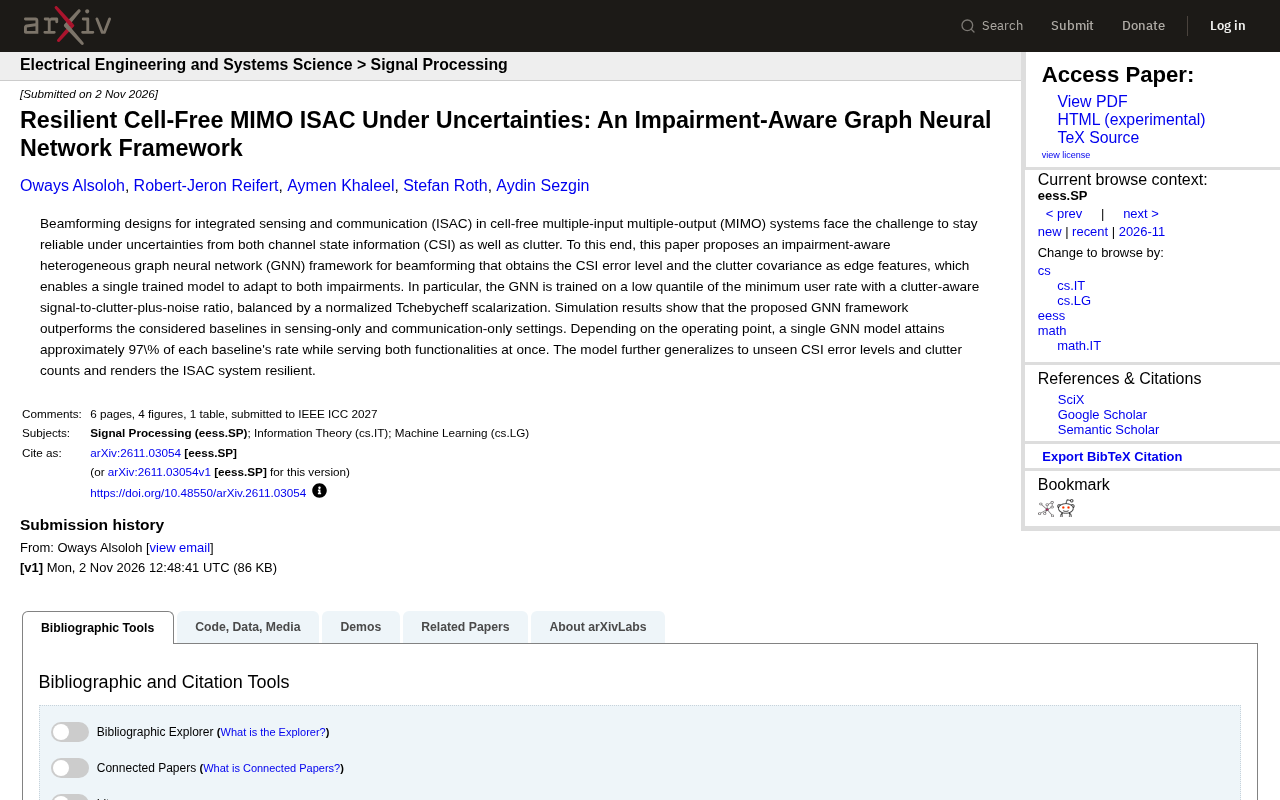
The article presents a study on cell-free massive MIMO ISAC systems, addressing robust beamforming when CSI errors and clutter covariance uncertainty coexist. It proposes an impairment-aware heterogeneous graph neural network framework that encodes CSI error levels and clutter covariance as edge features, enabling a single trained model to adapt to both impairments via message passing. Training uses a low quantile of the minimum user rate and clutter-aware SCNR, with normalized Tchebycheff scalarization to balance communication and sensing. Simulations show the single GNN model achieves about 97% of dedicated baseline rates and generalizes to unseen impairment levels. The article also discusses insights and limitations, noting that computational overhead and sensitivity to prior quality in practical deployment require further study.
The combination of cell-free massive MIMO and integrated sensing and communication (ISAC) is regarded as a key enabling technology for 6G networks. However, channel state information (CSI) errors and clutter uncertainty pose severe challenges to the reliability of beamforming design. A recent paper proposes an impairment-aware heterogeneous graph neural network framework that enables a single model to adapt to both types of impairments simultaneously, offering a new approach to the robustness of ISAC systems in uncertain environments.
Problem Background: The Dual Uncertainty of CSI Errors and Clutter
In cell-free MIMO systems, multiple access points cooperatively serve users, and beamforming design must simultaneously optimize communication rate and sensing performance. In ISAC scenarios, this optimization problem becomes even more complex: the system must both transmit data to users and use the same signal to detect environmental targets.
In real-world deployments, two types of uncertainty are unavoidable. The first is CSI error—channel estimation always has deviations, which are especially significant in high-mobility or low-SNR scenarios. The second is the uncertainty of clutter covariance—sensing receivers pick up reflections from non-target objects such as buildings and terrain, and the spatial characteristics of this clutter are difficult to model accurately.
Traditional robust optimization methods are usually designed for a single type of impairment. When both types of uncertainty are present simultaneously, either computational complexity rises sharply or excessive conservatism leads to performance loss. The authors point out that existing schemes lack a unified framework capable of handling both CSI errors and clutter uncertainty at the same time.
Framework Design: How a Heterogeneous Graph Neural Network Encodes Impairment Information
The core innovation of the paper lies in embedding impairment information into the edge features of a graph neural network. Specifically, the authors construct a heterogeneous graph structure: nodes represent access points, users, and sensing targets, while edges carry two key types of information—the CSI error level and the clutter covariance.
The ingenuity of this design is that, through the message passing mechanism, the GNN allows each node to adaptively adjust its beamforming strategy based on the impairment features of adjacent edges. A single trained model can therefore adapt to both CSI errors and clutter variations simultaneously, without retraining for each combination of impairments.
The design of the training objective is also noteworthy. The authors adopt a low quantile of the minimum user rate as the optimization objective rather than the average rate, which guarantees the communication quality of edge users. At the same time, a clutter-aware signal-to-clutter-plus-noise ratio (SCNR) is introduced to balance sensing performance, and the normalized Tchebycheff scalarization method is used to handle the trade-offs in multi-objective optimization.
A heterogeneous graph neural network is a variant of graph neural networks whose core characteristic is that the graph contains multiple types of nodes and edges, and different types of nodes and edges have different feature spaces and semantic relationships. Compared with homogeneous graphs (where all nodes and edges are of the same type), heterogeneous graphs can more naturally model the diversity of entity types in real systems, such as access points, users, and sensing targets in wireless networks. Heterogeneous graph neural networks typically map the features of different nodes into a unified space through type-specific transformation matrices, and consider edge type information during message passing, thereby learning richer structural representations. In the field of wireless communications, heterogeneous graph neural networks have been used for problems such as power allocation and user scheduling, with the advantage of flexibly adapting to dynamic changes and heterogeneity in network topology.
The message passing mechanism is the core computational paradigm of graph neural networks. Its basic idea is that each node in the graph updates its own representation by aggregating messages from neighboring nodes (usually transformed vectors of neighbor features); after multiple rounds of iteration, each node can capture the structural information of its local neighborhood and even the global structure. Specifically, in the k-th iteration, the representation update of node v typically includes three steps: message generation, message aggregation, and node update. The advantage of the message passing mechanism is that it can handle irregular topologies, support inductive learning (i.e., reasoning over unseen graph structures), and has computational complexity linear in the number of edges. In beamforming design, message passing enables each node to adaptively adjust its strategy based on the impairment features of adjacent edges (CSI error, clutter covariance), which is precisely the key mechanism by which this framework achieves impairment awareness.
Simulation Results: A Single Model Approaches Dedicated Baseline Performance
Simulations verify the effectiveness of the framework. Under both sensing-only and communication-only settings, the proposed GNN framework outperforms the comparison baselines. More convincingly, when a single GNN model serves both functions simultaneously, it can achieve about 97% of the rate of the respective baselines depending on the operating point—meaning that the performance loss caused by integrated sensing and communication is kept within a small range.
The generalization ability of the model is another highlight. Experiments show that the trained GNN can generalize to unseen CSI error levels and clutter counts, significantly enhancing the robustness of the system in uncertain environments. This is particularly important for practical deployment: the impairment distribution in real networks changes over time, and the model needs the ability to cope with distribution shifts.
Tchebycheff scalarization is a commonly used method in multi-objective optimization for transforming multiple objectives into a single objective. Its basic form is: min max_i { λ_i (f_i(x) - z_i*) }, where λ_i is the weight vector and z_i* is the ideal point of each objective (usually the single-objective optimum). Normalized Tchebycheff scalarization normalizes each objective so that objectives with different scales can be compared fairly and can generate uniformly distributed solutions along the Pareto front. In the trade-off between communication and sensing, this method allows designers to explore different performance trade-off points by adjusting the weight vector, thereby flexibly balancing communication rate and sensing SCNR. Compared with the linear weighting method, Tchebycheff scalarization can better handle cases where the Pareto front is non-convex and ensures solution diversity.
Insights and Limitations
The value of this work lies in providing an "impairment-aware" design paradigm—rather than trying to eliminate uncertainty, it lets the network learn to make robust decisions amid uncertainty. The reason graph neural networks are suitable for this task is that they naturally fit the topology of cell-free systems, and the message passing mechanism can effectively aggregate local impairment information.
It is worth mentioning that the paper is currently based on simulation validation; the computational overhead in actual system deployment, the training data requirements, and compatibility with existing protocols remain to be investigated. In addition, the acquisition of clutter covariance itself involves errors in reality, and the sensitivity of the framework to the quality of this prior has not been fully discussed.
Overall, this framework provides a promising direction for robust beamforming in ISAC systems, and the idea of impairment-aware graph representation may also inspire research on other wireless resource allocation problems.
Clutter covariance is a second-order statistic that describes the spatial correlation characteristics of clutter in sensing systems. In radar or integrated sensing and communication systems, clutter refers to reflected signals from non-target objects (such as buildings, terrain, and vegetation), and these reflections interfere with target detection and parameter estimation. The clutter covariance matrix characterizes the correlation structure of clutter across different antenna channels, and its acquisition usually relies on prior environmental knowledge or estimation from auxiliary data. In practical systems, clutter covariance is often difficult to know precisely and changes dynamically with the environment (e.g., weather, vehicle movement), so its uncertainty is one of the key factors affecting sensing performance. In beamforming design, accounting for the uncertainty of clutter covariance helps improve the robustness of the system in complex environments and avoid false alarms or detection performance degradation caused by insufficient clutter suppression.
One-line Summary
Proposes an impairment-aware heterogeneous graph neural network framework that uniformly handles CSI errors and clutter uncertainty to achieve robust ISAC beamforming.
Paragraph Summary
This article introduces a study on cell-free massive MIMO integrated sensing and communication (ISAC) systems, focusing on the challenge of robust beamforming when channel state information (CSI) errors and clutter covariance uncertainty coexist. The paper proposes an impairment-aware heterogeneous graph neural network framework that encodes CSI error levels and clutter covariance as edge features in a heterogeneous graph, enabling a single trained model to adapt to both types of impairments through a message passing mechanism. The training objective uses a low quantile of the minimum user rate and clutter-aware signal-to-clutter-plus-noise ratio, and employs normalized Tchebycheff scalarization to balance communication and sensing performance. Simulations show that a single GNN model can achieve about 97% of the rate of each dedicated baseline and generalize to unseen impairment levels. The article concludes by discussing the insights and limitations of the framework, noting that computational overhead in practical deployment and sensitivity to prior quality still require further study.
Related articles
 Tech Frontiers
Google Omni 1.2 Flash: 15-Second AI Video at Just $0.07 per Second
Google DeepMind releases Gemini Omni 1.2 Flash: 15-second video, 720p at $0.07/sec (30% cheaper), multi-turn editing without regeneration, draft upscaling to 4K.
 Tech Frontiers
No AI Ghostwriting: Writer's Quarter Reinvents Novel Writing with a Visual Workbench
The Writer's Quarter is an AI-free novel writing and planning tool that unifies character building, story planning, and manuscript writing in one visual workbench. This article analyzes its positioning, target users, and differentiated value amid the rise of AI writing tools.
 Tech Frontiers
Fleeep: A Unified Inspiration Collection Notes App for Creatives
Fleeep is a notes app for creatives that unifies screenshots, bookmarks, saved posts, and inspiration into one calm, cross-device, offline-capable space. This article analyzes its positioning, differentiation, and target users.