ImpedanceMimic: Learning Impedance as an Action Space for Precise Force Imitation

ImpedanceMimic uses reinforcement learning to dynamically modulate joint impedance, achieving high-fidelity force tracking from motion data alone.
ImpedanceMimic addresses the structural conflict in physics-based motion imitation where fixed-gain PD controllers cannot simultaneously optimize motion and force tracking, by treating learned impedance itself as the action space. An RL policy outputs per-joint stiffness, damping, and position setpoint modulation from motion and force measurements, requiring only motion data at inference. Expressing gains as multiples of an inertia-scaling prior enables zero-shot transfer to unseen individuals and humanoid robots. Experiments on 129 participants across six activities show it outperforms fixed-gain PD, direct torque, and muscle-driven controllers, with learned impedance forming a cross-body low-dimensional motion state representation.
Inferring the underlying forces from a motion is an ill-posed problem: different controllers can reproduce the same trajectory while producing vastly different contact forces. Physics simulation can resolve this ambiguity, but conventional methods rely on fixed-gain PD control. ImpedanceMimic takes a different approach, letting a reinforcement learning policy dynamically modulate each joint's stiffness, damping, and position setpoint, achieving high-fidelity force tracking from motion data alone.
The Inherent Limitations of Fixed-Gain PD Control
Physics-based motion imitation typically employs proportional-derivative (PD) controllers to track reference motions. However, fixed gains mean joint stiffness and damping remain constant throughout the process. The contact phase and swing phase have diametrically opposed requirements for joint impedance: contact demands high stiffness to transmit forces precisely, while swing requires low stiffness for smooth motion. This conflict forces fixed-gain PD into a trade-off between motion tracking and force tracking, unable to optimize both simultaneously.
The paper explicitly states that this trade-off is a structural problem of fixed-gain control. Even with parameter tuning, it is difficult to make a single controller perform well across all scenarios.
A PD controller (proportional-derivative controller) is one of the most fundamental feedback control laws in robotics: the proportional term generates restoring force based on the deviation between current and target position, while the derivative term provides damping based on velocity deviation. In physics-simulation-driven motion imitation, PD controllers typically serve as the "low-level controller" that receives reference trajectories and outputs joint torques. Fixed gains mean the proportional and derivative coefficients remain constant throughout simulation, equivalent to assuming joint impedance does not vary with task phase. However, in biological motor control, the central nervous system adjusts muscle co-contraction in real time according to task demands, thereby changing the joint's equivalent stiffness and damping. This biological mechanism is precisely what ImpedanceMimic attempts to emulate with a reinforcement learning policy.
The Core Idea of ImpedanceMimic
ImpedanceMimic treats the learned impedance itself as the action space. Specifically, the reinforcement learning policy outputs modulation amounts for each joint's stiffness, damping, and position setpoint based on motion and force measurements. The key innovation is that the policy requires only motion data at inference time, with no force sensor input.
To handle biomechanical differences across individuals, the method expresses gains as multiples of an inertia-scaling prior. This allows a single policy to control subject-specific biomechanical models without explicit anthropometric parameter inputs. Experiments show the policy can transfer zero-shot to unseen individuals and even generalize to humanoid robots.
"Impedance" in robotics describes a joint's resistance to external perturbations: higher stiffness means stronger restoring force from position deviation; higher damping means velocity deviations are suppressed more quickly. The goal of impedance control is not precise position tracking but rather modulating this "spring-damper" characteristic so the robot exhibits compliant or rigid interaction behavior when contacting the environment. Treating impedance parameters themselves as the action space means the policy outputs controller parameters rather than torques—this amounts to having the learning algorithm make decisions at a meta-control level, redefining the behavior of the underlying PD controller at every time step. Position setpoint modulation allows the policy to fine-tune target positions without altering the reference trajectory, further expanding the reachable force-motion combination space.
Experimental Validation: Across Participants and Activities
The study covers 129 participants and six activities, comparing against multiple baselines including direct torque control, muscle-driven models, and existing imitation controllers. On both kinematic fidelity and force fidelity, ImpedanceMimic outperforms matched fixed-gain PD control and approaches the performance of dedicated motion-to-force regressors.
You may not have noticed, but ImpedanceMimic's advantage holds consistently regardless of the integration scheme used. This demonstrates that its gain modulation mechanism is universal and does not depend on specific simulation settings.
Zero-shot transfer refers to a model being directly applied at inference time to an individual or morphology it has never seen during training, without any fine-tuning. In human motion imitation, participants differ significantly in height, weight, and limb proportions, and conventional methods typically require tuning controller parameters separately for each subject. By expressing gains as multiples of an inertia-scaling prior, ImpedanceMimic enables the policy's output impedance parameters to automatically scale with individual inertial characteristics, achieving cross-individual generalization without anthropometric parameter inputs. This design philosophy is similar to domain randomization but emphasizes leveraging physical priors rather than relying solely on data augmentation.
Learned Impedance: A Low-Dimensional Representation of Motion State
Analysis reveals that the learned impedance forms a low-dimensional representation of motion state, and this representation is shared across different bodies. Furthermore, the representation generalizes to activities not seen in training: stiffness increases with load, while damping anticipates the unloading process. This pattern aligns with expectations from biological motor control, indicating the model captures underlying physical regularities.
Significance and Outlook
ImpedanceMimic offers a new paradigm for physics-based motion imitation: rather than relying on hand-tuned fixed gains, it lets the policy autonomously learn how to modulate impedance. This not only improves force tracking accuracy but also enhances generalization across individuals and morphologies. In the future, the method could be applied to robot learning, biomechanical simulation, and animation, where precise force interaction is critical.
Although the paper does not mention specific computational costs, the design of a single policy handling multiple bodies suggests high computational efficiency. As reinforcement learning and simulation techniques advance, the idea of impedance as an action space may become an important tool for force-sensitive motion generation.
One-line Summary
ImpedanceMimic uses reinforcement learning to dynamically modulate joint impedance, achieving high-fidelity force tracking from motion data alone.
Paragraph Summary
ImpedanceMimic addresses the structural conflict in physics-based motion imitation where fixed-gain PD controllers cannot simultaneously optimize motion and force tracking, by treating learned impedance itself as the action space. A reinforcement learning policy outputs per-joint stiffness, damping, and position setpoint modulation based on motion and force measurements, requiring only motion data at inference without force sensors. By expressing gains as multiples of an inertia-scaling prior, a single policy can transfer zero-shot to unseen individuals and even humanoid robots. Experiments on 129 participants across six activities show ImpedanceMimic outperforms fixed-gain PD, direct torque, and muscle-driven controllers on both kinematic and force fidelity, and that the learned impedance forms a low-dimensional motion state representation shareable across bodies that generalizes to untrained activities.
Related articles

Zero-Code Replication of a $10,000 3D Website with Claude Code: A Six-Tool Breakdown
Bilibili creator Yomi used Claude Code plus five free tools to build a 3D product landing page quoted at $10,000 overseas—zero code. Breakdown of the six-tool division of labor, image-to-3D workflow, and the core collaboration method: "give AI a reference, not 'make it look better.'"

Claude Code in Practice: Install, Connect Models, Calculate Tokens, and Ship a Full-Stack Project with a Single Document
Based on a Bilibili public course demo, this covers Claude Code installation, model connection, token cost calculation, and the practical path of shipping a full-stack project with a single document, plus comparisons with Copilot, Cursor, Trae, and other coding assistants.
Who Accepts AI-Written Code? A 25-Minute Deep Dive into Verification Loops and the New Code Review Paradigm
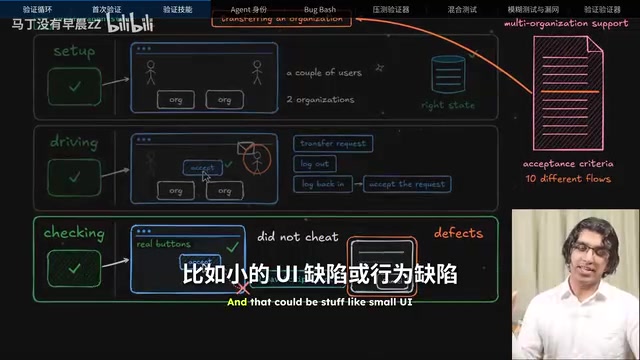
After AI writes lots of code, how should Code Review verify it? This article breaks down the Claude Code team's verification loop framework: surface-level end-to-end verification, setup/drive/check three-stage skills, hybrid end-to-end testing and reliability checklists, and how to tighten the loop when issues slip through.