In-Depth Analysis of AI-Powered Office Automation and Video Creation Masterclass

Systematic AI automation course integrating office workflows and video creation with practical monetization
This course addresses AI tutorial fragmentation by systematically integrating office automation and video creation through Harness, WorkBuddy, Codex, and Minimax. It progresses from fundamentals (prompt engineering, workflow basics) through advanced techniques (character consistency, camera work) to monetization projects. While promising for rapid skill acquisition, learners should recognize that tools evolve quickly and sustainable success requires creativity beyond mere tool mastery.
The Era of Building AI Automation Workflows from Scratch
As generative AI technology matures, a new skill paradigm is emerging: delegating repetitive office tasks and content production to AI agents, allowing humans to focus on creativity and decision-making. Generative AI refers to artificial intelligence systems that can autonomously generate text, images, audio, video, and other content based on input prompts, primarily built on Large Language Models (LLMs) and Diffusion Models. The explosive growth of ChatGPT in 2022 marked this technology's transition from laboratory to mainstream application. AI Agents represent a further evolution—they not only generate content but also autonomously plan tasks, invoke external tools, and execute multi-step operations.
This systematic course launched by a Bilibili content creator addresses precisely this proposition—by integrating mainstream AI agent tools like Harness, WorkBuddyAd, and Codex, combined with AI video generation engines like Minimax, it builds a complete automation pipeline for office work and content creation for absolute beginners.
Interestingly, the creator candidly states they reanalyzed the entire technical ecosystem "from the perspective of a complete beginner." This reflects a common pain point in the current AI tutorial market: fragmented tool explanations lacking systematic process integration.
Structural Deficiencies in Existing AI Tutorials
After spending a month reviewing dozens of AI agent tutorials across platforms, the creator concluded that whether viral hits with millions of views or niche gems, they all share the problem of being "insufficiently systematic and incomplete." Specifically:
- Single-point instruction focus: Most content remains at the "which button to click" operational level
- Missing process connections: Critical transitions from Tool A to Tool B are often "glossed over"
- Core challenges avoided: Issues that frustrate beginners most—character consistency, shot transitions, narrative pacing—are rarely thoroughly addressed
This observation is quite insightful. The real barrier to AI tools has never been using individual features, but rather how to chain multiple tools into stable, reusable automation workflows. The approach of chaining multiple AI tools into automation workflows actually borrows from the pipeline concept in software engineering. In traditional software development, CI/CD (Continuous Integration/Continuous Deployment) pipelines automate the connection of code writing, testing, building, and deployment stages; in AI content creation, similar thinking is applied to the full chain of script generation → storyboard design → visual generation → voiceover synthesis → editing assembly. The core value of this engineering mindset lies in reusability and scalability: once a stable workflow template is established, subsequent content production can dramatically reduce marginal costs, achieving a leap from artisanal creation to scaled content production. This is the gap the course attempts to fill.
Three-Module Course Architecture
The course is divided into three major sections—Core Fundamentals, Advanced Capabilities, and Complete Project Practice—forming a progressive path from concepts to skills to monetization.
Core Fundamentals: Building Complete AI Automation Cognition
The fundamentals section starts with core AI video concepts, guiding learners through the complete process of "AI video + agent creation." Mainstream tools covered include:
| Tool Category | Representative Tools |
|---|---|
| AI Agents | WorkBuddy, Codex, Harness |
| AI Video Generation | Minimax and other mainstream engines |
Minimax is a leading domestic multimodal AI company whose video generation models can produce high-quality short videos based on text or image prompts. Current mainstream technical approaches to AI video generation fall into two categories: one based on diffusion models (like Stable Video Diffusion, Runway Gen series), which generate video frames through progressive denoising from random noise; the other based on Transformer architecture autoregressive generation (like OpenAI's Sora), which understands video as spatiotemporal token sequences for prediction. These approaches have different strengths—diffusion models excel in image quality and controllability, while Transformer architectures show more potential in long video coherence and physical world understanding.
The focus at this stage is building overall cognition of "AI office automation" and "video prompt engineering." Prompt Engineering, as a core capability throughout, is emphasized separately—in the generative AI era, the ability to precisely describe requirements is often more important than the tools themselves. Excellent prompts typically include clear role definitions, specific task descriptions, expected output formats, reference examples, and constraints. In video generation, prompt engineering is particularly complex, requiring simultaneous description of shot composition, camera movements, lighting style, character features, and multiple other dimensions, with different AI video engines having varying syntax and weighting mechanisms for prompts. Mastering this capability is the fundamental prerequisite for wielding all AI creation tools.
Advanced Capabilities: Conquering Core AI Video Creation Challenges
The advanced section concentrates on solving technical pain points in AI video creation, covering:
- Character and scene consistency: This is the biggest technical challenge in AI video—maintaining character appearance across shots remains a difficult problem. Character Consistency is tricky because current video generation models essentially generate fragments independently; models struggle to "remember" precise appearance features of the same character across different shots—hairstyle, clothing, facial details may all drift. Current industry solutions mainly include: using reference images to anchor character appearance (IP-Adapter, InstantID technologies), embedding detailed character feature descriptors in prompts, using LoRA (Low-Rank Adaptation) to fine-tune models to learn specific characters, and employing post-production compositing techniques for face replacement and correction. Even so, achieving perfect consistency across multiple shots in long videos remains an unresolved industry challenge.
- Camera work and transitions: Giving footage cinematic language
- Lighting and color grading: Enhancing production quality
- AI voiceover and sound effects: Perfecting the auditory dimension
- Multi-shot assembly and long video generation: Moving from individual clips to complete works
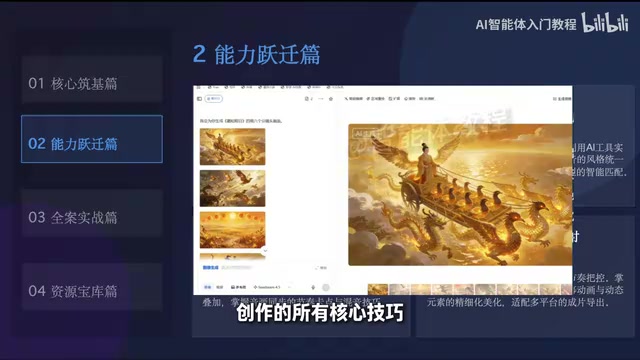
The leap from "can generate individual clips" to "can create complete high-quality works" is precisely the divide between amateur and professional. The creator's inclusion of style unification and professional post-production tool integration demonstrates understanding of industrialized content production pipelines.
AI Project Practice and Monetization Path Analysis
The most attractive part of the course is the complete project practice section, where the creator promises to complete multiple "directly monetizable" projects hands-on.

Covered Monetization Scenarios
Practice projects span a wide range:
- AI short dramas, AI comic series, AI films: Content entertainment track
- AI office automation, AI automated editing: Efficiency tools track
- Local deployment, commercial advertising, talking-head videos: Commercial services track
Among these, Local Deployment refers to running AI models on the user's own computer or private server rather than relying on cloud API services. Core advantages of this approach include: data privacy protection (sensitive data need not be uploaded to third-party servers), elimination of API call costs (lower long-term usage costs), network independence (unaffected by network conditions), and greater customization freedom. However, local deployment also demands higher hardware requirements—mainstream AI video generation models typically require graphics cards with at least 8GB VRAM. Open-source models like Stable Diffusion and ComfyUI ecosystems provide rich toolchain support for local deployment.
This "ready to take orders after learning" positioning reflects the prevailing logic of current AI skills training—directly linking learning costs with short-term returns. For learners, a rational perspective is needed: AI tools can significantly lower creative barriers, but truly stable monetization still relies on continuous work refinement and market connection capabilities. Simply mastering tool operations does not equal commercial success.
Supporting Resource System
To lower the barrier for absolute beginners, the course provides complete auxiliary materials:
- Complete learning mind maps
- Tool prompt libraries
- Project templates and asset packs
- AI film creation guides
- "Workspace Setup Blueprint"
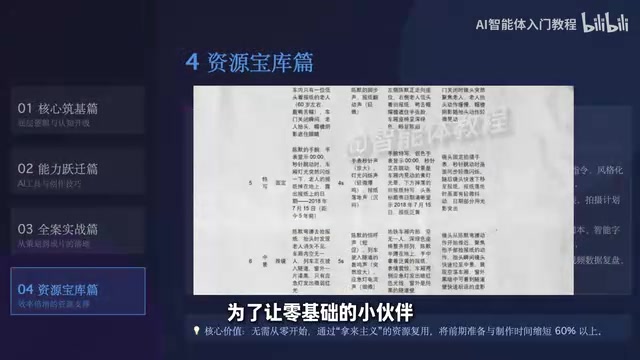
Comprehensive templates and prompt libraries are indeed key for beginners to get started quickly. In AI creation, a mature prompt template can often save substantial trial-and-error time. The value of prompt libraries lies not only in direct reuse but more importantly in helping learners build intuition about "effective prompt structure"—understanding why certain phrasings produce better results, thereby gradually developing the ability to independently write high-quality prompts.
Objective Evaluation and Course Selection Advice
The value of this course lies in its systematic integration approach: no longer limited to single-tool instruction, it attempts to connect office automation and video creation into a complete pipeline. This positioning precisely addresses the current pain point of fragmented AI tutorials.
However, clear awareness is also needed:
- Rapid tool iteration: Tools like Harness, Codex, and Minimax update frequently, creating potential timeliness risks for tutorial content. In AI video generation, for example, between 2024 and 2025, mainstream tools' interfaces and features changed significantly every few weeks—tutorials recorded a month ago may already differ in operational details from the latest versions.
- Monetization promises require caution: "Ready to take orders after learning" is marketing language; actual earnings depend on individual investment and market conditions
- Core competitiveness lies in creativity: AI is merely a tool; what remains truly scarce is narrative ability and aesthetic judgment
For newcomers hoping to enter AI content creation, such systematic courses can serve as scaffolding for rapid entry, but long-term development still requires continuously deepening understanding of tool combinations and creative principles through practice. While the vision of AI completing repetitive labor for humans is enticing, mastering the ability to wield these tools is the true moat in this era.
Related articles

Amphibious Transforming Drone: Beyond 100x Power Savings, What Are the Real Needs?
Is the amphibious transforming drone just a gimmick? Starting from the 100x power difference of the M4 Morphobot, explore real application scenarios and thesis topic ideas, analyzing boundary conditions where pure drones and pure ground robots both fail.

Warhound Raises $200 Million: Genetically Engineered "War Dogs" Paired with Anduril Gear
Warhound raises $200M, backed by Ben Lamm and Palmer Luckey, to genetically engineer dogs for military and law enforcement use and equip them with Anduril gear. This article analyzes its technology direction, funding logic, and ethical controversy.

Claude API Comes to Google Cloud: IAM Integration and SDK Access Guide
Anthropic hosts the full Claude API on Google Cloud with IAM-controlled permissions and unified billing. This guide covers the Vertex AI and Anthropic-hosted entry points, IAM role configuration, and SDK access.