Indie Game Community Split Over AI and Big Walk

IGF judges refuse to vote for any game using generative AI, while the Big Walk developer admits limited use, splitting the indie game community.
The indie game community is in controversy over generative AI. IGF judges stated they will not vote for games using generative AI "to any degree," emphasizing creative purity; almost simultaneously, the developer of the hit indie game Big Walk admitted to "limited" AI use during the final development sprint to solve difficulties. The two statements, appearing back-to-back, brought the AI controversy to the forefront. Community reactions are polarized: some support the judges' stance, believing AI undermines the handcrafted value of indie games; others understand the developer, arguing that reasonable tool use should not be stigmatized. The controversy exposes the mismatch between the "to any degree" principle of award criteria and the gray areas of development reality, and raises the need for AI disclosure norms. At a deeper level, it reflects the indie game community's anxiety over its "indie" identity and creative values.
A Chain Reaction Triggered by a Statement
The indie game community is currently in the throes of a fierce debate over generative AI. According to RSS sources, some Independent Games Festival (IGF) judges issued a statement yesterday declaring they would not vote for games that use generative AI "to any degree."
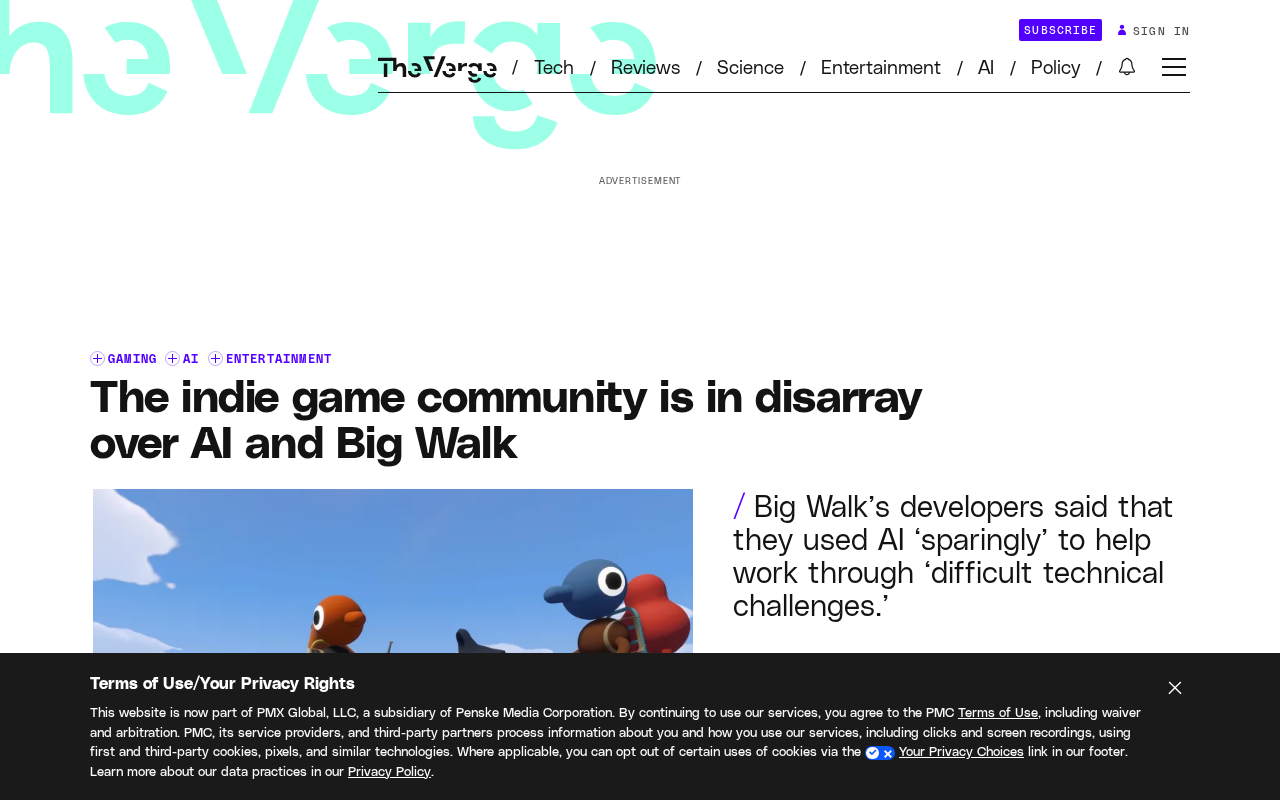
Almost simultaneously, the developer of the hit indie game Big Walk released a statement admitting to "limited" use of AI during the "final sprint" of development to "help solve some difficulties." The two statements, appearing back-to-back, have pushed the already simmering AI controversy into the spotlight.
The core conflict at the heart of this controversy is: when award criteria collide with development realities, how should the indie game community position itself?
The IGF Judges' Stance: Rejecting AI "to Any Degree"
The IGF judges' statement is unambiguous—they will not vote for games that use generative AI, regardless of the amount. This effectively sets a hard threshold in the awards process, directly excluding any work that has involved AI from consideration.
This stance is rooted in a commitment to creative purity. Indie games have long been regarded as a bastion of personal expression and handcrafted polish, and the judges worry that the involvement of generative AI will dilute that value. But the phrase "to any degree" has also drawn scrutiny: if a developer used AI only for a bit of auxiliary work, should the entire game be rejected?
According to RSS sources, the statement spread rapidly within the community after its release, with voices of both support and opposition emerging simultaneously.
Independent Games Festival (IGF) is one of the most influential independent game awards events globally, typically held alongside the Game Developers Conference (GDC), and its awards are considered a significant honor in the indie game field. The IGF features multiple award categories, with judges drawn from industry developers, media, and academics. The selection process emphasizes innovation, artistic expression, and independent spirit. Because of this, the IGF's award criteria carry bellwether significance for the indie game community, and individual judges' statements are easily interpreted as signals of industry stance.
The Big Walk Developer's Response: Admitting "Limited" Use
Shortly after the judges' statement was released, the Big Walk developer issued another statement, admitting to using AI during the "final sprint" of development but emphasizing it was "limited" use aimed at "helping solve some difficulties."
The subtlety of this statement lies in its timing and wording. "Final sprint" implies that AI was not used throughout the entire development process but rather was a pragmatic choice under end-stage pressure; "limited" attempts to keep AI's impact within a confined scope. But the problem is that the IGF judges' standard is "to any degree," not "extensive" or "core环节."
The developer chose to proactively disclose rather than conceal—a decision that is itself worth examining. At a time when transparency norms around AI use are still lacking, proactive admission may risk awards disadvantages, but the cost of silence, once exposed, could be even greater.
Big Walk is an indie game that has attracted considerable attention in recent years, building high expectations in the community with its unique walking simulation and narrative exploration gameplay. The development team behind the game is small, fitting the typical indie production model. In game development, the "final sprint" typically refers to the final stretch before release, when developers must focus on bug fixing, content filling, and detail polishing under immense time pressure. Introducing AI tools to help solve specific difficulties at this stage is not uncommon among small teams, but publicly admitting it still means facing dual pressure from community opinion and award rules.
The Tearing Apart of the Indie Game Community
The two statements combined have plunged the indie game community into "chaos." According to RSS sources, the community's reaction to the matter shows clear polarization.
Some support the IGF judges' stance, believing that the value of indie games lies in human creation and that AI involvement, no matter how small, undermines that foundation. Others express understanding toward the Big Walk developer, arguing that under real development pressure, reasonable use of tools should not be stigmatized.
This split is not an isolated incident. Since generative AI entered the creative field, discussions about "what counts as original" and "where the boundary between tools and creation lies" have been ongoing. The indie game circle, because of its small scale, close community ties, and strong value consensus, makes the conflict appear particularly acute.
The Mismatch Between Award Criteria and Development Reality
This controversy has exposed a structural problem: award criteria tend to pursue clarity and principle, while development reality is full of compromises and gray areas.
The IGF judges' "to any degree" standard is easy to enforce in principle—if there's AI, you're out. But in reality, developers may use AI in various stages—art assistance, code completion, text polishing—with vastly different amounts and natures of use. Whether a one-size-fits-all standard can accurately reflect the actual state of creation is a question the community needs to confront.
The Big Walk case falls squarely in this gray area. The developer emphasizes "limited" and "final sprint" to argue that AI is not the core of the work, but the award rules make no such distinctions.
The Dilemma of Transparency
What is noteworthy is the developer's proactive disclosure of AI use. In the absence of unified industry norms, proactive transparency may bring direct losses—such as losing award eligibility—but the risks of concealment are equally real.
This raises a deeper question: does the indie game community need a set of disclosure norms for AI use? If restrictions are only placed at the awards level while consensus is lacking at the development level, similar conflicts will recur.
At present, the community has yet to form a unified opinion. The IGF judges' statement and the Big Walk developer's response are merely the beginning of this long discussion.
Conclusion: Identity Anxiety Behind the Tool Controversy
The indie game community's fierce reaction to AI is, on the surface, a dispute over tools, but at a deeper level, it is identity anxiety. When "indie" means small teams, handcrafted polish, and personal expression, the entry of generative AI touches the self-perception of this group.
The Big Walk incident will not be an isolated case. As AI tools become increasingly common in game development, the indie game community needs to find a way to both uphold creative values and accommodate real-world tool usage. That path is not yet clear, but the debate itself may be the first step toward consensus.
Background Notes
Generative AI refers to artificial intelligence models capable of generating text, images, audio, or code based on training data, such as large language models and image generation models. In game development, generative AI can be used in concept design, code completion, dialogue generation, texture creation, and other stages. What distinguishes it from traditional tools is that AI-generated content is often trained on massive amounts of existing works, which has sparked widespread controversy over originality, copyright attribution, and creative ethics. The indie game community's sensitivity to generative AI stems precisely from its cherished value of "handcrafted creation."
One-line Summary
The IGF judges refuse to vote for any game using generative AI, while the Big Walk developer admits limited use, sparking a split in the indie game community.
Paragraph Summary
The indie game community is embroiled in controversy over generative AI. IGF judges stated they will not vote for games that use generative AI "to any degree," emphasizing creative purity; almost simultaneously, the developer of the hit indie game Big Walk admitted to "limited" AI use during the final development sprint to solve difficulties. The two statements, appearing back-to-back, brought the AI controversy to the forefront. Community reactions are polarized: some support the judges' stance, believing AI undermines the handcrafted value of indie games; others understand the developer, arguing that reasonable tool use should not be stigmatized. The controversy exposes the mismatch between the "to any degree" principle of award criteria and the gray areas of development reality, and raises the need for AI disclosure norms. At a deeper level, it reflects the indie game community's anxiety over its "indie" identity and creative values.
Related articles

Microsoft WebIQ: Verifiable Real-Time Web Grounding for AI Agents
Microsoft WebIQ gives AI Agents real-time, citable web grounding across web, news, images, videos, and Places—164ms P95 latency, 50% fewer tokens, Scopes source control, and MCP integration.
Augmentable Gaussian Splatting: Building Photorealistic Simulation Environments for Robot Training
Team combines Gaussian Splatting with meshes to build photorealistic robot simulation environments, integrating MuJoCo Warp physics and Franka Panda for augmentable, relightable real-site simulation.
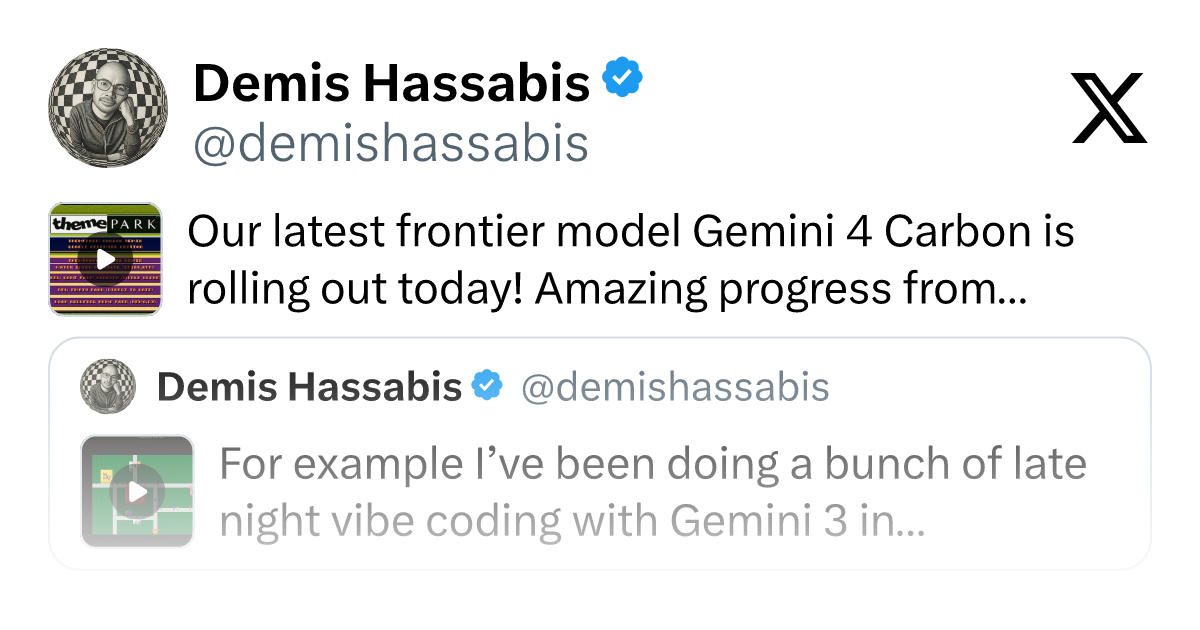
Gemini 4 Carbon Released: The Leap from Gemini 3 to Gemini 4 in Under a Year
Google releases Gemini 4 Carbon, less than a year after Gemini 3. In the official demo, Carbon reverse-engineered the Theme Park binary, added a new DeepMind-themed ride, and ported it to the web in one shot.