Industrial-Grade AI Agent Development Guide: From Demo to a Four-Layer Architecture That Can Handle Real Business
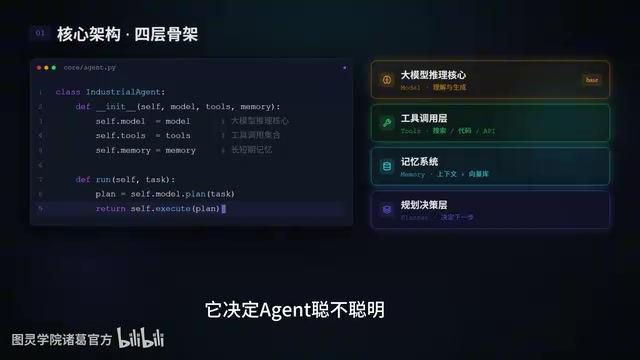
From Demo to industrial-grade Agent: four-layer architecture and the ReAct loop for stability, memory, and fault tolerance.
This article challenges the misconception that calling an LLM API equals building an Agent, and systematically breaks down the real gap between industrial-grade Agents and toy Demos: stability, memory, and fault tolerance. It covers the four-layer architecture (LLM core, Tools, Memory, Planner), explains why the Planner is the decision-maker while Tools are only executors, and shows how the ReAct loop's stability determines whether an Agent spins in circles. Three practical challenges test architectural understanding, and vector databases are highlighted as the foundation for RAG-based long-term memory in enterprise Agent deployments.
Calling an LLM API Doesn't Mean You Know How to Build an Agent
Many developers assume that successfully calling a large model API means they've mastered agent development — but this misconception is precisely the gap between a Demo and an industrial-grade Agent. Something that runs once is a Demo; something that can withstand real business workloads is industrial-grade.
As broken down by technical creators on Bilibili, the difference boils down to three things: stability, memory, and fault tolerance. A script that only handles a single task will often crash when faced with the complex inputs, unexpected return values, and long-context scenarios of real-world business. The value of an industrial-grade Agent isn't whether it can complete one task — it's whether it can run continuously, reliably, and stably.
This logic reflects the fundamental difference between engineering thinking and toy thinking: the former cares about how a system behaves at its boundaries; the latter only cares about whether the happy path works.
The Four-Layer Architecture of an Industrial-Grade Agent
A complete industrial-grade Agent is typically composed of four layers, stacked from bottom to top:
- Bottom layer: LLM inference core — The intelligence source of the entire system, responsible for language understanding and generation.
- Tool-calling layer (Tools) — Enables the model to actually operate the outside world; search, code execution, and API calls all live here.
- Memory system (Memory) — Short-term memory handles context; long-term memory is stored in a vector database.
- Planning and decision layer (Planner) — Sits at the top and determines how "smart" the Agent actually is.
Breaking the project apart makes things clearer: the Planner decomposes vague requirements into executable steps — it's the Agent's "brain"; Tools are its "hands and feet," responsible for actual execution; Memory is its "knowledge store." Only when all three work in concert can an Agent get real work done.
The advantage of this layered design is decoupled responsibilities: decision-making and execution are separated, making the system easier to debug and extend. A common misconception is treating Tools as the decision-maker — in reality, Tools are only executors. What decides "what to do next" is always the Planner layer.
The ReAct Loop: What Determines Whether Your Agent Goes in Circles
The core operating logic of an Agent is called the ReAct loop: first Reason, then Act, then Observe the result, then reason again — cycling around and around until the task is complete.
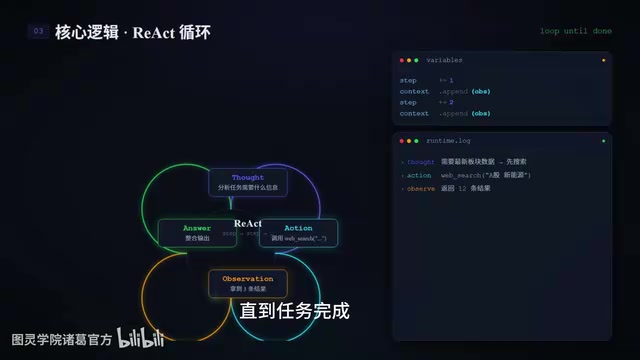
Whether this loop is stable directly determines whether the Agent will go in circles or get stuck. In real deployments, runaway loops are one of the most common problems: the model might repeatedly call the same tool, fall into a meaningless reasoning deadlock, or fail to correct course after observing an error.
From a code perspective, the implementation is actually quite clean: initialize the Agent with a model, tools, and memory, then fire it off with a single run call. The underlying logs will fully capture the Agent's entire process of thinking, searching, observing, and summarizing — and this is the critical window for debugging Agent behavior. How well you've built in observability often determines whether an Agent project can successfully move from experiment to production.
ReAct (Reasoning + Acting) is a prompting framework proposed by researchers from Google and Princeton University in 2022. The core idea is to interleave a language model's reasoning process with external tool calls, rather than completing all reasoning before acting. Traditional Chain-of-Thought (CoT) only has the model "think" — ReAct inserts an "act" step after each reasoning step and feeds the action's result back to the model as a new observation, forming a closed loop. This design addresses the problems inherent in pure reasoning approaches: stale information and hard-to-correct hallucinations. When a tool returns a real-world result, the model's next reasoning step has a factual anchor, significantly reducing the likelihood of confident-sounding nonsense. In engineering implementations, the ReAct loop typically includes a maximum iteration limit (max_iterations) and a timeout mechanism as safety valves to prevent the model from looping infinitely — these are exactly the kinds of engineering details that must be added when upgrading from Demo to industrial-grade.
Three Practical Challenges: Test Your Understanding
Enough theory — let's get practical. These three challenges quickly test your grasp of core Agent concepts.
Challenge 1: Who Decides What to Do Next?
The answer is the Planner (planning and decision layer). It breaks large goals into smaller steps — it's the Agent's brain. This challenge tests your understanding of where "decision authority" lives — many people mistakenly think it's the model itself or the tools doing the deciding.

Challenge 2: Match Modules to Responsibilities
- Planner → Decomposes goals
- Tools → Calls external capabilities
- Memory → Stores context and long-term knowledge
Pay special attention to this: Tools are executors, not decision-makers — this is the most common point of confusion. Getting this relationship straight is essential for correctly separating decision logic from execution logic in your architecture.
Challenge 3: Complete the Code
Configure a Code Runner in the tools so the Agent can execute code, pass a vector database into memory, and trigger the task with agent.run. Fill in all three correctly, and you've written the first prototype of an industrial-grade Agent.

The vector database serves as the carrier for long-term memory, enabling the Agent to retrieve historical knowledge and external documents — this is also how RAG (Retrieval-Augmented Generation) is implemented within an Agent system.
RAG (Retrieval-Augmented Generation) is a technical paradigm that combines an external knowledge base with a large model's generative capabilities. The basic flow is: documents are chunked and converted into high-dimensional vectors via an embedding model, then stored in a vector database (such as Chroma, Pinecone, or Milvus); when the Agent needs to answer a question, the question is also vectorized, semantically similar document chunks are retrieved from the database, and those chunks are injected into the prompt as context so the model can generate a response grounded in real material. Within an Agent system, the vector database plays the role of "long-term memory," compensating for the large model's inherent limitations: a finite context window, inability to remember past conversations, and no access to enterprise-private knowledge. Unlike short-term memory (the current conversation context), knowledge in a vector database can persist across sessions and be updated on demand — making it one of the critical pieces of infrastructure for deploying enterprise-grade Agents.
The Distance Between "It Runs" and "It Holds Up"
To summarize this Agent development methodology, keep three modules and one loop in mind:
- Three modules: Planner (planning), Tools (execution), Memory (memory)
- One loop: Reason → Act → Observe
And remember the most fundamental truth: running once doesn't count for much — running reliably over time is what makes something industrial-grade. Going from Demo to industrial-grade Agent is fundamentally a leap from "validating feasibility" to "guaranteeing reliability."
For developers who want to genuinely deploy Agents into enterprise business workflows, stability, memory, and fault tolerance are the core capabilities that require long-term investment — and these three are precisely what the vast majority of current Agent projects most commonly overlook.
Related articles

Prompt → MCP → Agent → Skill: The AI Terminology Evolution Chain Explained in 5 Minutes
A clear guide to five core AI concepts — Prompt, MCP, Agent, Skill, and Cowork — and how they connect in a layered evolution chain from simple instructions to multi-agent teamwork.
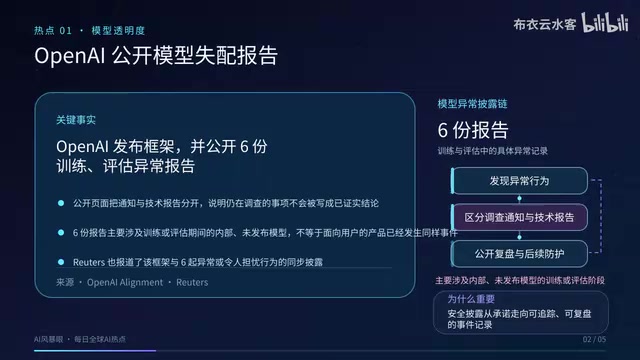
OpenAI Discloses Model Anomalies, DeepMind Launches AGI Forum, NVIDIA Partners on Grid Power Management
Sept 17 AI roundup: OpenAI publishes model anomaly disclosure framework with 6 reports, Google DeepMind launches AGI public forum, NVIDIA leads AI energy management alliance with 18 partners.
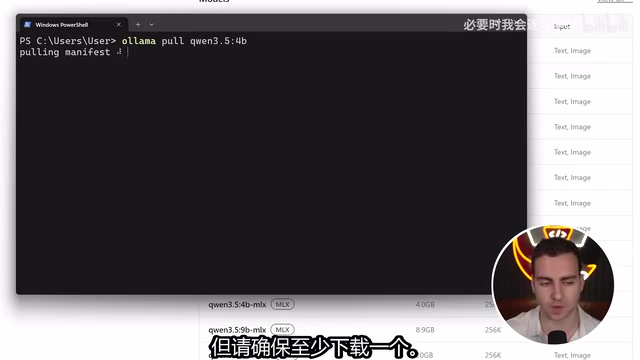
Build a Local AI Agent with Python in 10 Minutes: Ollama + PydanticAI in Action
A hands-on guide to building a fully local AI agent with Python, Ollama, and PydanticAI in 10 minutes — covering model selection, tool functions, and conversation loops.