Inexact Stochastic Variance-Reduced Gradient Method Solves Constrained Finite-Sum Optimization Challenges

The inexact SVRG method narrows the complexity gap between ε-SFSO solutions and ε-expected feasible solutions in constrained finite-sum optimization.
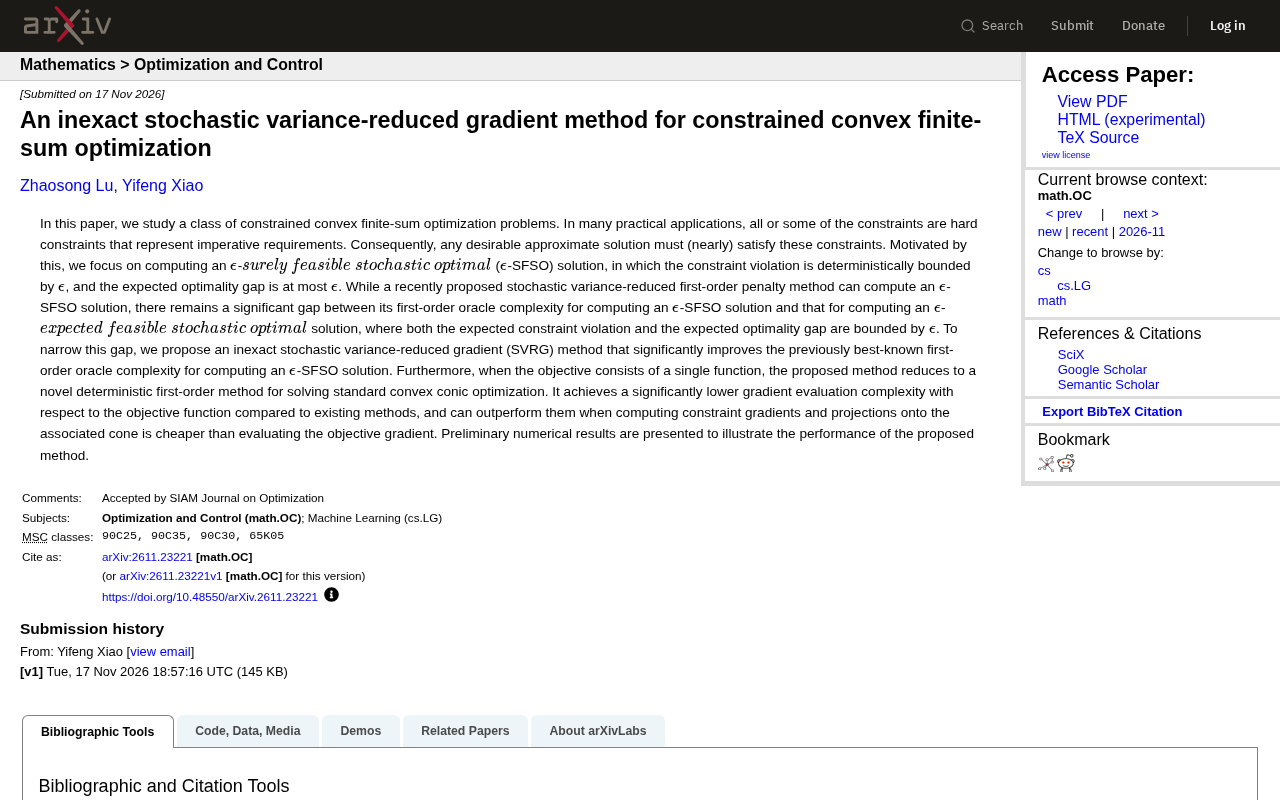
This paper addresses constrained convex finite-sum optimization, studying how to efficiently compute ε-surely feasible stochastic optimal (ε-SFSO) solutions with deterministically bounded constraint violation and expected optimality gap at most ε. Traditional stochastic variance-reduced first-order penalty methods have a significant complexity gap versus computing ε-expected feasible solutions. The authors propose an inexact SVRG method that significantly improves the complexity bound via inexact gradient evaluations and variance reduction. When the objective degenerates to a single function, the method simplifies to a novel deterministic first-order method for convex cone optimization with lower objective gradient evaluation complexity, advantageous when constraint gradient computation and projection are cheap. Preliminary numerical experiments validate the method.
Constrained optimization problems are ubiquitous in machine learning, signal processing, and operations research. In many scenarios, constraints are hard requirements that must be strictly satisfied, such as capacity limits in resource allocation or safety boundaries in physical systems. However, traditional stochastic optimization methods often focus only on the optimality of the objective function and do not control constraint violations strictly enough. A recent paper from arXiv proposes an inexact stochastic variance-reduced gradient (SVRG) method specifically for constrained convex finite-sum optimization problems, aiming to efficiently compute solutions where both constraint violation and optimality gap are ε.
Problem Background: ε-SFSO Solutions and Hard Constraint Requirements
The paper studies a class of constrained convex finite-sum optimization problems, where the objective function is the average of multiple functions and the constraint set is convex. In practical applications, all or some of the constraints are hard constraints, and any acceptable approximate solution must (almost) satisfy these constraints. Therefore, the authors focus on computing a solution called ε-surely feasible stochastic optimal (ε-SFSO). Specifically, ε-SFSO requires that the constraint violation be deterministically bounded within ε, while the expected optimality gap is at most ε.
This requirement is stricter than ε-expected feasible stochastic optimal solutions, which only control the expected constraint violation. Previously, a stochastic variance-reduced first-order penalty method was able to compute ε-SFSO solutions, but there was a significant gap between its first-order oracle complexity for computing ε-SFSO solutions and that for computing ε-expected feasible solutions. Closing this gap is the core motivation of this paper.
Stochastic variance-reduced gradient (SVRG) is a class of techniques for reducing the variance of stochastic gradient estimates, proposed by Johnson and Zhang in 2013. Its core idea is to periodically compute the full gradient as a reference, and in each inner iteration use the combination of "current stochastic gradient - reference stochastic gradient + full gradient" to construct a low-variance unbiased gradient estimate. This structure enables SVRG to achieve linear convergence rates on strongly convex and generally convex finite-sum optimization problems, significantly outperforming traditional stochastic gradient descent. In constrained optimization, SVRG is often combined with projection or penalty methods, but how to simultaneously control constraint violation and optimality gap remains a challenge.
First-order oracle complexity is a theoretical metric for measuring the efficiency of optimization algorithms, referring to the number of times the algorithm needs to call first-order information (i.e., gradients or subgradients) to reach a given accuracy ε. In finite-sum optimization, two types of complexity are usually distinguished: one based on the number of evaluations of individual function gradients (i.e., stochastic oracle complexity), and the other based on the number of full gradient evaluations. Reducing first-order oracle complexity means the algorithm can achieve the same accuracy with fewer gradient computations, which is crucial for large-scale machine learning problems. One of the core contributions of this paper is improving the upper bound on the first-order oracle complexity for computing ε-SFSO solutions.
Method Innovation: Inexact SVRG and Deterministic First-Order Method
To close the aforementioned complexity gap, the authors propose an inexact stochastic variance-reduced gradient (SVRG) method. By introducing inexact gradient evaluations and variance reduction techniques, this method significantly improves the previously known first-order oracle complexity for computing ε-SFSO solutions. The paper states that the new method achieves a better complexity bound in theory; although the specific numerical values are not given in the abstract, the authors emphasize a "significant improvement."
A noteworthy feature is that when the objective function degenerates to a single function, the proposed method naturally simplifies to a novel deterministic first-order method for solving standard convex cone optimization problems. This deterministic method has significantly lower gradient evaluation complexity for the objective function than existing methods, and can demonstrate better performance in scenarios where the cost of computing constraint gradients and projecting onto the relevant cone is lower than evaluating the objective gradient. This provides a competitive new tool for convex cone optimization.
Convex cone optimization refers to optimization problems where the constraint set is a convex cone (i.e., a convex set closed under nonnegative scaling and addition), such as nonnegative orthant constraints, second-order cone constraints, and positive semidefinite cone constraints. Such problems arise widely in signal processing, statistical learning, and control theory. First-order methods for solving convex cone optimization problems typically require computing the gradient of the objective function and the projection onto the cone. When the cost of computing the projection or constraint gradient is much lower than evaluating the objective gradient (e.g., the objective function involves a complex model while the constraint structure is simple), algorithms should be designed to minimize the number of objective gradient calls. The deterministic first-order method proposed in this paper targets exactly this scenario, reducing the evaluation complexity of the objective gradient through inexact gradient evaluations and variance reduction ideas.
Numerical Experiments and Performance Demonstration
The paper provides preliminary numerical results to verify the performance of the proposed method. Although the abstract does not disclose specific experimental settings and comparison data, the authors state that the experimental results demonstrate the effectiveness of the method. Considering that the theoretical analysis shows complexity improvements, the numerical experiments likely demonstrate fewer gradient evaluations or faster convergence under the same accuracy requirements. For practitioners, this means that the new method may bring computational efficiency improvements when dealing with large-scale finite-sum constrained optimization problems.
Impact and Outlook
The contribution of this work lies in theoretically closing the complexity gap between ε-SFSO solutions and ε-expected feasible solutions, and providing a new deterministic first-order method for convex cone optimization. For machine learning problems that require strict constraint satisfaction (such as safe reinforcement learning and fairness-constrained training), this method provides a more reliable optimization tool. Possible future research directions include extension to nonconvex problems, adaptive step-size strategies, and broader experimental validation. Although the paper is currently only a preprint, its theoretical results have already attracted attention from the optimization community.
Overall, the inexact SVRG method takes an important step in the field of constrained finite-sum optimization, balancing constraint violation control and computational efficiency, and laying the foundation for future research.
One-line Summary
The inexact SVRG method narrows the complexity gap between ε-SFSO solutions and ε-expected feasible solutions in constrained finite-sum optimization.
Paragraph Summary
This paper addresses constrained convex finite-sum optimization problems, studying how to efficiently compute ε-surely feasible stochastic optimal (ε-SFSO) solutions, i.e., solutions with deterministically bounded constraint violation and expected optimality gap at most ε. Although traditional stochastic variance-reduced first-order penalty methods can compute ε-SFSO solutions, there is a significant gap between their first-order oracle complexity and that for computing ε-expected feasible solutions. The authors propose an inexact stochastic variance-reduced gradient (SVRG) method that significantly improves the complexity bound through inexact gradient evaluations and variance reduction techniques. When the objective function degenerates to a single function, the method simplifies to a novel deterministic first-order method for convex cone optimization, with lower objective gradient evaluation complexity than existing methods and greater advantages in scenarios where constraint gradient computation and projection costs are low. Preliminary numerical experiments verify the effectiveness of the method.
Related articles

The Gemini 4 Trio and 3.8 Flash: A Full Comparison of Positioning, Pricing, and Benchmarks
A comparison of Gemini 4 Neon, Carbon, Argon, and Gemini 3.8 Flash: positioning, context, API pricing, Artificial Analysis and Arena benchmark scores, and available entry points.

AI Coding Model Leaderboard: Opus 5.5 Crowned, Gemini Neon Stages a Comeback
Tech blogger Matthew Berman releases an AI coding model tier list: Claude Opus 5.5 holds S-tier, Gemini Neon surprises with A-tier, OpenAI Astra lands B-tier. How do open-source models like DeepSeek fare? We break down the scoring logic and practical takeaways.

New Jersey Joe Sandwich: Meat and Coleslaw on Triple-Decker Rye
New Jersey Sloppy Joe isn't a ground beef burger—it's triple-decker rye bread with meat, Swiss cheese, and coleslaw, plus Russian dressing. Learn the authentic Essex County method and family recipe.