Infinite Drive: Unlocking Unlimited Space for Laptops with a Streaming Cloud Drive

Infinite Drive uses streaming access and AI search to make cloud drives no longer occupy local disks.
Infinite Drive is a streaming cloud drive product that debuted on Product Hunt, advocating "streaming" as a replacement for traditional cloud drive "syncing," allowing files to enter local apps directly without occupying local disk space; the official claim is that even 4K video can stream directly into editors. The product also offers AI search, supporting retrieval of assets by natural language description rather than filenames. Its target users focus on video editors, creative professionals, and remote teams, whose common pain points are large file sizes, frequent retrieval, and tight local space. The article also points out that this solution depends heavily on network quality, AI search accuracy and editing software compatibility remain to be verified, and the product is in an early exposure stage — it's advisable to trial on a small scale before migrating core assets.
When Local Disks Become the Creator's Bottleneck
Video editors and remote teams often face the same dilemma: footage keeps piling up, yet a laptop's local storage is extremely limited. The traditional cloud drive approach is "sync" — downloading files locally before opening them — which essentially doesn't solve the disk space problem. Infinite Drive, which debuted on Product Hunt, proposes a different approach: making the cloud drive "streaming," so files don't occupy local disk space and stream directly into local apps like watching online video.
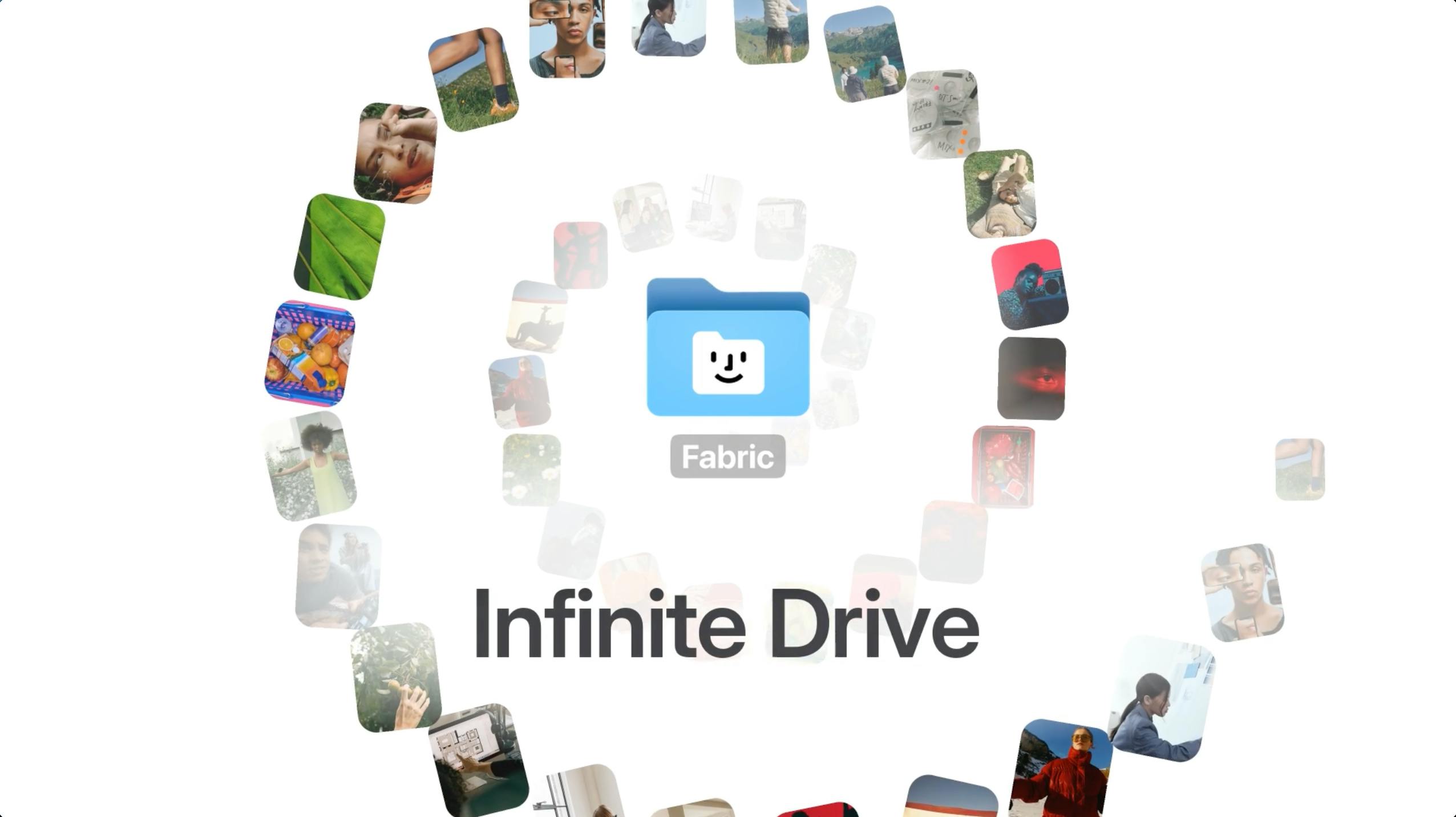
Its official tagline is "A cloud drive you stream to give your laptop infinite space," with a clear positioning targeting creative professionals, video editors, and remote teams. Currently, the product has 75 upvotes and 8 comments on Product Hunt, ranking #16, with categories spanning video streaming, storage, and photo & video. The maker is johnny makes.
Core Technical Logic: Zero-Disk Streaming Access
Infinite Drive's most critical promise is "files occupy zero disk space and can be streamed instantly." According to the official description, even 4K video can stream directly into editors without first being fully downloaded locally.
The Essential Difference from Sync-Based Cloud Drives
Conventional cloud drives (such as marking files as "online-only") still trigger downloads when opened, and large files require waiting. Infinite Drive emphasizes the streaming experience: files are read on demand, transferred as they're used, and the editor receives an instantly accessible content stream. For editing workflows that require frequent previews of large assets, this model can significantly reduce idle time spent "waiting for downloads to complete."
The difference between "online-only" files and streaming access deserves further clarification. The "online-only/on-demand files" feature offered by mainstream cloud drives (OneDrive, Dropbox, Google Drive) is essentially a placeholder mechanism: only minimal metadata files are kept locally, and a full download is triggered when you double-click to open. Once downloaded, the file materializes to disk and continuously occupies space. In other words, it optimizes "when to download," not "whether disk space is occupied."
Streaming access is different. It relies on HTTP Range requests and on-demand chunked reading: when an app reads a certain segment of a file, the client only fetches the corresponding byte range, and uses local caching or a virtual file system (such as macOS's FUSE or Windows's Cloud Files API) to "disguise" these chunks as a complete file exposed to upper-layer software. The whole process theoretically leaves no persistent full copy, and caches can be evicted at any time. The trade-off is greater sensitivity to network jitter, and random reads (such as scrubbing the timeline during video editing) frequently trigger remote requests, demanding significantly higher latency than sequential reads.
The Real Significance of 4K Video Streaming
The size of 4K assets is dozens of times that of ordinary documents. Traditional approaches either rely on high-speed local drives or endure lengthy syncing. Infinite Drive delegates this step to the cloud and streaming transmission, theoretically enabling low-storage laptops to handle high-bitrate assets.
The conversion between bitrate and bandwidth helps understand the threshold for 4K streaming. Taking common 4K assets as an example, the bitrate after H.264 compression is about 50–100 Mbps, while ProRes 422 HQ, commonly used in professional editing, can reach about 880 Mbps (approximately 110 MB/s) at 4K, with RAW formats even higher. When scrubbing the timeline, stacking multiple tracks, and adding effects, editing software often needs to read multiple clips simultaneously, and the actual bandwidth requirement may be several times a single bitrate.
This explains a key difference: streaming players (like Netflix) can pre-buffer and reduce bitrate, while non-linear editing requires near-random instant access, with no quality reduction and no long buffering. Therefore, a streaming cloud drive may smoothly preview proxy files on consumer broadband, but when handling high-bitrate original assets, bandwidth close to LAN or even local SSD is ideal. This is also why such products typically recommend using a proxy workflow.
AI Search: Finding Files by Description Rather Than Filename
Besides streaming access, Infinite Drive's other capability is AI search. The official description is "find anything by describing it." This means users don't need to remember filenames or directory structures, but can search by describing content in natural language.
For creators with large asset libraries, this solves a long-standing pain point: filenames are often meaningless numbers, and keyword searches have low hit rates; searching by content description is closer to how the human brain remembers things — "I remember there's a slow-motion shot of the seaside." Combined with streaming access, you can open what you find, making the whole chain more coherent.
The technology behind descriptive search typically involves multimodal embedding. The system generates vector representations for each file (or keyframes of videos), encoding visual content, scenes, objects, actions, etc. into high-dimensional vectors; when users input natural language queries, these are also encoded into vectors, and approximate nearest neighbor (ANN) search is used to find the most semantically similar assets. This is a completely different technical path from traditional retrieval based on filenames, tags, or EXIF metadata.
Its limitations stem from this: vector search excels at "semantic similarity," but is less reliable than keyword search for exact matches (such as specific names, precise timecodes, or on-screen text); videos also require frame sampling strategies, and sampling density directly affects recall and indexing costs. Therefore, in practice, hybrid retrieval is often used — semantic vectors + metadata filtering + full-text/OCR search working together — to address both "I remember a seaside slow-motion shot" and "find the one shot last Wednesday."
Who It's For: Creators and Remote Teams
From the product positioning, Infinite Drive's target users are quite focused:
- Video editors: need to handle large assets while preserving laptop local space for the system and software.
- Creative professionals: diverse asset types (images, videos, design files) with strong retrieval needs.
- Remote teams: members have varying device configurations, and unified cloud streaming access can lower hardware requirements per machine.
What these scenarios share is "large files, frequent retrieval, tight local space," which exactly corresponds to Infinite Drive's three propositions: zero disk usage, instant streaming, and AI search.
What to Consider Rationally
Streaming cloud drives are not a brand-new concept, and their experience depends heavily on network quality. Streaming 4K video into an editor demands far higher bandwidth and latency than ordinary file previews; when network conditions are poor, local disk solutions may still be more stable. In addition, the accuracy of AI search, the range of supported asset formats, and the depth of compatibility with traditional editing software all need real-world use to verify.
The data of 75 upvotes and 8 comments on Product Hunt indicates it is still in an early exposure stage, with limited community discussion, and there is not yet enough real user feedback to substantiate long-term stability. For interested teams, it's advisable to first trial with small-scale assets, evaluate the match between network conditions and workflow, and then decide whether to migrate core asset libraries.
Summary
Infinite Drive attempts to redefine the "cloud drive" from a storage sync tool into a "streaming access layer," addressing creators' space and retrieval pain points with zero disk usage and AI descriptive search. The direction is clear, but to truly replace local hard drives, it still needs more evidence on transmission stability and format compatibility.
One-line Summary
Infinite Drive uses streaming access and AI search to make cloud drives no longer occupy local disks.
Paragraph Summary
Infinite Drive is a streaming cloud drive product that debuted on Product Hunt, advocating "streaming" as a replacement for traditional cloud drive "syncing," allowing files to enter local apps directly without occupying local disk space; the official claim is that even 4K video can stream directly into editors. The product also offers AI search, supporting retrieval of assets by natural language description rather than filenames. Its target users focus on video editors, creative professionals, and remote teams, whose common pain points are large file sizes, frequent retrieval, and tight local space. The article also points out that this solution depends heavily on network quality, AI search accuracy and editing software compatibility remain to be verified, and the product is in an early exposure stage — it's advisable to trial on a small scale before migrating core assets.
Related articles

FBI Warns: Hackers Weaponize AI Agent ARTEX to Attack 200+ Organizations
FBI warns that AI penetration framework ARTEX is being used to attack 200+ organizations, with CrowdStrike tracking the VaporPanda group. We break down ARTEX's agent orchestration architecture, the real attack chain, loss data, and the FBI's five defense recommendations.

FBI Warns: Free AI Hacking Tool Artex Spirals Out of Control, Breaches Cloud Systems in Three Hours
FBI warns that the free open-source AI penetration tool Artex is being abused by criminals and state-backed hackers to breach cloud systems in as little as three hours. This article analyzes real attack cases, overlooked side-door risks, and defense measures enterprises and individuals can take immediately.

Verse Engine: Turn Blender/Unity/Unreal Scenes into Browser 3D Links in One Click
Verse Engine by Ctruh is a browser-native 3D and XR engine that publishes Blender, Unity, and Unreal scenes as browser links in one click. View-based streaming opens a 1.03 billion-triangle city scene on a laptop. It offers embeds, API, and SDK for developers, 3D artists, architecture, and e-commerce teams.