Insects No Longer Swarm Under LED Lights? A New Observation Challenges Conventional Wisdom
A personal observation claims insects don't swarm under LED lights, sparking discussion about spectra, ecology, and AI monitoring.
The article centers on a personal blog observation: insects do not swarm under LED lights as common knowledge suggests—a topic that gained 300 points and 154 comments on Hacker News. The author notes that differences in spectral composition may be the key factor behind the differing insect attraction of LEDs versus traditional sources, but the original material discloses no specific methods or data, so the observation should not be treated as conclusive. The discussion extends to urban lighting design, pest monitoring and agricultural IoT recalibration, and the data distribution shift caused by generational changes in environmental technology affecting AI model effectiveness. The article emphasizes that single-source personal observation should be a starting point for discussion, requiring multi-location, multi-species controlled verification.
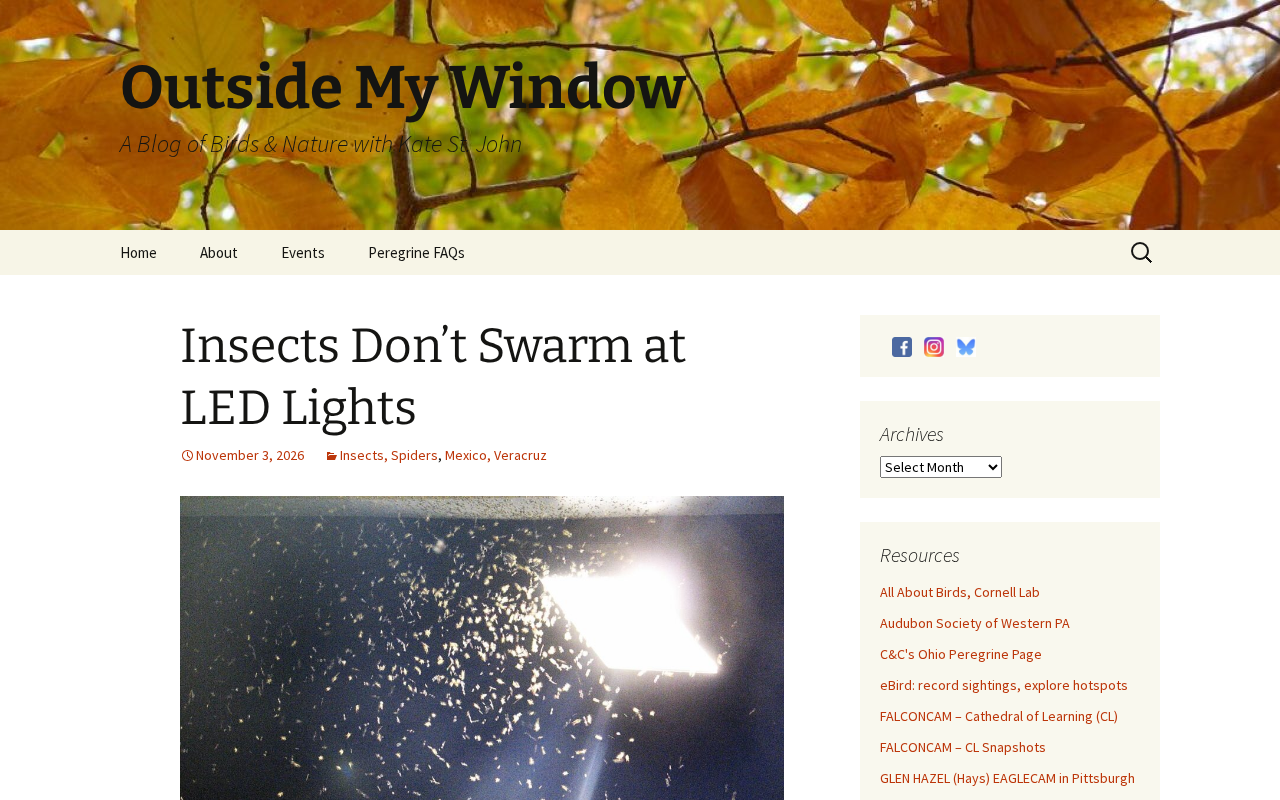
For a long time, "insects are drawn to light" has been taken as common knowledge—clouds of bugs swirling around streetlamps on summer nights seem like an inevitable sight. But an article from a personal observation blog offers a different view: insects don't gather under LED lights the way we assume. The post gained 300 points and 154 comments on Hacker News, sparking broad discussion in the tech and science community.
Core Argument: Changes in Insect Behavior Under LED Lights
The article's title is blunt—"Insects Don't Swarm at LED Lights." Based on everyday observation, the author points out a clear difference between LED lighting and traditional light sources (such as incandescent and fluorescent lamps) in terms of attracting insects. This observation echoes some recent research in entomology: spectral composition significantly affects insects' phototactic behavior, and the specific wavelength bands emitted by LEDs may be less attractive to nocturnal insects than traditional sources.
It should be noted that the original material only provided the title and a source link, without disclosing specific observation methods, locations, or data details. Therefore, this article does not introduce any precise figures not confirmed by the source material, but instead focuses on the discussion value and industry implications of this topic.
Phototaxis is the biological phenomenon in which insects exhibit directed movement responses to light sources, typically divided into positive phototaxis (movement toward light) and negative phototaxis (movement away from light). Conventional wisdom holds that nocturnal insects are positively phototactic, but the mechanisms behind this behavior are not simple: mainstream hypotheses include the "light compass hypothesis" (insects use parallel light such as moonlight for navigation, and artificial point sources cause them to fly in spirals) and the "glare hypothesis" (strong light directly interferes with the insect visual system). Sensitivity to spectra varies greatly across insect orders—for example, Lepidoptera (moths) are particularly sensitive to ultraviolet and blue bands, while some Diptera respond more strongly to green light. This explains why light source type (not just brightness) significantly changes insect attraction, and provides a biological basis for understanding the differences between LEDs and traditional sources.
Why This Topic Sparked Discussion on HN
The 154 comments on Hacker News show that this is not just a piece of natural observation trivia, but touches on multiple technical and industrial issues: urban lighting design, the ecological impact of outdoor LED retrofits, and how to verify "common knowledge" when everyday observation disproves it. For developers working in IoT lighting, smart cities, and agricultural light control, the relationship between light source spectra and biological behavior directly affects product design.
A common point of contention in the comments is: is individual observation sufficient to support general conclusions? Sensitivity to spectra varies enormously across insect species, and observations from a single site are hard to extrapolate to all scenarios. This suggests we should understand "insects don't swarm at LED lights" as a phenomenon worthy of further verification, not a settled conclusion.
Implications for AI and Sensing Applications
If LED lighting does indeed change the distribution of insect activity, then pest monitoring systems that rely on light traps need recalibration. Many agricultural IoT solutions use specific light sources to attract pests and perform image recognition counting; changes in light source type directly affect data distribution, which in turn affects the training and inference accuracy of AI models.
This is also a reminder about data collection: when environmental conditions (such as lighting technology) undergo generational change, distribution shift may occur between historical data and current scenarios, requiring continuous validation and updating of models. For teams working in edge vision and ecological monitoring, cases like this—where "common knowledge is challenged"—deserve consideration in data governance.
Distribution shift is a core concept in machine learning, referring to a mismatch between the data distribution at model deployment and that of the training data, leading to performance degradation. Common types include covariate shift (input distribution changes but the label rule remains the same) and concept drift (the relationship between input and label itself changes). In pest monitoring scenarios, if training data are collected from images of traps using traditional light sources while the deployment environment switches to LED sources, the species and quantity of insects captured, and even the background lighting conditions of the images, will change—constituting a typical covariate shift. Response strategies include continuously monitoring the inference data distribution, periodically fine-tuning models with new-scenario data, and adopting domain adaptation techniques. This concept reminds developers: generational turnover in environmental hardware is a hidden cause of model failure.
How to Reasonably View Such Observations
Single-source personal observation has inspirational value but limited reliability. A more rigorous approach would combine controlled observations across multiple locations and species, and record light source spectral parameters and environmental conditions. For content creators and technical professionals, the value of this article lies not in providing conclusions, but in reminding us that both everyday experience and technical assumptions deserve continuous scrutiny.
In the absence of complete experimental data, treating "insects don't swarm at LED lights" as a starting point for discussion rather than a factual endpoint is the more responsible attitude.
One-line Summary
A personal observation claims insects don't swarm under LED lights, sparking discussion about spectra, ecology, and AI monitoring.
Paragraph Summary
The article centers on a personal blog observation: insects do not swarm under LED lights as common knowledge suggests—a topic that gained 300 points and 154 comments on Hacker News. The author notes that differences in spectral composition may be the key factor behind the differing insect attraction of LEDs versus traditional sources, but the original material discloses no specific methods or data, so the observation should not be treated as conclusive. The discussion extends to multiple technical and industrial issues: the ecological impact of urban lighting design, the potential need to recalibrate light-trap-based pest monitoring and agricultural IoT solutions, and the impact of data distribution shift caused by generational changes in environmental technology on AI model effectiveness. The article ultimately emphasizes that single-source personal observation should serve as a starting point for discussion and requires multi-location, multi-species controlled verification.
Related articles

40C3 halfnarp Launches: Optimizing Conference Agendas with Preference Submissions
40C3 halfnarp is a conference scheduling tool on Hacker News that lets attendees submit talk preferences in advance to help organizers optimize agendas and reduce conflicts among popular talks. It's a reference for community tech conferences.
 Tech Frontiers
68% of Americans Support Pausing AI Development; Superintelligence Ban Sparks Debate
A Reddit discussion of a survey showing 68% of Americans support pausing AI development and banning superintelligence reflects public anxiety, the expert-public perception gap, and US-China differences in AI safety discourse.
 Tech Frontiers
Building a Sailing Simulator with Claude Code and Pitting Frontier AI Models Against Each Other
A developer built a sailing simulator with Claude Code and raced frontier AI models in it. Gemini 4 Argon won at one-fifth the cost, highlighting AI coding and multi-model comparison.