Inside ARTEX: How AI Hackers Breached the Defenses

AI attacks and defenses both hit machine speed within a week, raising questions about human control.
Using a week in November 2026 as a timeline, the article connects multiple AI security events: the FBI warns that the hacking tool ARTEX is being used for machine-speed intrusions, with some attacks reaching top-level access from first contact in under three hours; security firm Barracuda is breached for 44 hours via an unreclaimed external AI vendor key, with characteristics matching ARTEX but no attribution; Google observes the first fully automated AI agent attack chain with no human involvement, but two lines of Russian comments cannot identify the attacker; Coinbase uses AI to block $4.7 million in deepfake fraud, also without human involvement. The author notes that both "first" and attribution require caution, contrasts this with Xi Jinping's call for AI to always remain under human control, and closes with the open question of whether human-free AI hacking tools should be treated as weapons.
Introduction: When Attacks No Longer Need Humans
Imagine this: an attacker infiltrates a security company's cloud environment—not by picking locks or breaking down doors, but by using a key the company never reclaimed—and stays inside for 44 hours. This isn't a movie plot; it's a real incident disclosed by a security company itself. More unsettling still, the attack closely matches the AI hacking tool ARTEX that the FBI warned about the same week. And just days later, Google discovered something worse—AI agents capable of completing intrusions with no human involvement.
When both attack and defense operate at machine speed, where does that leave humans?
The key difference between an AI agent and an ordinary chatbot lies in "autonomous execution": a large model only generates text based on prompts, whereas an agent plans its own steps around a goal, invokes tools (such as scanners, exploit frameworks, command lines), and adjusts its next actions based on execution results. What Google calls an "exploit agent" belongs to this category—it can read code diffs, infer potential vulnerabilities, generate and deliver attack payloads, all without a human issuing step-by-step instructions. An agent's capability ceiling depends on the toolset and permission boundaries it can access, so "no human involvement" does not equal "no human design"—attackers still need to set up the environment and configure the model and toolchain.
ARTEX: From "Good Guy Tool" to Machine-Speed Intrusion
According to an urgent alert issued by the FBI on November 13, ARTEX is a tool designed for "good guys," but since at least August 2026, criminals have used it to breach networks at machine speed. ARTEX itself has no brain—it needs to connect to other companies' AI models, including Anthropic's Claude, OpenAI's GPT, and China's DeepSeekAd. The FBI noted that in attackers' configurations, Chinese models were the most common.
In late September 2026, a hacker launched an attack against a South Korean bank. Security firm CrowdStrike confirmed that ARTEX was used and found Claude Code session history on the hacker's own server—which shows which AI they plugged in, but not who they are.

How fast is "machine speed"? The FBI says some intrusions went from first contact to top-level access in under three hours. Top-level access means control of the most important systems—like a principal holding every key. On October 8, 2026, the developer took ARTEX offline, but copies had already spread across the internet, and a paid version, ARTEX Pro, is still circulating.
"Machine-speed" intrusion refers to attack operations driven by automation tools, where the intervals between reconnaissance, exploitation, and lateral movement are compressed to minutes or even seconds—far beyond the rhythm of a human security team's "detect—assess—respond" cycle. Traditional defense relies on analysts investigating after log alerts, a loop that often takes hours; when the attack chain advances at machine speed, the attacker may have already obtained domain control or cloud admin privileges before defenders finish initial triage. This also explains why the FBI emphasizes "less than three hours from first contact to top-level access"—it measures the overall efficiency after automation has nearly eliminated the serial waiting time across intrusion stages, not the technical difficulty of any single point.
The Barracuda Incident: 44 Hours, One Key, Ten Accounts
Two days before the FBI alert, security firm Barracuda had already disclosed the details of an attack on November 1. At 4:33 a.m. UTC that day, someone entered its cloud environment. They didn't crack a lock—they used a key that Barracuda had provided to an external AI company. When that vendor finished its work, Barracuda did not reclaim the key.
Over roughly 44 hours, the attacker accessed about 10 cloud accounts, and Barracuda described the work as "methodical and tireless." On November 13, the same day as the FBI alert, Barracuda said the attack matched ARTEX's publicly known characteristics. But Barracuda chose its words carefully: "Because many organizations use ARTEX, the match tells us how the attacker operated, not who they were."
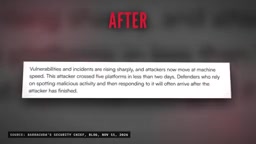
Defenders who rely on spotting malicious activity and then responding often arrive after the attacker is done. This may be the real problem brought by "machine speed."
A "key" in a cloud environment usually refers to a long-lived access credential, such as an API key, a service account token, or an OAuth authorization. Unlike temporary credentials, such keys do not automatically expire when a task ends; if they are not reclaimed or rotated after a third-party vendor finishes its work, a "shadow access" channel is created. Attackers can enter with legitimate credentials without cracking any authentication mechanism, appearing in logs as normal authorized activity—making traditional anomaly-based login detection hard to trigger. The core governance measures for this risk are least privilege, credential lifecycle management, and third-party access auditing, rather than simply strengthening perimeter defenses.
Google's Discovery: The First Fully Automated AI Agent Attack Chain
On November 16, Google's threat intelligence team published a report on the first observed use of AI by attackers to fully automate vulnerability discovery and exploitation, with no human intervention throughout. Simply put, both finding vulnerabilities and exploiting them were done by machines.
The attacker had an unprotected staging server. Inside it, Google found a group of cooperating AI agents, which it called an "exploit agent." This kind of AI agent can autonomously execute tasks rather than merely answer questions. Google said the agent compares code before and after fixes, identifies possible vulnerabilities, drafts attacks, and executes them without human intervention. Server data suggests the operator may have been interested in French websites and the media, entertainment, and education sectors.
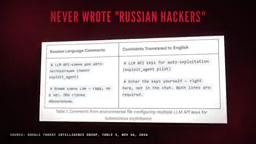
Some headlines called this "the first autonomous AI cyberattack," and some said "Russian hackers." But Google never wrote "Russian hackers." It only showed two lines of Russian comments in a settings file, one of which translates to "enter your own key here, don't use chat." That's all. Google did not name any country, organization, or individual. Two lines of comments in some language only show that someone writes in that language—anyone could leave false clues.
Moreover, the word "first" warrants caution: in November 2025, Anthropic said it had stopped an espionage campaign in which most of the work was done by its AI, but humans still made several key decisions. So Google's "first" has a narrower meaning: it is the first time Google has seen the full chain from vulnerability discovery to exploitation with no human involvement.
Machine Attack and Machine Defense: The Coinbase Case
On November 17, Coinbase told a story about a fake Musk. In October 2026, during a Tesla livestream demo, scammers ran a fake livestream on YouTube showing an AI-generated Musk deepfake video. The promise: send cryptocurrency to this address and get double back.
Coinbase said more than 500,000 people watched, and within about two hours, hundreds of customers tried to send money. Coinbase said its AI intervened before the funds went out, asked questions, and blocked $4.7 million—about 91% of what customers attempted to send—while also protecting internal employees. But in the end, Coinbase said the process involved "no human involvement."

Note: all these figures come from Coinbase itself; no independent verification was seen, nor were comments from Musk, Tesla, X, or YouTube.
Human Control: World Leaders' Call and Unresolved Mysteries
On November 19, Trump and Xi Jinping met in Shenzhen, with Putin also joining (according to CBS). The official Chinese readout said Xi called on the two countries to ensure that AI always remains under human control. The White House had not released a readout.
"Human control"—and in the same week, a machine carried out an attack with no human involvement at all.
We still don't know who was behind the Exploit Agent. Two lines of Russian are not the answer. We also don't know who spent 44 hours inside Barracuda's cloud environment—"how," not "who."
The author's prediction: by June 30, 2027, a US or European government will formally accuse a country of launching an attack that it claims was carried out by AI agents. If not, the prediction is wrong.
"Human control" in the context of AI governance usually means meaningful human oversight—that is, humans retain substantive ability to review, intervene, and veto key system decisions, rather than merely signing off at the end of a process. When both the discovery and exploitation in an attack chain are completed autonomously by agents, and response speed exceeds human reaction time, who should exercise "control," at which stage, and through what technical means (such as mandatory approval nodes, capability switches, behavioral auditing) remain without consensus standards. This is the most worth-asking point when such calls are placed alongside fully automated attack cases: is the object of control the model, the toolchain, or the organization deploying the tools?
Open Question: Should Human-Free AI Hacking Tools Be Treated as Weapons?
Google discovered a tool that can find vulnerabilities and attack, entirely without human involvement. Should such AI hacking tools be treated as weapons? This question may be more worth pondering than the technology itself.
Related articles

ChatGPT Plus Subscription Pitfall Guide: Go/Plus/Pro Tier Comparison and Quick Activation
A complete ChatGPT Plus subscription guide based on a Bilibili tutorial: from registering an account, comparing Go/Plus/Pro tiers, to the practical steps for quickly completing your subscription.

GPT-6.2 Sol/Astra Released! A Step-by-Step ChatGPT Plus Subscription Guide and Tier Comparison
GPT-6.2 Sol/Astra is out—here's a ChatGPT Plus subscription guide: register an account, compare Go/Plus/Pro tiers, and subscribe in a minute.

Comparing Three Channels for Subscribing to GPT Plus in China: Is Website Top-Up the Easiest?
How to subscribe to GPT Plus in China? This article compares website top-up, credit card, and mobile top-up channels—process, cost, and risk—with steps and tips to help you choose wisely.