Inside Microsoft Outlook's Worst-Ever Outage: A 24-Hour Disconnection
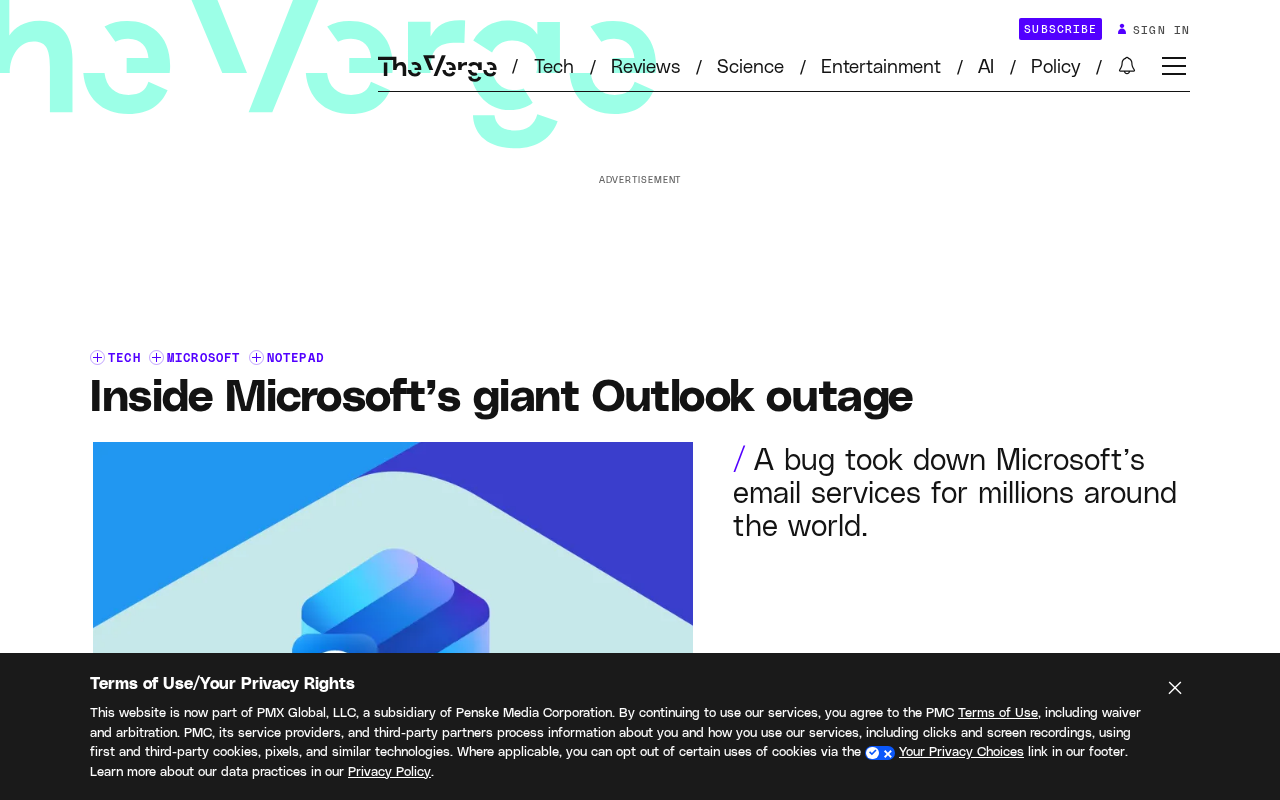
A nearly 24-hour large-scale Microsoft Outlook outage affected enterprises and government agencies in multiple countries, exposing cloud centralization risks.
The article uses a nearly 24-hour large-scale Microsoft Outlook outage as its entry point, tracing how the incident escalated from localized anomalies within an hour after 9 a.m. into total unavailability. Those affected included Microsoft employees, enterprise customers, and even government agencies in multiple countries, with the damage coming mainly from the blast radius rather than technical complexity. The article notes that the failure may have been in shared infrastructure or the authentication chain, making rapid isolation difficult. This leads to two levels of reflection: first, excessive concentration of critical communications infrastructure causes single points of failure to spread across a network; second, the nearly 24-hour recovery window itself raises questions about fault localization, degradation plans, and communication mechanisms. For users, the lesson is not to bet business continuity entirely on a single cloud service, but to prepare backup communication channels and incorporate large-scale vendor outages into regular contingency plans.
An Ordinary-Looking Thursday Morning
According to RSS sources, everything was normal at the Microsoft campus at 9 a.m. last Thursday — employees arrived one after another, ready to begin another workday filled with emails and meetings. But less than an hour later, one of the worst outages in Microsoft's history began to unfold: employees, enterprises, and even government agencies in multiple countries were unable to access Outlook email for nearly 24 hours.
The damage from this incident lay not in technical complexity but in its blast radius. Outlook is not a niche tool; it carries the daily communications lifeline of a vast number of organizations. When it goes silent, the ripple effects spread quickly into conference rooms, customer service centers, approval workflows, and cross-agency collaboration.
How the Outage Escalated from "Anomaly" to Crisis
Signals in the First Hour
The timeline described in the original reporting is notably restrained: everything normal at 9 a.m., and less than an hour later the failure began to surface. This "normal first, collapse later" pattern is not uncommon in enterprise-grade incidents — monitoring metrics may first show localized jitter, which is then amplified level by level through dependency chains.
What is worth noting is that this failure was not quickly isolated. From "some users affected" to "inaccessible for nearly 24 hours," there was a clear escalation window in between. For a cloud provider of Microsoft's scale, this suggests the failure point may have been in shared infrastructure or the authentication chain, rather than in some independent module that could be quickly restarted.
Shared infrastructure and the authentication chain are the two most common amplification points in enterprise cloud service outages. Shared infrastructure refers to underlying components used by multiple services — such as load balancers, DNS resolution, storage clusters, or message queues. Once degradation occurs at any one of these layers, the impact spreads laterally along dependency chains rather than being confined to a single application. The authentication chain involves authentication gateways, token issuance, and directory services; email clients depend heavily on this chain when establishing sessions, so once authentication is blocked, what users see is "complete inaccessibility," even if the mail storage itself is running normally. What both share is this: the failure is not inside the business module, it is hard to recover quickly by restarting a single service, and troubleshooting requires cross-team coordination — which explains why there is a clear escalation window between "localized jitter" and "total unavailability."
What Nearly 24 Hours of Disconnection Means
The key facts given in the original article are: employees, enterprises, and government agencies in multiple countries were all affected, and the duration was close to 24 hours. A number of this magnitude speaks for itself — enterprise SaaS availability commitments are usually discussed in terms of minutes of downtime, and outages measured in hours are enough to trigger scrutiny at the contract level.
For ordinary users, what does 24 hours without email mean? Approvals stall, customer emails go unanswered, meeting invitations cannot be sent. For government agencies, the impact may involve both external communications and internal workflows. The original article does not elaborate on specific loss figures, but the phrase "multiple governments" is enough to indicate the scope.
An SLA (Service Level Agreement) is a formal availability commitment between a cloud provider and its customers, usually expressed as a monthly uptime percentage — for example, 99.9% corresponds to about 43 minutes of allowed downtime per month. In enterprise SaaS contracts, SLAs often come with service credit clauses, but the credit amounts are usually negligible relative to the actual losses caused by business interruption. More importantly, there is a gap between the SLA's measurement methodology (how "unavailable" is defined, whether it is calculated separately by region or function) and users' real experience: a global outage lasting several hours may show up statistically only as a change in the decimal places for a given month, yet it is enough to trigger a customer's internal business continuity review and contract renegotiation. Therefore, an outage measured in hours carries weight at both the contractual and operational levels far beyond the number itself.
What Can Be Learned from This Incident
The Cost of Centralization
This prolonged outage of Microsoft Outlook once again puts the old problem of "excessive concentration of critical communications infrastructure" on the table. When a large number of organizations entrust their email systems to the same cloud vendor, the impact of a single point of failure is no longer a single point — it spreads across a network.
This is not to say that centralization has no value — cost, operational efficiency, and the speed of feature iteration are all real benefits. But this incident reminds us that availability risk does not automatically disappear just because a vendor is large; it may actually amplify the consequences because of that scale.
A single point of failure originally refers to a node in a system whose failure makes the whole system unavailable. In the context of cloud centralization, the concept has been extended: when a large number of organizations share the same region and the same authentication system of the same vendor, some internal component of the vendor becomes a de facto "super single point." Unlike traditional single points of failure, this centralized risk cannot be eliminated by customers building redundancy on their own — customers can keep local backups, but as long as the primary link points to the same cloud, an outage on the vendor side will still hit all customers simultaneously. This is also why multi-cloud and hybrid architectures are repeatedly discussed: their value lies not in eliminating failures but in splitting the failure domain from "vendor level" back to "organization level," so that a single incident no longer affects all dependent parties at once.
Incident Response Deserves More Review Than the Incident Itself
The original narrative stops at the point where "the failure began" and does not elaborate on Microsoft's response details. But from a retrospective view, the nearly 24-hour recovery window itself constitutes a question that needs answering: How long did fault localization take? Why couldn't degradation plans take effect earlier? Was the communication mechanism timely and transparent?
These questions have no answers from the original article, but they are what enterprise customers care about most after every major outage. For teams that depend on Outlook, what they really need is not an apology statement but verifiable commitments to improvement.
Practical Lessons for Users
The most direct lesson from this incident is: do not bet business continuity entirely on a single cloud service. For critical communications links, at least prepare a backup channel that can take over when the primary service is unavailable — whether it is a backup email domain, an emergency instant-messaging group, or a pre-arranged offline contact method.
Another lesson concerns expectation management. High availability of cloud services is not absolute, and there is a gap between the numbers in SLA clauses and real-world experience. When making architectural decisions, teams should incorporate "large-scale vendor outage" into their contingency plans as a normal scenario rather than treating it as a low-probability accident.
This nearly 24-hour disconnection of Microsoft Outlook will ultimately be recorded in the archives as an incident. But the questions it raises will not disappear when service is restored: on top of highly centralized digital infrastructure, how much redundancy have we actually prepared for the "what if"?
One-line Summary
A nearly 24-hour large-scale Microsoft Outlook outage affected enterprises and government agencies in multiple countries, exposing the risks of cloud centralization.
Paragraph Summary
The article takes a nearly 24-hour large-scale Microsoft Outlook outage as its entry point, tracing how the incident escalated from localized anomalies within an hour after 9 a.m. into total unavailability. Those affected included Microsoft employees, enterprise customers, and even government agencies in multiple countries; the damage came mainly from the blast radius rather than technical complexity. The article notes that the failure may have been in shared infrastructure or the authentication chain, making rapid isolation difficult. This leads to two levels of reflection: first, excessive concentration of critical communications infrastructure causes single points of failure to spread across a network; second, the nearly 24-hour recovery window itself raises questions about fault localization, degradation plans, and communication mechanisms. For users, the lesson is not to bet business continuity entirely on a single cloud service, but to prepare backup communication channels and incorporate large-scale vendor outages into regular contingency plans.
Related articles

Gemini 4 Hydrogen Hands-On: Google's Fastest and Cheapest AI Model
Hands-on with Gemini 4 Hydrogen: the fastest, cheapest model in the Gemini 4 family. We break down the Carbon/Argon/Hydrogen split, API pricing traps, free-tier limits, and the cost trade-offs of four thinking levels—with a real bug-debugging demo.

Gemini 4 Hydrogen vs Sonnet Comparison Test: Uses Only 1% of Weekly Quota, Performance on Par
Hands-on test: Gemini 4 Hydrogen vs Sonnet on the same CRUD task—Hydrogen used only 1% weekly quota with comparable performance and better UI details, while Anthropic's model used 7%. Developer says daily tasks don't require expensive models.

Gemini 4 Neon Released: Beats Opus 5.5 on Multiple Benchmarks, Google Returns to the Top Tier
Google DeepMind releases Gemini 4 Neon: 61 on the Artificial Analysis intelligence index (3rd) and 1st on the coding index, beating Opus 5.5 on multiple benchmarks. $3/$15 per million tokens; available in the Gemini API and AI Studio.