Inside Seed: How a Minimal, Self-Modifying AI Agent Framework Enables Self-Evolution
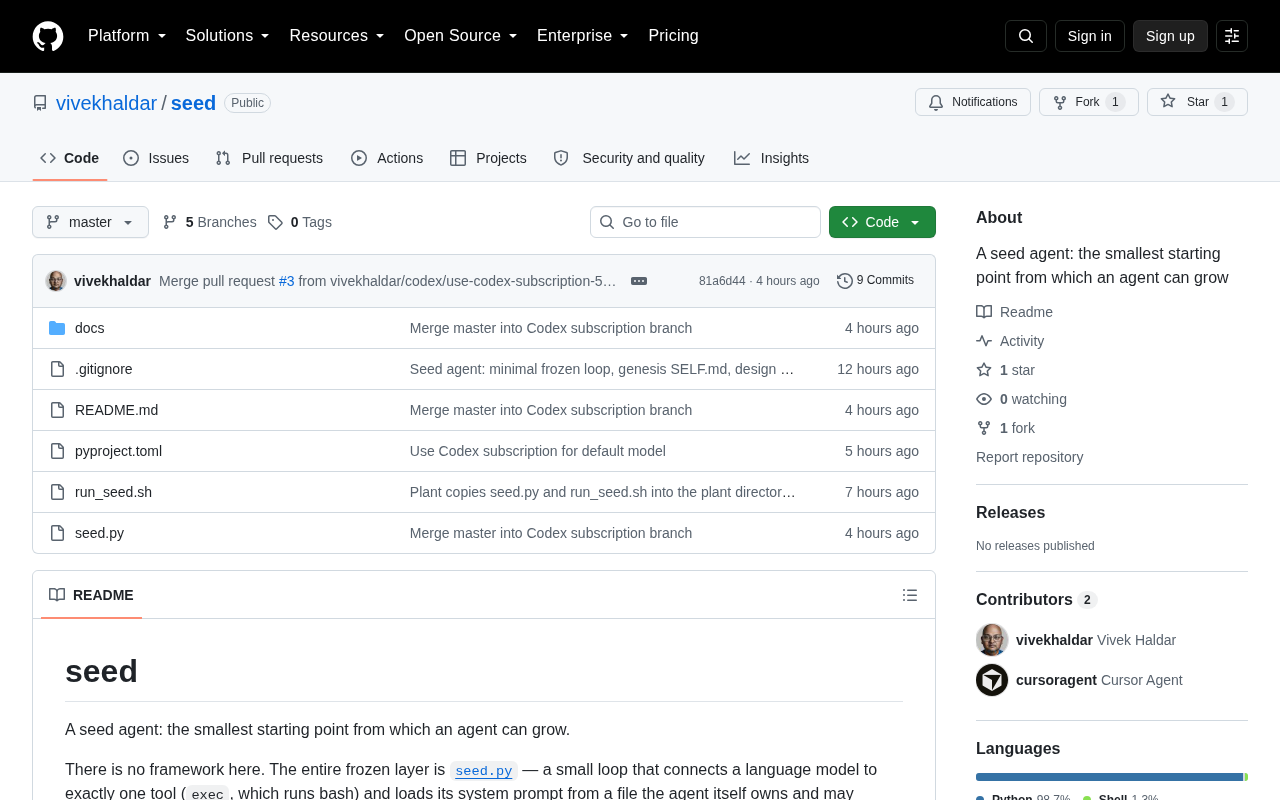
Seed is a minimal, self-modifying AI agent framework that lets agents rewrite their own runtime logic.
Seed is an open-source AI agent framework built around two core ideas: keeping the harness as thin as possible, and allowing the agent to modify its own runtime logic and prompts. While still a proof-of-concept, it represents a meaningful direction in agent architecture — trading safety guardrails for greater model autonomy. The project raises important questions about controllability, auditability, and how much self-modification is safe in practice.
What Is Seed: A Minimal, Self-Modifying Agent Framework
A recent open-source project called Seed has been drawing attention on Hacker News. Positioned as a "minimal, self-modifying agent harness," it hasn't gone viral yet — but the technical philosophy it represents sits at the cutting edge of AI Agent development, and at the center of one of its most contested debates: letting agents modify their own runtime logic and code.
An AI Agent is an autonomous software system that perceives its environment, makes decisions, and takes actions to accomplish specific goals. Unlike traditional "question-and-answer" interactions with large language models, agent architectures give models tool-calling capabilities, multi-step planning, and persistent memory — enabling them to independently complete complex, end-to-end tasks. Between 2023 and 2025, as models like GPT-4, Claude 3/4, and Gemini rapidly advanced, AI Agents moved quickly from lab concepts to engineering practice, giving rise to a wave of frameworks: LangChain, AutoGen, CrewAI, OpenDevin, and many more. Against this backdrop, "how thick should the framework be?" became a persistent debate in the community.
In traditional AI Agent architectures, the agent's behavioral logic — prompt templates, tool-calling flows, decision loops — is written by developers in advance and locked in place. The agent can only operate within that predefined framework. Seed tries to break that boundary: it makes the agent itself a modifiable object, and even allows the agent to rewrite the "harness" code that drives it.
It's worth noting that Hacker News, operated by Y Combinator, has long been one of the most important early-exposure channels for open-source projects. "Show HN" posts are typically concept proofs or early prototypes from individual developers — upvote counts and comment volume early on are poor indicators of long-term value. Many projects that later became highly influential (early Docker, Tailwind CSS) had similarly quiet starts. Evaluating Seed, then, should focus on the technical direction it represents rather than its current community metrics.
Understanding the Harness: Why Thinner AI Agent Frameworks Are Better
What Is an Agent Harness
In AI engineering, a "harness" refers to the outer scaffold code that hosts and drives a large language model. It manages the interaction loop with the model, maintains context, parses model outputs, calls external tools, and feeds results back to the model. Think of it as the agent's runtime environment.
A consensus has been forming in the industry: harnesses should be as thin as possible. Overly thick framework layers cause two problems — they constrain what the model itself can do by hard-coding too many decisions into the framework, and as model capabilities evolve rapidly, bloated frameworks quickly become technical debt. Seed's choice to make "Minimal" a core design principle is a direct expression of this thinking.
The Technical Trade-offs of Minimalism
The value of a minimal harness lies in returning more autonomy to the model itself. When the underlying model is capable enough, it makes more sense to provide a lightweight execution environment and let the model decide how to act, rather than constraining it with layers of code. This reduces maintenance overhead and lets the framework adapt faster to the next generation of models.
But minimalism also means fewer safety guardrails and higher uncertainty — which is precisely what projects like Seed need to validate repeatedly in practice.
Self-Modification: The Next Step in AI Agent Evolution
The Core Value of Self-Modification
Seed's most striking feature is "self-modifying." This means the agent doesn't just execute tasks — it can adjust its own behavioral logic mid-run: rewriting its own prompts, adding or removing available tools, or even modifying control-flow code.
This idea is philosophically aligned with the long-term vision of "recursive self-improvement," a concept first articulated by I.J. Good in 1965 with his "intelligence explosion" hypothesis: a sufficiently intelligent machine could design a machine smarter than itself, and so on in a loop. In contemporary engineering terms, this vision takes a more concrete form — letting a model modify its own prompts, toolset, or control code at runtime, improving task performance without retraining its weights. OpenAI's o-series models, Anthropic's Claude, and DeepMind's research have all explored model self-reflection and self-correction to varying degrees. In theory, an agent that can modify itself can continuously optimize its strategy through interaction with its environment, achieving a form of ongoing learning without retraining the underlying model.
Potential Use Cases for Self-Modifying Agents
Self-modifying agents open up interesting possibilities in several areas:
- Adaptive task handling: When faced with new types of tasks, the agent can dynamically generate or adjust its processing workflow rather than relying on developer-predefined branching logic.
- Tool bootstrapping: The agent can write new tool functions for itself as needed, expanding its own capability boundary.
- Prompt self-optimization: By analyzing task successes and failures, the agent can iteratively improve its system prompt, gradually converging on better performance. Prompt Engineering has evolved since 2022 from an "art" toward a "science," producing systematic methods like Chain-of-Thought and Few-Shot prompting. Automatic Prompt Optimization (APO) is an active research area, and Seed's runtime prompt self-optimization is a concrete implementation of that direction at the agent layer.
The Risks and Challenges Behind the Promise
Controllability and Safety
Self-modification is a double-edged sword. When an agent can rewrite its own runtime logic, its behavior becomes significantly less predictable. A single bad self-modification can cause the agent to drift from its intended goal, or fall into an unrecoverable failure state.
In AI Safety engineering, controllability is an especially acute challenge for self-modifying agents: traditional software systems have deterministic state, but a self-modifying agent's behavior space expands dynamically with each modification, making behavior prediction and auditing extremely difficult. The mainstream engineering responses include sandbox isolation (confining the agent's modifications to a controlled environment), version snapshots (saving the full state before each modification to enable rollback), modification audit logs (recording the content and trigger of every self-modification), and human oversight checkpoints (introducing manual confirmation steps before critical modifications). Anthropic's Constitutional AI and OpenAI's Superalignment initiative are both exploring analogous problems at a broader level. Defining the boundaries of self-modification, preserving rollback mechanisms, and auditing every self-change are therefore fundamental engineering challenges this class of framework must confront.
The Distance from Proof-of-Concept to Production
Seed is still at a very early stage (just 4 points and 0 comments on Hacker News), and is more of a proof-of-concept exploration than a production tool. Translating this kind of frontier idea into something stable and deployable is a long road. Its current value lies mainly in providing the community with a minimal vehicle for research and experimentation — the smallest possible codebase to test whether a self-modifying agent is even viable.
Conclusion: Minimal Frameworks and the Future of Agent Autonomy
Seed is still niche, but it touches two key questions in AI Agent development: how thin should the framework be, and how much autonomy should an agent have. As underlying model capabilities continue to improve, the combination of thin frameworks and high autonomy may well become a defining direction for future agent architectures.
For developers and researchers, the significance of minimal projects like Seed isn't what they can do today — it's that they provide a clean starting point from which to observe the behavior, boundaries, and failure modes of self-modifying agents. It's an experimental specimen worth watching, and a window into understanding what next-generation AI Agent architectures might look like.
Key Takeaways
Related articles
AWS Agent Code Payments Explained: A Complete Guide to AI Agent Autonomous Payment Infrastructure
Deep dive into AWS Agent Code Payments: how AI agents achieve autonomous payments via X402 protocol, wallet security, session budgets, WAF AI traffic monetization, and Coinbase/Stripe integration.
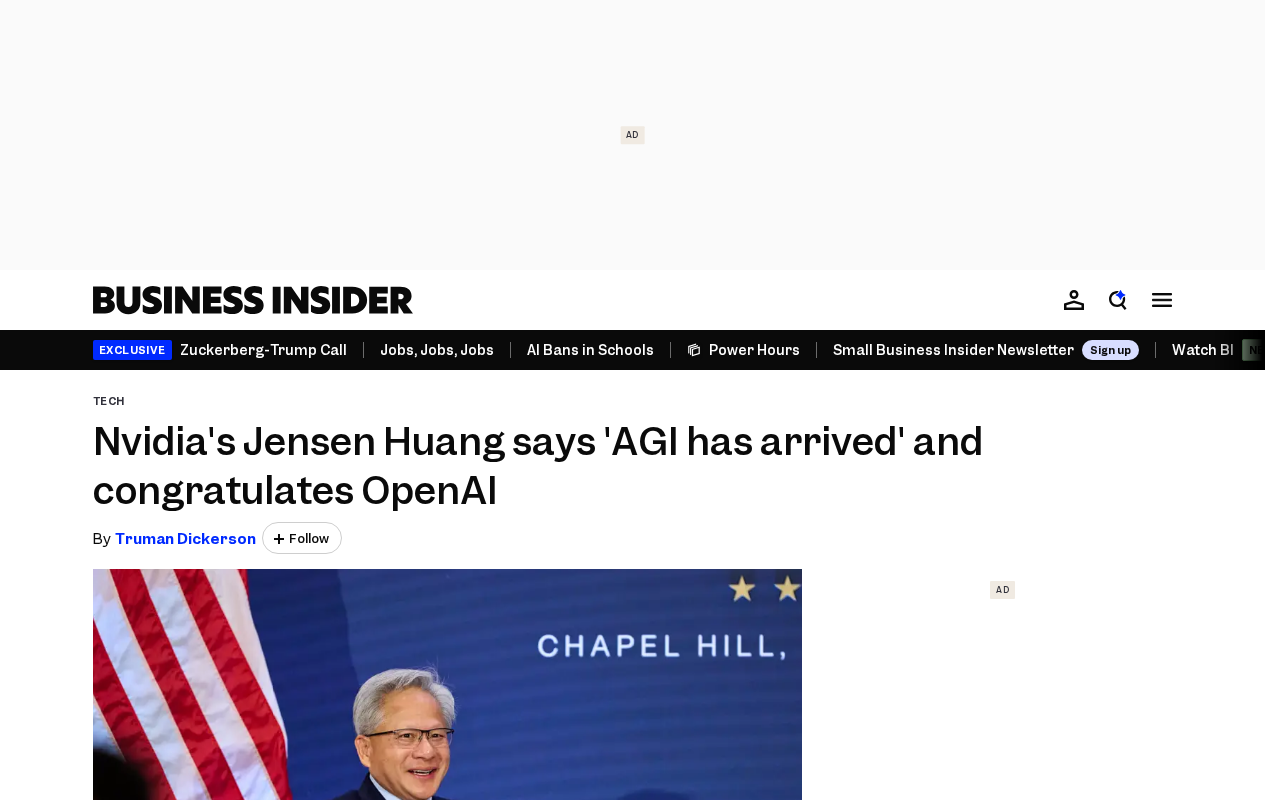
Jensen Huang Declares AGI Has Arrived and Congratulates OpenAI, Sparking Industry Debate
Nvidia CEO Jensen Huang declares AGI has arrived and congratulates OpenAI. Deep analysis of his reasoning, OpenAI's contributions, community pushback, and industry implications.
How Short-Form Video Creators Are Using AI Video Generation Tools
Exploring the real-world application of AI video generation tools in short-form video creation. From Seedance to Runway, how do creators integrate AI assets? Revealing the gap between demos and production use.