Insight7 Voice AI Agents: Let AI Make Calls to Your Customers for You

Insight7 launches Voice AI Agents, generating AI outbound call scripts and schedules from one sentence to cover long-tail customer success communications.
Insight7's Voice AI Agents is a gap-filling tool for customer success and sales teams, covering long-neglected long-tail communications like renewal reminders, silent user re-engagement, and SMB follow-ups. Describe the call purpose in one sentence and the system generates scripts, question lists, and schedules, with test calls before formal outreach. Calls run once, on schedule, or triggered by external CRMs, with results summarized into reports flagging customers needing human follow-up. The product received 74 votes and ranked 20th, still in early stage; compliance and real-time human transfer are not described and need independent assessment.
When the Customer Success Team Is Overwhelmed, AI Can Help Make the Calls
In customer success and sales scenarios, there are always customers the team "never gets around to"—renewal reminders, silent users who signed up but never activated, small and mid-sized accounts that need periodic follow-ups. Insight7's Voice AI Agents, launched on Product Hunt, aims to solve this problem: describe the purpose of the call in one sentence, and AI generates the call script, question list, and calling schedule—and lets you call yourself first as a test before formally reaching out to customers.
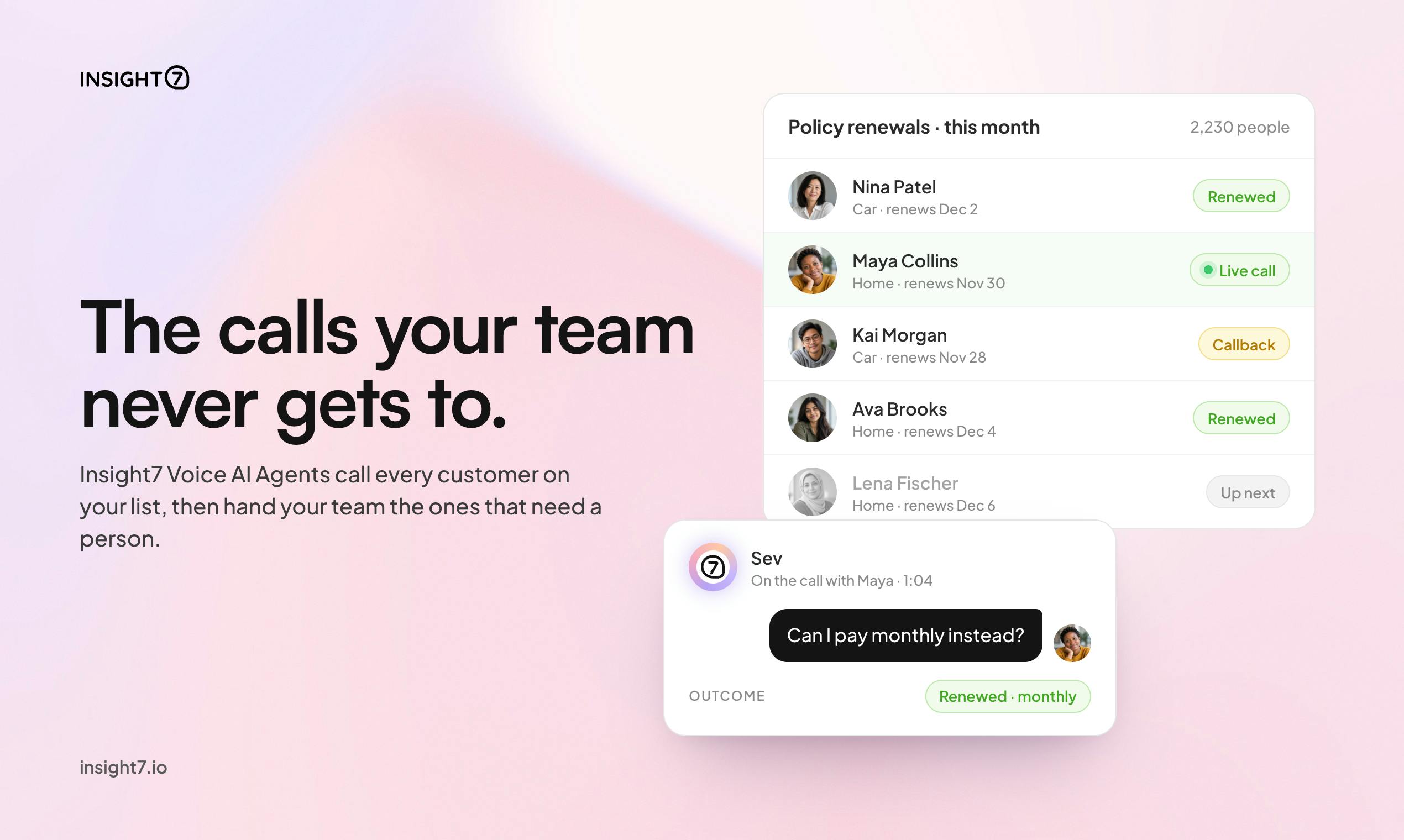
The product positioning is clear: it doesn't replace sales or customer service, but covers the long-tail communications that are hard to reach with human resources. According to the official description, the results, patterns, and customers requiring human intervention from every call are consolidated into a report.
Core Features: From "One Sentence" to "One Phone Call"
Automatic Script and Schedule Generation
Users only need to describe the purpose of the call in one sentence, and the system drafts the script, question list, and calling schedule. This lowers the configuration barrier—no need to write complex conversation flows or prepare a Q&A library in advance.
Test First, Then Call Out
Before formally calling customers, you can call yourself first as a test to confirm whether the tone, questions, and flow meet expectations. This design is a necessary safety valve for teams worried about AI saying the wrong thing.
The Voice AI Tech Stack: An AI outbound call typically goes through speech recognition (ASR) to convert the customer's speech into text, an LLM to understand intent and generate replies, and speech synthesis (TTS) to convert replies back into natural speech—all chained together with low latency to achieve a conversation rhythm close to that of a real person. The call script and question list are essentially prompt constraints on the LLM, rather than the button-based fixed menus of traditional IVR, so the AI can handle free-form answers that deviate from the preset questions. But this also brings uncertainty: the model may misunderstand accents, make recognition errors in noisy environments, or give inappropriate responses to sensitive questions. The test call step is precisely what allows the team to verify recognition accuracy and script boundaries under controlled conditions—a necessary quality gate before going live.
Three Trigger Methods
According to the product page, calls can be run once, on a scheduled recurring basis, or triggered by external systems—for example, automatically initiated when a renewal is due or a registration process stalls. This means it can be embedded into existing CRM or customer success workflows.
CRM and Workflow Trigger Mechanisms: The original text mentions that calls can be triggered by external systems, which typically relies on Webhook or API integrations. In customer success scenarios, the CRM (customer relationship management system, such as Salesforce or HubSpot) records customers' renewal dates, registration status, and interaction history. When a field meets preset conditions (such as "30 days before renewal is due" or "7 days after registration with no login"), the system sends a request to the AI outbound calling platform via event notification or scheduled task, and the latter then executes the call according to the script. This "event-driven" architecture eliminates the need to manually initiate calls one by one, but it also requires proper field mapping and deduplication logic between the two systems to avoid calling the same customer repeatedly. For legacy CRMs without open APIs, teams may need to use automation middleware like Zapier to build the trigger chain.
Result Summary: What Happens After the Conversation
Insight7 emphasizes that all conversations ultimately come back to a single report, including call results, patterns that emerged, and which customers need human follow-up. This points to a key pain point: if the data generated by AI outbound calls is scattered across individual call records, it actually increases the team's burden. Structuring the results and flagging high-priority customers is the dividing line for whether such tools can truly save time.
Looking at the Product Hunt data, the product received 74 votes and 6 comments, ranking 20th on the day's leaderboard. This level of interest shows the market has interest in AI outbound calling tools, but the number of comments also indicates it's still in an early stage, and actual effectiveness needs more user validation.
Use Cases and Potential Concerns
The most direct use cases include: renewal due reminders, re-engagement of users who registered but haven't been active, and periodic follow-ups by customer success teams. For sales teams, it can be used for preliminary lead qualification and meeting scheduling.
It's worth noting that AI outbound calling involves compliance and customer experience issues. The product page doesn't elaborate on how it handles rejections, complaints, or regional telemarketing regulations. Teams need to assess the compliance requirements of their target markets before deployment and set up human takeover mechanisms—Insight7's reporting feature at least provides clues about "which customers need a real person," but real-time transfer capability is not mentioned in the available information.
The Compliance Framework for AI Outbound Calling: Phone outreach is strictly regulated across different jurisdictions. In the United States, for example, the Telephone Consumer Protection Act (TCPA) requires prior express consent for autodialed or prerecorded voice calls, with violators facing hefty fines; the EU's GDPR and ePrivacy Directive classify marketing calls as personal data processing, typically requiring separate consent and the ability to withdraw at any time. China's Personal Information Protection Law similarly requires that personal information processing have a clear purpose and necessary scope, and marketing calls must also comply with communications authorities' regulations on harassing calls. Therefore, before deploying AI outbound calling, teams should confirm whether target customers have given consent records permitting calls, whether they are on "do not call" lists, and whether it's necessary to state at the beginning of the call that this is AI rather than a real person. These obligations typically cannot be fulfilled automatically by the outbound calling tool—the business side needs to prepare them in advance at the data level.
Summary
Insight7 Voice AI Agents lowers the configuration barrier for AI outbound calling to the "one sentence" level, and uses two steps—test calls and result reports—to compensate for the uncertainty introduced by automation. For customer success teams, it's more of a gap-filling tool: first cover the customers that have long been neglected, then use the reports to decide which conversations are worth handing over to a human. The product is currently in an early stage, and actual call quality and compliance support will be the key variables determining its value.
One-line Summary
Insight7 launches Voice AI Agents, generating AI outbound call scripts and schedules from one sentence, covering long-tail customer success communications.
Paragraph Summary
Insight7's Voice AI Agents, launched on Product Hunt, is positioned as a gap-filling tool for customer success and sales teams, covering long-tail communications that have long been neglected—renewal reminders, re-engagement of silent users, follow-ups with small and mid-sized accounts. Users only need to describe the call purpose in one sentence, and the system generates the call script, question list, and calling schedule, and supports calling yourself first as a test before formally calling out. Calls can run once, on a schedule, or be triggered by external systems like CRMs, with results summarized into a report that flags customers needing human follow-up. The product received 74 votes, 6 comments, and ranked 20th, and is in an early stage; compliance handling and real-time human transfer capabilities are not described on the page and need to be assessed independently before deployment.
Related articles

Unkernel: Compiling the Linux Kernel to WebAssembly
The Unkernel project compiles a real Linux kernel to WebAssembly, making it possible to run a complete kernel in the browser. This article covers its technical principles, challenges, and prospects.
New Claude Sonnet Model Tested: Performance Approaches Opus with Less Thinking
Anthropic quietly tests a new Sonnet model in Claude Code—performance approaches Opus 5.5 with far fewer thinking tokens, plus Codex transfer optimization, xAI's low-level rewrite, Google Antigravity updates, and the AI science understanding gap.

Building a Reasoning Model from Scratch: Making Complex AI Algorithms Accessible
Mike Finley, author of Build a Reasoning Model from Scratch, shows how a few hundred lines of code, single-sample training, and code reuse make complex AI algorithms like RL and verifiers accessible to all.