Instacart Launches AI Shopping Assistant Clementine: Reimagining the Online Grocery Shopping Experience
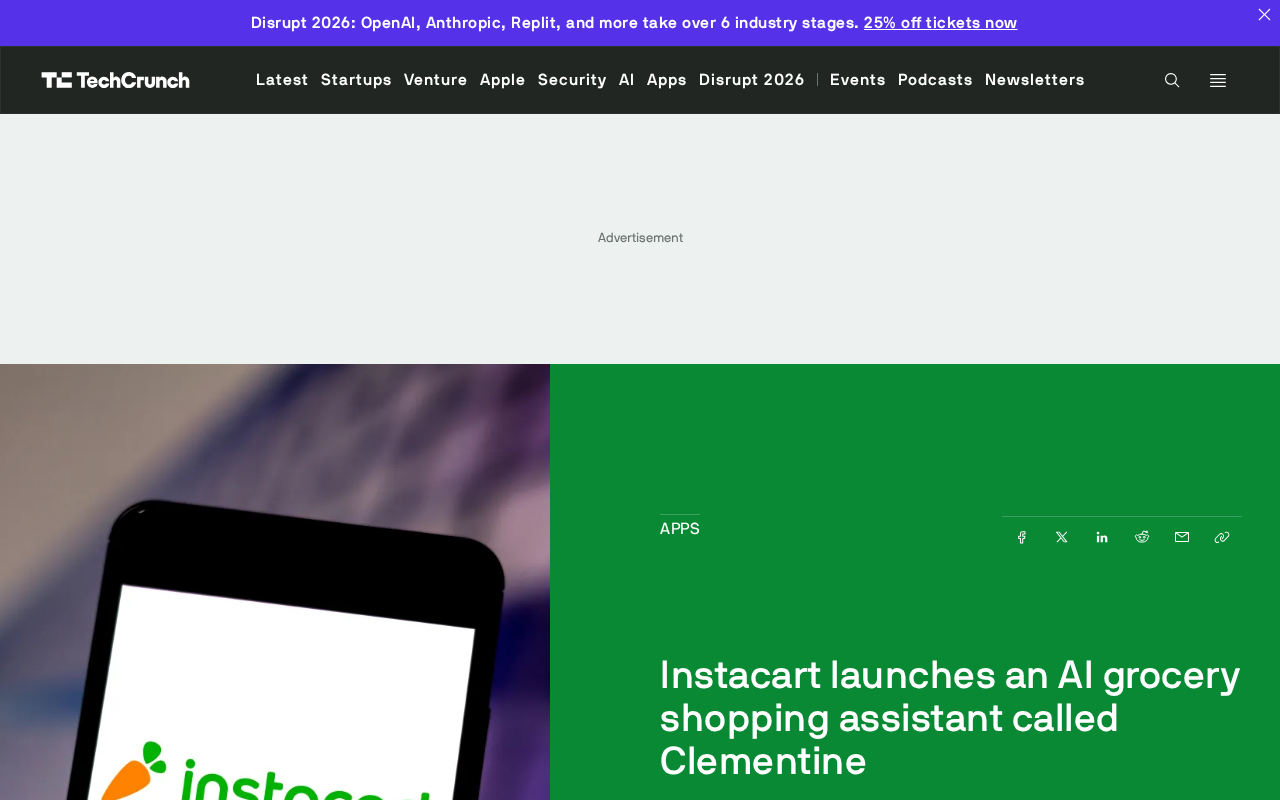
Instacart launches Clementine, an AI shopping assistant reimagining the online grocery experience.
Instacart has launched Clementine, a conversational AI shopping assistant that uses large language models to transform online grocery shopping. The tool offers intelligent product recommendations, natural language interactions, and nutrition-based suggestions. As competition intensifies among Amazon Fresh, Walmart, and delivery platforms, Clementine represents Instacart's strategic push to differentiate through AI, though challenges around accuracy, privacy, and cost remain.
Instacart Launches AI Shopping Assistant Clementine: Reimagining the Online Grocery Shopping Experience
AI-Powered Innovation in Online Grocery Shopping
Instacart recently announced the launch of Clementine, a new conversational AI shopping assistant, officially joining the ranks of tech companies deeply integrating generative AI technology into their core products. This move signals that the online grocery delivery space is embracing large language model technology to reshape users' shopping decision-making through intelligent conversation.
Generative AI refers to artificial intelligence systems capable of creating entirely new content based on training data, distinguishing them from traditional AI that can only classify or predict. Large language models (LLMs), led by OpenAI's GPT series, Google's Gemini, and Anthropic's Claude, form the core technological foundation of today's generative AI. These models acquire language understanding and generation capabilities through pre-training on massive text datasets, then adapt to specific business scenarios through techniques like fine-tuning and Retrieval-Augmented Generation (RAG). Conversational AI assistants are a quintessential application of LLM technology — they wrap complex system functionality behind a natural language interface, allowing users to access services without learning specific operational workflows.
Founded in 2012 and headquartered in San Francisco, Instacart is one of North America's largest online grocery delivery platforms. Its business model operates as a three-sided marketplace connecting consumers, retailers, and delivery workers (Shoppers), partnering with over 1,500 retailers including Costco, Kroger, and Aldi, covering more than 85,000 stores. Instacart went public on the Nasdaq in September 2023. The company had already made AI investments, including machine learning-based product search ranking and intelligent substitute recommendations. The launch of Clementine marks a strategic shift from backend optimization to front-end user interaction.
Clementine's launch reflects a broader trend among application platforms adopting AI assistants as a key strategic direction for enhancing user experience and improving service efficiency. From e-commerce to social media, conversational AI is becoming a new interaction layer connecting user needs with platform services.
A Deep Dive into Clementine's Core Features
As an AI assistant designed specifically for the grocery shopping scenario, Clementine offers the following core capabilities:
Intelligent Product Recommendations
Based on users' shopping history, dietary preferences, and seasonal needs, the AI assistant can proactively recommend suitable products, helping users discover new items or alternative options. When faced with tens of thousands of products, this feature significantly reduces decision fatigue. The core of an intelligent recommendation system lies in multi-dimensional matching between user profiles and product attributes. Traditional collaborative filtering and content-based recommendation algorithms are already widely used on e-commerce platforms, but the addition of LLMs enables recommendation systems to understand more complex semantic needs — for example, when a user says "find a snack that's good for protein recovery after a workout," the system needs to not only retrieve high-protein products but also understand the contextual constraint of "snack."
Natural Language Shopping Interaction
Users can express their needs through everyday conversation, such as "I need ingredients for an Italian dinner," and the AI assistant can understand the intent and generate a complete shopping list, dramatically reducing the cognitive load of shopping.
Natural language shopping interaction involves the coordinated work of several key technologies behind the scenes. First is Intent Recognition, where the system must accurately extract shopping intentions and constraints from the user's natural expressions. Next is Named Entity Recognition, mapping conversational content to specific product categories, brands, and specifications. Finally, the system needs to interface with real-time inventory systems to ensure recommended products are actually available at stores in the user's area. This workflow typically employs a Retrieval-Augmented Generation (RAG) architecture, where the LLM retrieves from the product database in real time while generating responses, rather than relying solely on static knowledge from model training, thereby ensuring information timeliness and accuracy.
Nutrition and Dietary Advice
Leveraging nutritional information in the product database, Clementine can provide shopping recommendations based on health goals, helping users find a balance between convenience and healthy eating. Implementing this feature relies on structured nutritional data labeling — including calories per serving, macronutrients (protein, carbohydrates, fat), micronutrients, and allergen information. The AI assistant can translate user-defined health goals (such as low-sodium diets, calorie control, or gluten-free requirements) into specific product filtering criteria, automatically excluding non-qualifying options during the recommendation process.
The AI Race in Online Grocery
Instacart's move is also a response to competitive market pressures. Competitors like Amazon Fresh and Walmart are exploring AI applications in retail scenarios, from smart restocking reminders to personalized discount notifications. Technological innovation is becoming a critical battleground for winning user loyalty.
The online grocery delivery market experienced explosive growth during the pandemic and has since entered a phase of refined competition. Amazon's Amazon Fresh and Whole Foods delivery services leverage the Prime membership ecosystem and proprietary logistics network; Walmart utilizes its nationwide network of over 4,700 stores to promote a Buy Online, Pick Up In Store (BOPIS) model; DoorDash and Uber Eats are expanding horizontally from food delivery into grocery delivery. According to eMarketer data, U.S. online grocery sales are expected to surpass $150 billion in 2025, yet penetration remains at only about 14%, indicating substantial room for growth. Against this backdrop, AI technology has become the new frontier for platform differentiation.
The value of conversational AI assistants extends beyond improving the efficiency of individual shopping trips — it lies in building user habits through ongoing interaction, enhancing long-term platform retention. When users become accustomed to "consulting" an AI assistant for shopping decisions, switching costs rise significantly.
Challenges and Future Outlook
Despite the promising outlook, Clementine still faces real-world challenges:
Accuracy Requirements: Grocery shopping involves specific brands, specifications, and inventory information. AI-generated suggestions must precisely match user needs, as incorrect recommendations could lead to user churn. This challenge is known in the AI field as the "hallucination" problem — LLMs may generate plausible-sounding but nonexistent product information, or recommend products that have been discontinued. The key to solving this problem lies in rigorous fact-checking of model outputs against real-time databases, ensuring every recommendation is backed by actual inventory.
Privacy Concerns: Gaining deep insight into users' dietary habits and household composition means collecting sensitive data. Balancing personalization with privacy protection is a critical issue. Dietary data can reveal highly sensitive personal information such as health conditions, religious beliefs, and family composition. As data privacy regulations across U.S. states become increasingly stringent (e.g., California's CCPA, Virginia's VCDPA), platforms must carefully balance the breadth of data collection with regulatory compliance.
Cost-Effectiveness: LLM API call costs are not trivial, requiring a sustainable business model that balances improved user experience with increased operational costs. Taking GPT-4-class models as an example, the API cost per complex conversation can range from a few cents to tens of cents. If each user conducts multiple conversation rounds per shopping session, cumulative costs become considerable. Mitigation strategies include: using smaller specialized models (such as distilled domain-specific models) instead of general-purpose large models to reduce per-inference costs; employing caching mechanisms to reuse generated responses for similar queries; and offsetting AI service costs through higher average order values and improved user retention. Instacart's average order value is approximately $110, and its commission and advertising revenue model provides some room to absorb AI investment costs.
From a broader perspective, Clementine represents the evolution of AI from "tool" to "assistant." The future shopping experience may no longer involve users browsing digital shelves to make selections, but rather collaborating with an AI partner that understands their needs. This paradigm shift will redefine the core competitive advantage of e-commerce platforms — moving from product variety and price advantages to the depth of user need understanding and the intelligence of service delivery. Notably, this trend aligns with the broader "Agentic AI" wave across the tech industry — AI no longer merely answers questions but can execute complete task workflows on behalf of users, from understanding needs to filtering products, comparing prices, placing orders, and making payments, progressively achieving end-to-end autonomous shopping decisions.
Key Takeaways
Related articles
Geiger: A Deep Dive into AI Agent Behavior Monitoring
Deep dive into Geiger, an AI agent monitoring tool. Explore runtime observability, prompt injection risks, and security strategies for local AI agents.

ROS2 Beginner's Guide: Understanding the Core Framework for Robot Development from Scratch
A comprehensive introduction to ROS2 core concepts, version selection, and learning paths. Covers ROS1 vs ROS2 differences, Humble vs Jazzy comparison, and version compatibility tips for beginners.

Open-Source AI Agents for Computer Control: A Comprehensive Guide to Multi-Model Integration
Explore how open-source AI Agent frameworks enable computer control with multi-model support. Compare AutoGPT, LangChain, and Open Interpreter with DeepSeek V3 integration.