Instagram's New Rule: AI Accounts That Don't Disclose Their Identity Will Be Throttled
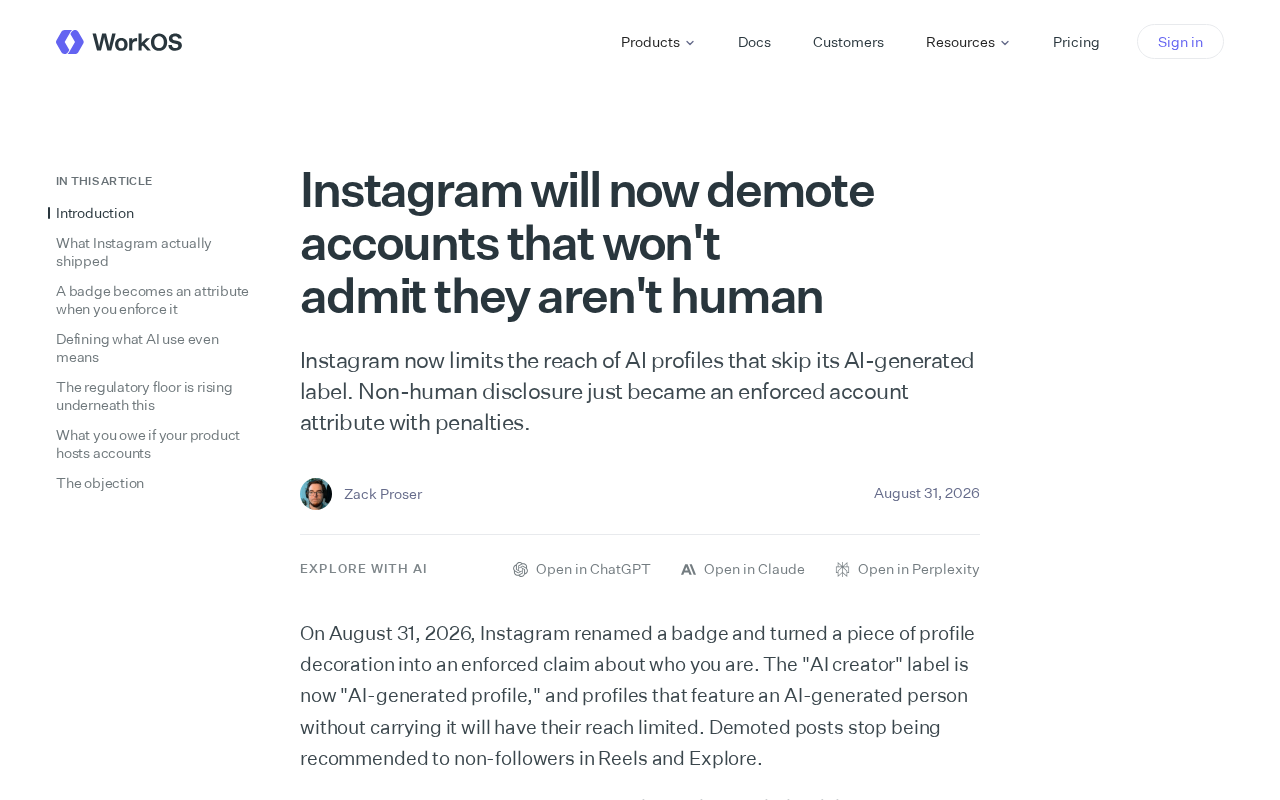
Instagram will throttle AI accounts that refuse to disclose their non-human identity.
Instagram now requires AI accounts to disclose their non-human identity or face systematic content throttling. This shift from voluntary labeling to enforced transparency uses traffic distribution as a compliance lever. The article examines the technical limits of AI detection, the gray areas in defining AI accounts, and the global regulatory trends driving this change across the social media industry.
Instagram's New Rule: Throttling for AI Accounts That Don't Disclose Their Identity
Instagram has recently introduced a major governance measure targeting AI-generated content: AI accounts that skip the platform's AI-generated labels and refuse to disclose their non-human identity will have their content reach systematically restricted. This means "non-human identity disclosure" has officially been upgraded from an optional, voluntary action to a mandatory account attribute enforced through penalties.
This change may appear to be a minor tweak to content labeling rules, but it reflects the deeper governance challenges social platforms face in the era of generative AI. As AI-generated images, videos, and virtual personas become increasingly indistinguishable from authentic content, platforms must find a balance between "technology that can't perfectly detect everything" and "the user's right to know must be protected."
From "Voluntary Labeling" to "Mandatory Disclosure": The Evolution of Instagram's AI Labeling Rules
In the past, social platforms mostly handled AI content at the encouragement level — providing labeling tools and hoping creators would proactively tag their content. But this self-compliance model had an obvious flaw: the accounts most likely to deceive and mislead were precisely the ones least willing to label themselves.
The core of Instagram's new approach lies in the introduction of a penalty mechanism. The platform no longer merely offers a labeling option — it directly ties "whether AI identity is disclosed" to an account's distribution weight. AI accounts that refuse to disclose will receive lower exposure. In effect, the platform is using its most powerful lever — traffic distribution — to compel compliance.
This strategy of "throttling" rather than "banning" is particularly telling. It avoids the free speech controversies that could arise from outright content deletion, while making non-compliant behavior economically and influence-wise "not worth it" by reducing distribution efficiency. For content accounts that depend on algorithmic recommendations for survival, being throttled is tantamount to receiving a "suspended sentence." Notably, this approach shares much in common with the long-standing "Shadow Ban" mechanism employed by social platforms. Shadow banning is a covert content moderation technique where the content creator can still see their own posts normally, but the content doesn't appear in other users' recommendation feeds, search results, or topic pages. This practice originated in the forum era for dealing with spammers and was later widely adopted by Twitter (now X), TikTok, Instagram, and other platforms. Its advantage is reduced confrontation — penalized users often don't immediately realize they've been restricted, so they don't quickly create new accounts to circumvent the ban. However, this opacity has long been controversial, with critics arguing it lacks due process and deprives users of their right to know and their opportunity to appeal.
Why Is Instagram Cracking Down on AI Accounts?
The explosive growth of generative AI has dramatically lowered the barrier for misinformation, deepfakes, and automated content farms. Generative AI refers to artificial intelligence systems capable of automatically creating text, images, audio, video, and other content based on input prompts. Image generation models like Stable Diffusion, Midjourney, and DALL-E, along with large language models like the GPT series, have driven the cost of producing high-quality content down to nearly zero. One consequence of this democratization of technology is the emergence of large-scale automated content farms — operators use AI to mass-produce seemingly original images and copy, running dozens or even hundreds of accounts at minimal cost, harvesting traffic and ad revenue through platform recommendation algorithms. A single person can rapidly generate vast quantities of convincing images and virtual personas for traffic generation, fraud, or even public opinion manipulation.
At the same time, the threat of deepfake technology is growing increasingly severe. Deepfake technology, based on Generative Adversarial Networks (GANs) and Diffusion Models in deep learning, can produce extremely realistic face-swapped videos and synthetic images. Early deepfakes were primarily used for entertainment and academic research but were quickly weaponized for revenge porn, political manipulation, and financial fraud. As a social platform centered on images and short videos, Instagram is naturally a high-risk environment for deepfake content distribution. Virtual influencers and AI-generated "perfect personas" have already formed a gray market on the platform, with some accounts even competing with real influencers for brand partnership opportunities.
For a visually-driven platform like Instagram, the proliferation of AI-generated images directly threatens the credibility of the content ecosystem. If users cannot tell whether the photo in front of them was actually taken or AI-synthesized, the platform's foundation of trust erodes. And trust is precisely a social platform's most valuable asset.
Therefore, mandatory AI identity disclosure is essentially a governance logic of "information transparency": the platform doesn't prohibit AI content from existing but requires it to be "clearly labeled," allowing users to make their own judgments with full knowledge. This aligns closely with the growing global regulatory push for AI content transparency. In fact, AI content regulation worldwide is tightening rapidly. The EU's AI Act officially took effect in 2024, explicitly requiring AI-generated content (including deepfakes) to be clearly labeled as artificially synthesized, with violators facing heavy fines. While the United States has yet to enact unified federal AI legislation, multiple states have passed or are advancing bills requiring transparent labeling of AI content, and the FTC (Federal Trade Commission) has issued multiple enforcement warnings about deceptive AI content. China's "Interim Measures for the Management of Generative Artificial Intelligence Services," implemented in 2023, similarly requires prominent labeling of AI-generated content. These regulatory developments indicate that "mandatory labeling" of AI content is transitioning from industry self-regulation to legal obligation, and platforms, as the core nodes of content distribution, are shouldering increasing compliance responsibilities. Instagram's new throttling rule is a proactive response to this global regulatory trend.
Challenges and Controversies in Enforcing AI Account Throttling Rules
Despite the clear intent behind the rules, implementation on the ground still faces significant challenges.
The Technical Limits of AI Content Detection
The biggest question is: how can the platform accurately identify which accounts are AI and which content is AI-generated? Current AI detection technology is far from perfect, with both false negatives (genuine AI content evading detection) and false positives (real human creators being incorrectly flagged). If real users are caught in the crossfire, it will trigger strong backlash.
From a technical standpoint, there are currently three main approaches to AI content detection. The first is digital watermarking technology, such as Google's SynthID, which embeds markers invisible to the human eye in AI-generated content. However, this method relies on the active cooperation of generation tools and cannot cover all open-source models — when users generate images using locally deployed open-source models (such as community versions of Stable Diffusion), the watermarking mechanism is completely ineffective. The second is the C2PA (Coalition for Content Provenance and Authenticity) content provenance standard, an industry alliance standard driven by companies like Adobe and Microsoft that tracks origins by recording content creation and editing history in file metadata. However, this standard has yet to be widely adopted, and metadata can be easily stripped. The third approach uses deep learning-based AI content classifiers, which can identify AI-generated images with relatively high accuracy, but as generation models rapidly iterate, detectors and generators are locked in an "arms race" — each new generation of models may break through the previous generation of detectors' identification capabilities. Each of these three methods has its shortcomings, and currently no single technology can provide a reliable end-to-end AI content detection solution.
The Gray Area in Defining "AI Accounts"
The definition of "AI account" itself exists in a gray area. Does a photographer who uses AI-assisted retouching count as AI content? How should an account operated by a real person but publishing AI-generated illustrations be classified? These boundary questions require the platform to provide clearer operational standards; otherwise, inconsistent enforcement is likely.
Transparency Issues with Throttling Penalties
"Throttling" itself is an opaque form of punishment — throttled accounts often have difficulty confirming whether they've been penalized and have little recourse for appeal. While this shadow ban-style approach has low enforcement costs, it's also prone to accusations of "operating in a black box."
Impact on Creators and the Social Media Industry
For compliant AI creators, this rule actually provides clear "rules of the game": as long as you honestly label your AI identity, you can receive normal traffic distribution. This actually helps establish a healthy, transparent AI content ecosystem.
For the social media industry as a whole, Instagram's approach is very likely to become a trendsetter. When a leading platform begins using its traffic lever to enforce AI transparency, other platforms will most likely follow suit with similar measures. This marks a new phase in social platforms' governance of AI content, shifting from "reactive response" to "proactive regulation."
Conclusion
Instagram's throttling measures for undisclosed AI accounts represent an important attempt at content governance in the generative AI era. Using the most direct lever of traffic distribution, the platform has transformed transparency from a moral appeal into a hard requirement.
However, the success or failure of this rule ultimately depends on the precision of its execution — whether it can accurately identify AI content, treat creators fairly, and maintain transparency in its penalty mechanisms. In an age where the line between AI and authentic content is increasingly blurred, this battle for transparency over "who is human and who is AI" has only just begun.
Related articles
AI Gains Confined to Tech? Non-Tech Industries See Little Payoff
Apollo analysis finds AI's economic returns remain highly concentrated in tech, with no quantifiable payoff yet in non-tech sectors. We break down the key arguments, Hacker News debate, and practical implications for enterprise AI investment and measurement.

FreeDNS: A Classic Choice for Free Dynamic DNS Services
FreeDNS is a platform offering free dynamic DNS hosting, supporting a shared domain pool and HTTP updates. This article covers its core features, community reviews, use cases, and comparisons with other DNS solutions.

AI Agents on Your Phone: Where's the Line Between Convenience and Privacy?
A developer finds people accept AI agents operating laptops but feel uneasy about phones. This article analyzes the trust gap behind data density, permission models, and observability, exploring the specific task boundaries users are willing to hand to mobile AI agents.