Insuring AI Agents: How AIUC Uses Insurance Mechanisms to Mitigate Agency Risk
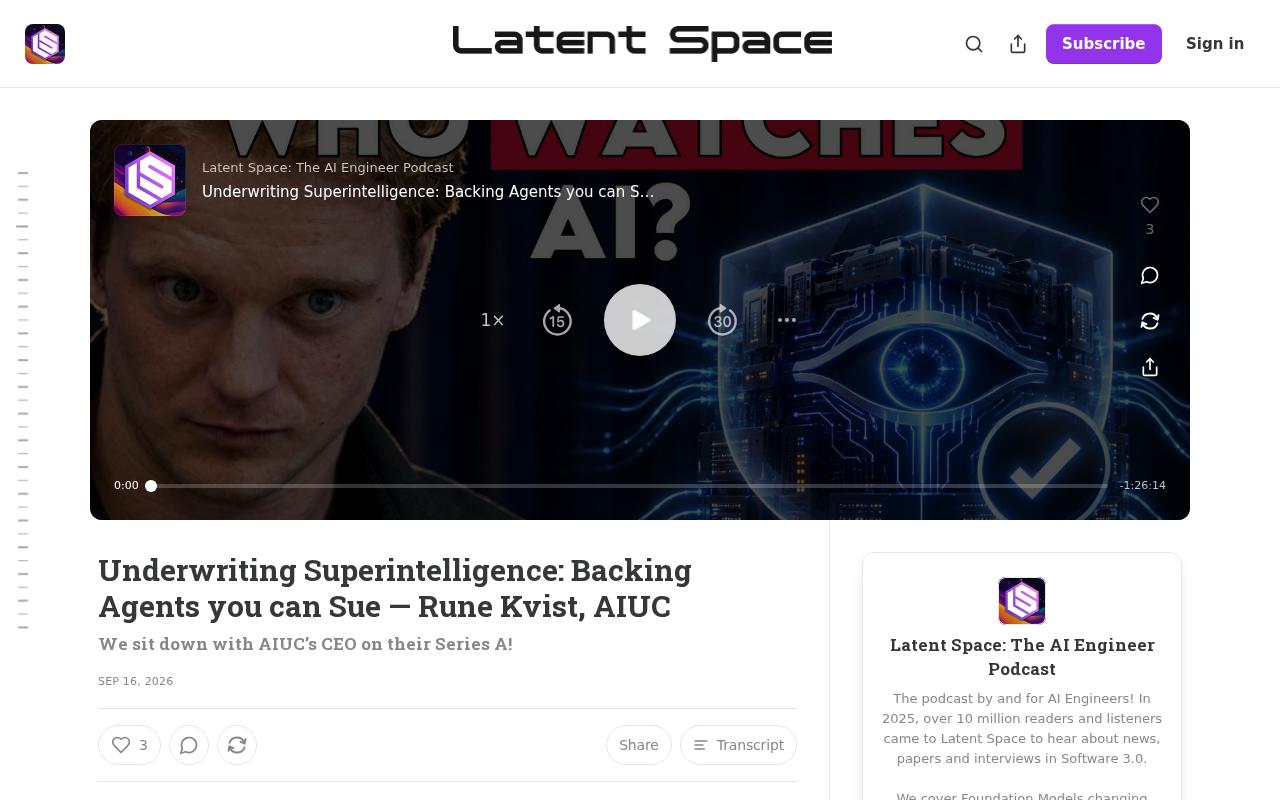
AIUC uses insurance to back AI agent accountability, turning abstract AI trust into a priceable risk management business.
As autonomous AI agents enter real business environments, liability attribution is becoming urgent. AIUC proposes "Underwriting Superintelligence" — creating accountable, legally actionable AI agents through insurance. Beyond compensation, insurers controlling payout risk will naturally pressure AI vendors to raise safety and auditability standards, forming a market-driven regulatory mechanism. AIUC's Series A signals growing investor confidence, though specific underwriting models and pricing details remain to be validated.
When AI Agents Go Wrong, Who's Responsible?
As autonomous AI agents move from the lab into real-world business environments, one unavoidable question has emerged: when an agent makes a wrong decision, causes financial losses, or triggers legal disputes, who bears the liability? In a recent interview following the company's Series A fundraise, AIUC CEO Rune Kvist — AIUC being a company focused on AI insurance and underwriting — shared his thinking on exactly this question.
The central theme of the interview was captured in the phrase "Underwriting Superintelligence" — an ambitious framing. The underlying logic: if we are going to deploy powerful AI agents at scale, we must build a mechanism that makes those agents accountable and legally actionable — in short, "Agents you can Sue."
What Does It Mean to Have "Agents You Can Sue"?
Rune Kvist's concept of "Backing Agents you can Sue" is the key to understanding AIUC's business model. When traditional software fails, users often have little recourse and the issue quietly disappears. But as AI agents begin executing high-stakes tasks on behalf of humans — financial transactions, customer service, contract processing — the absence of accountability mechanisms becomes the single biggest barrier to enterprise adoption.
AIUC's approach is to introduce insurance, one of the oldest and most mature financial tools available. By underwriting AI agent behavior, the insurer effectively vouches for the reliability of those agents. When an agent causes a loss, the enterprise can be compensated rather than bearing the full risk alone. In a sense, this transforms the vague proposition of "trusting AI" into a concrete question of quantifiable, priceable risk.
From a legal standpoint, the phrase "can be sued" touches on a fundamental unresolved issue: AI agents currently lack independent legal personhood in most jurisdictions — they cannot be plaintiffs or defendants. Existing legal frameworks typically assign liability to developers, deploying companies, or end users, but when agents act autonomously across multiple chains of delegation, that attribution often falls into a gray zone. AIUC's insurance mechanism essentially fills this institutional gap through contractual and compensation structures, even before legal personhood is clarified. Once a company purchases coverage, there is a clear backstop — regardless of where legal liability ultimately lands, the party absorbing the economic loss is unambiguous. This stands in stark contrast to early internet platforms' strategy of using terms of service to evade liability; instead, it is an institutional design that proactively makes risk visible.
How Insurance Becomes Infrastructure for AI Deployment
At its core, the insurance industry prices risk. To underwrite AI agents, AIUC must assess the probability of failure in specific scenarios, estimate the scale of potential losses, and design premiums accordingly. This process inherently drives the development of AI auditability and safety standards — because only risks that can be evaluated can be insured.
From this perspective, AI insurance may become one of the critical infrastructure layers enabling large-scale commercial AI deployment. Just as auto insurance underpins transportation and liability insurance underpins healthcare, a mature AI underwriting market may be the prerequisite for enterprises to confidently hand over core business processes to autonomous agents. AIUC's ability to close a Series A round signals that capital markets are beginning to recognize the value of this space.
A Deeper Signal Worth Watching
The proposition of "Underwriting Superintelligence" touches on a dimension of AI governance that has long been overlooked: liability allocation. Most mainstream AI safety discourse focuses on technical alignment and regulation, while AIUC represents a market-based governance path — using financial mechanisms rather than purely legal or technical means to constrain and support AI behavior.
If this model proves viable, its significance extends well beyond compensation. To control payout risk, insurers will naturally require insured parties to meet certain safety standards, creating market-driven pressure on AI vendors. In other words, insurance could evolve into an "invisible regulator" of AI safety.
It should be noted that the source material here is a fundraising interview; specifics around the underwriting model, pricing methodology, and claims cases remain unclear, and the commercial viability of this model still awaits market validation.
A note on AI Alignment vs. insurance: AI Alignment refers to the research effort of ensuring AI systems' goals and behaviors remain consistent with human intent — work concentrated primarily in academia and frontier AI labs, with core challenges around preventing models from producing unexpected behaviors in complex scenarios. By comparison, insurance provides a market-based "after-the-fact correction" complement: rather than solving the alignment problem at its root, it assumes that failures will occur and establishes a buffer for their economic consequences. The two approaches are not mutually exclusive — alignment reduces the probability of failure, while insurance manages residual risk. Historically, aviation safety standards have combined technical regulations (airworthiness certification) with commercial insurance in exactly this dual-track fashion, and AI may be entering a similar early stage of institutionalization.
In Summary
AIUC has entered the market with the thesis of "underwriting agents you can sue," seeking to bring AI risk within a mature insurance framework. This approach reframes the abstract problem of AI trust as a manageable, priceable risk question, and offers a new infrastructure model for the commercial deployment of autonomous agents. As AI agents proliferate rapidly, the question of who pays for their mistakes is shifting from a philosophical puzzle into a very real business.
Related articles
Automattic Executives Signed Reciprocal Severance Agreements During Mullenweg's Brief Ouster
Automattic's CFO and General Counsel signed reciprocal severance agreements during Matt Mullenweg's brief ouster, covering one year's salary and accelerated equity vesting, raising corporate governance concerns.
H3 Singularity Optimization: 40% Speed Boost With Better Image Quality
A Reddit user's Minimax Singularity workflow tip: insert an RTX upsampler before H3 Latent for 40%+ speed gains and better quality. Covers parameters, 12-bit output, and more.
Glyph: A Multi-Strategy Agent System for Automated Enterprise Data Catalog Annotation
Glyph is a multi-strategy LLM agent system for enterprise data catalogs that automates column description generation and sensitivity ontology tagging, grounding outputs in pipeline source code to improve accuracy.