Interactive Notes: RLHF, Attention, LoRA, and LLM Evaluation

Interactive notes help readers build intuition for RLHF, attention, LoRA, and LLM evaluation through hands-on operation.
The project uses interactive notes to cover four core LLM topics—RLHF, attention mechanisms, LoRA, and LLM evaluation—aiming to fill the gap between static textbooks and video courses. Traditional materials rely on text and formulas, while interactive interfaces let learners adjust parameters and observe changes to build intuition. The article analyzes the interactive value of each topic, notes the limitations of a single Show HN source, and suggests exploring with specific questions rather than reading linearly.
A Learning Tool That Brings LLM Concepts to Life
In the Show HN section of Hacker News, a project titled "Interactive notes on RLHF, attention, LoRA and LLM evals" has drawn attention. Using the format of interactive notes, it turns several of the most frequently mentioned—and most confusing—concepts in large language models (LLMs)—RLHF, attention mechanisms, LoRA, and LLM evaluation—into content you can operate by hand.
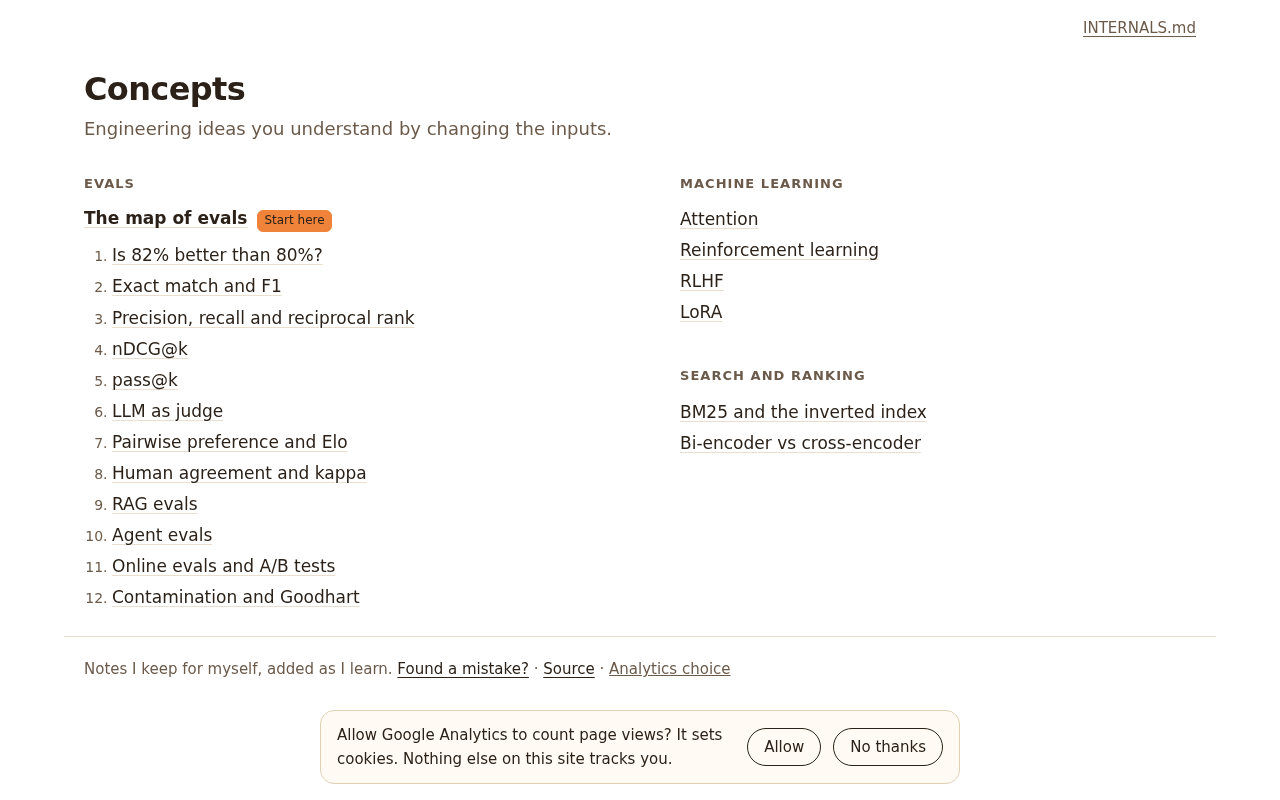
Traditional textbooks and blogs tend to explain these concepts with long passages of text and static formulas, leaving readers to complete the "formula to intuition" conversion in their own heads. This project takes the opposite approach: through an interactive interface, it lets learners build intuition by adjusting parameters and observing changes. According to the description in the Show HN post, the notes cover reinforcement learning from human feedback (RLHF), the Transformer's attention mechanism, low-rank adaptation (LoRA), and LLM evaluation.
Four Topics, Four Interactive Perspectives
RLHF: Turning "Human Preferences" into an Operable Process
RLHF is the key technique that aligns models like ChatGPT with human intent, but its three-stage pipeline (supervised fine-tuning, reward modeling, reinforcement learning optimization) often remains at the level of a flowchart. The value of interactive notes lies in letting learners trace step by step how preference data affects the reward model and, in turn, the final policy. The post does not reveal the specific form of interaction, but judging from the topic design, it attempts to break the abstract alignment process into observable steps and lower the barrier to understanding.
Common Algorithms in Reward Modeling and Policy Optimization
The third stage of RLHF typically uses Proximal Policy Optimization (PPO) to update the language model policy. PPO is a trust-region method that clips the importance sampling ratio to limit the magnitude of each policy update, avoiding the collapse problems common in reinforcement learning training. In the RLHF setting, the reward model scores each generated output, and PPO uses that score to compute the advantage function, together with a KL divergence penalty term to prevent the policy from drifting too far from the initial supervised fine-tuned model. Understanding PPO's clipping mechanism and the role of the KL penalty helps grasp why RLHF can improve helpfulness while maintaining output stability.
Preference Data and the Bradley-Terry Model
The reward modeling stage is usually based on pairwise comparison data, using the Bradley-Terry model to convert human preferences into probabilistic form: for two responses to the same prompt, the reward model learns to predict which one is preferred. This model assumes each response has a latent reward score, and the preference probability is obtained by applying the sigmoid function to the difference between the two scores. This modeling approach enables the reward model to generalize to unseen response pairs, but it also carries the risk of reward hacking—the policy may find outputs that score highly but do not truly match human intent. If interactive notes allow readers to adjust the preference data distribution or reward model capacity, these trade-offs would be shown more intuitively.
Attention Mechanism: Seeing the "Focus" Between Tokens
The attention mechanism is the core of the Transformer and also the part most often oversimplified by static diagrams. Interactive notes let readers intuitively feel the interplay among queries, keys, and values. For beginners, this "hands-on tweaking" approach makes it easier to build spatial intuition than reading matrix multiplication formulas. According to the topic organization of the Show HN post, the attention section is designed as an interactive exploration module, forming a clear contrast with common text-only tutorials.
Scaled Dot-Product Attention and Multi-Head Mechanisms
Attention in the Transformer usually takes the scaled dot-product form: the dot product of queries and keys is divided by the square root of the dimension, then normalized via softmax and used to take a weighted sum of the values. The scaling factor prevents high-dimensional dot products from becoming too large and causing softmax gradients to vanish. Multi-head attention runs multiple independent sets of query, key, and value projections in parallel, allowing the model to capture different types of dependencies in different subspaces, and finally concatenates the outputs of each head and applies a linear transformation. If interactive visualizations can show how different attention heads focus on the same sentence in different patterns, they would help readers understand why multi-head mechanisms improve expressive power.
Causal Masking and Positional Encoding
In autoregressive language models, attention needs to be combined with causal masking to ensure that each position can only attend to itself and preceding tokens, preventing information leakage. In addition, because attention itself is insensitive to sequence order, the model relies on positional encoding (such as sinusoidal encoding or rotary position embedding, RoPE) to inject order information. Understanding the roles of masking and positional encoding is a prerequisite for reading attention heatmaps—otherwise readers may mistakenly think the model can "see the future" or ignore word order.
LoRA: An Intuitive Presentation of Low-Rank Adaptation
LoRA drastically reduces fine-tuning costs through low-rank decomposition, but what "low rank" actually means and why it works remains a black box for many developers. Interactive notes visualize this concept, helping readers understand how the rank of the adaptation matrix affects model behavior. According to the description in the Show HN post, the LoRA section is also presented interactively, aiming to make the principles of parameter-efficient fine-tuning perceptible.
Mathematical Intuition of Low-Rank Decomposition
The core assumption of LoRA is that weight updates during fine-tuning have low intrinsic rank. Specifically, for a pre-trained weight matrix W, LoRA does not directly update W but instead learns a low-rank decomposition ΔW = BA, where B and A are matrices of size d×r and r×k respectively, and the rank r is much smaller than the original dimensions. The forward pass becomes h = Wx + BAx, and only A and B are updated during training. This design reduces the number of trainable parameters from d×k to r(d+k), greatly lowering memory and compute overhead. If interactive notes allow adjusting the rank r and observing changes in adaptation performance, they can help readers build intuition about "how low-rank constraints affect model capacity."
Trade-offs with Full Fine-Tuning
The rank r of LoRA is a key hyperparameter: the higher the rank, the stronger the adaptation capability, but the parameter count and overfitting risk also increase; too low a rank may lead to underfitting. In practice, ranks between 4 and 64 are often chosen, together with a scaling factor alpha to control the magnitude of updates. Another advantage of LoRA is that BA can be merged back into W at inference time, introducing no additional latency. Understanding these trade-offs helps readers judge when to use LoRA and when full fine-tuning is needed.
LLM Evaluation: From Subjective Impressions to an Operable Framework
LLM evaluation is one of the most fiercely debated areas in the industry today—benchmarks, human evaluation, and automated metrics each have limitations. The notes treat evaluation as an independent topic, indicating that the author recognizes that "whether a model is good" cannot be judged by feeling alone. The interactive format may let readers compare output differences across evaluation methods, thereby understanding the applicable boundaries of each method. According to the topic setup of the Show HN post, the evaluation section is included in the interactive notes system, reflecting the importance placed on measuring model quality.
Common Evaluation Paradigms and Their Limitations
LLM evaluation can be roughly divided into three categories: benchmarks (such as MMLU and GSM8K), human preference evaluation (such as pairwise comparisons in Chatbot Arena), and automated metrics (such as BLEU, ROUGE, and BERTScore). Benchmarks are easy to reproduce and compare across models, but suffer from data contamination and saturation; human evaluation is closer to real user experience but is costly and highly subjective; automated metrics are fast but often disconnected from human judgment. In addition, LLM-as-a-judge, in which a strong model scores weaker models, has become a popular compromise, but it has known issues such as position bias and verbosity preference. If interactive notes let readers compare the score differences of the same output under different evaluation methods, they would intuitively reveal the essence that "evaluation is modeling."
Why Interactive Learning Deserves Attention
Knowledge dissemination in the LLM field has long faced a contradiction: concepts update extremely quickly, but most learning materials remain static. Interactive notes offer a middle path—more controllable than video, friendlier than papers, and more engaging than blogs.
Judging from the positioning of the Show HN post, it is not intended to replace systematic courses but to serve as supplementary material that helps learners build intuition for core concepts in fragmented time. For engineers, product managers, and researchers entering the LLM field, the value of such tools lies in shortening the distance from "knowing the terminology" to "understanding the principles."
That said, a single-source Show HN post can provide only limited information, and the project's specific interaction depth, coverage, and maintenance status still need to be verified through actual experience. But judging from the choice of topics alone, it targets exactly the points on the LLM learning path that most need intuitive explanation, and this direction itself is commendable.
Target Audience and Usage Suggestions
This kind of interactive note is best suited to two types of readers: first, beginners who have just encountered LLMs and been deterred by the density of terminology; second, intermediate developers who can already call models via APIs but want to fill in the principles. The recommended way to use it is to operate it with specific questions in mind—for example, "how does adjusting LoRA's rank affect the output" or "how do changes in attention weights alter the generated result"—rather than browsing linearly from start to finish. The value of interactive material lies in exploration, not reading.
For practitioners focused on AI applications and AI programming, such tools can also serve as material for internal technical sharing within a team. Projecting the interactive interface and discussing while operating is more effective than explaining concepts with slides.
One-line Summary
Interactive notes help readers build intuition for RLHF, attention, LoRA, and LLM evaluation through hands-on operation.
Paragraph Summary
This project uses interactive notes to cover four core LLM topics—RLHF, attention mechanisms, LoRA, and LLM evaluation—aiming to fill the gap between static textbooks and video courses. Traditional materials rely on text and formulas, requiring readers to complete the conversion from formula to intuition on their own; interactive interfaces let learners build spatial and operational intuition by adjusting parameters and observing changes. The article analyzes the interactive value of each of the four topics one by one: RLHF's three-stage pipeline can be broken into observable steps, attention mechanisms make the interplay of queries, keys, and values perceptible, LoRA visualizes the principles behind low-rank decomposition and reduced fine-tuning costs, and LLM evaluation helps compare the applicable boundaries of different methods. The article also notes that a single Show HN source provides limited information, that the interaction depth remains to be verified through experience, and suggests readers explore with specific questions rather than browsing linearly.
Related articles

AI Coding Enters the Team Collaboration Era: Interpreting Three Major Moves from Meta, GitHub, and Mistral
Meta acquires Conductor, GitHub Copilot Fusion becomes available, Mistral opens Large 4 weights—three moves show AI coding shifting from code generation to organizing development workflows. This article explains task orchestration, model collaboration, and cost control for developers.

Building a RAG Assistant with Dify: A Practical Guide to Knowledge Bases, Workflows, and Agent Nodes
How should knowledge bases, workflows, and Agent nodes connect in a Dify RAG assistant? We break down the division of labor and wiring logic for a shippable app.
 Tech Frontiers
The AI Industry Doesn't Lack Marketing—It Lacks Good Products
AI faces market selloffs and public skepticism—is marketing really the problem? This analysis of market signals and product experience argues the core困境 is incomplete products and a gap between promises and experience; the only way to change perceptions is to ship better products.