Intercepting Personal Data Before AI Chats: Almma PII Guard Open-Source Browser Extension
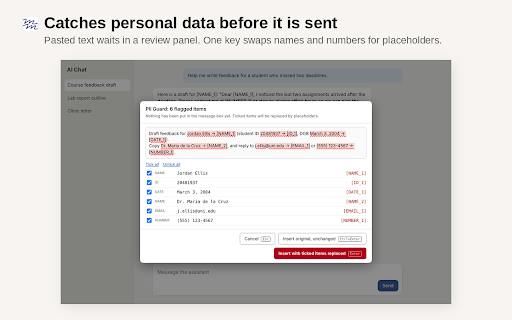
Almma's PII Guard is a free, open-source browser extension that runs entirely locally, intercepting and replacing PII in AI chats before sending.
Almma's PII Guard is a free, open-source browser extension for claude.ai and chat.almma.ai that prevents inadvertent PII leaks in AI chats. It flags names, emails, numbers, dates, and addresses via paste review and typing interception, replacing sensitive content with placeholders so model-bound data contains no original PII. It runs fully locally with no network calls, uses the MIT license, and is user-auditable. The article covers its privacy-first design, the need for PII protection in AI chats, and limitations like two-site support and possible false positives. It suits privacy-sensitive individuals; enterprises should assess accuracy before deployment.
In AI chat tools, we often type names, emails, phone numbers, or even addresses without a second thought. This personally identifiable information (PII) may be recorded by the model, used for training, or accidentally leaked. A free, open-source browser extension called Almma's PII Guard has appeared on Product Hunt, aiming to intercept this data before it leaves your browser.
How It Works: Paste Review, Input Interception
According to the Product Hunt page, this extension targets the input fields on claude.ai and chat.almma.ai. When you paste text, the extension pauses sending and highlights names, emails, numbers, dates, and addresses in the text for your review. If you type this information directly, it gets underlined in red and the send button is blocked until you make a decision.
The extension's core mechanism is replacing sensitive information with placeholders—for example, replacing a name with [NAME_1]—so that what is sent to the AI model no longer contains the original PII. The product page emphasizes "Everything runs locally"—there are no network calls in the code, and the README explains how to verify this. The extension uses the MIT license, meaning anyone can inspect, modify, and distribute the code.
Placeholder replacement is a common de-identification technique in privacy-enhancing technologies, often seen in engineering implementations of data masking and differential privacy. The basic idea is to replace original sensitive values with meaningless codes (such as [NAME_1], [EMAIL_1]) before sending, so the model only sees structured placeholders during inference and never touches real PII. To maintain semantic coherence, many implementations also maintain a local "placeholder-to-original-value" mapping table for reverse restoration after the model's response returns. The key limitation of this mechanism is that placeholders themselves change the statistical features of the text, potentially affecting the model's understanding of context; at the same time, the mapping table must be strictly kept locally, otherwise de-identification loses its meaning. PII Guard's claim of fully local operation is precisely to ensure this mapping table never leaves the browser.
Privacy-First Local Processing Logic
The most noteworthy design choice of PII Guard is its fully local operation. Many privacy tools claim to protect data but actually send it to their own servers for detection. This extension's code contains no network calls, meaning all detection logic runs within the browser.
This design has two direct benefits. First, users can audit the code to confirm there are no hidden data exfiltration channels. Second, even if the extension itself has vulnerabilities, attackers cannot obtain user information by intercepting its network traffic. For users handling sensitive client data, medical information, or legal documents, this verifiable privacy commitment matters more than feature richness.
The MIT license is a permissive open-source license that allows anyone to freely use, copy, modify, merge, publish, distribute, sublicense, and sell copies of the software, with the only requirement being to retain the original copyright notice and license notice, and providing no warranty. Unlike copyleft licenses such as GPL, MIT does not require derivative works to be open-sourced under the same license. For privacy tools, the value of the MIT license lies in: users can legally audit, modify, and redistribute the code to independently verify privacy commitments such as "no network calls"; developers can also integrate it into commercial products without worrying about license contamination. This makes PII Guard not just a tool, but a community-auditable reference implementation of privacy.
Why AI Chat Scenarios Need PII Protection
The interaction pattern of AI chat tools naturally encourages users to input large amounts of contextual information. To get useful answers, people describe their profession, health conditions, project details, or even paste contracts or email content. This text often contains direct identifiers such as names, contact information, and addresses.
Once sent, this information enters the third-party model's inference pipeline. Retention policies vary across providers, but users typically cannot confirm whether data is recorded, used for training, or manually reviewed. PII Guard adds a manual confirmation step before sending, turning "unconscious leaks" into "conscious choices."
PII (Personally Identifiable Information) has a clear definition in law and privacy engineering, typically referring to data that can identify a specific natural person alone or in combination with other information, including names, emails, phone numbers, addresses, ID numbers, biometrics, etc. PII protection requirements vary significantly across jurisdictions—for example, the EU's GDPR, various US state privacy laws, and China's Personal Information Protection Law all set strict conditions for the collection, processing, and cross-border transfer of PII. In AI chat scenarios, text pasted by users may inadvertently contain third-party PII (such as customer lists or contacts in contracts), and once sent to a model provider, it may constitute unauthorized data processing. PII Guard's local identification and replacement before sending essentially adds a "minimization" barrier between data controllers and processors, helping users reduce compliance risks.
Applicable Boundaries and Limitations
Product page information shows that the extension currently supports only two sites—claude.ai and chat.almma.ai—a limited scope. Users of ChatGPT, Gemini, or other AI chat tools cannot benefit directly for now.
Regarding detection capabilities, the product page lists five categories: names, emails, numbers, dates, and addresses. Numbers and dates are broad categories that may produce false positives—for example, project numbers or ordinary dates being incorrectly flagged. Users need to confirm each one, which may increase operational costs in long-text scenarios.
Additionally, the extension relies on users actively installing and enabling it. For enterprise environments, large-scale deployment and policy management capabilities remain unclear.
Who Should Use It
From its product positioning, PII Guard suits privacy-sensitive individual users, especially those who frequently use Claude to process work documents, client information, or legal texts. Its open-source nature and MIT license also make it a reference sample for developers examining how privacy tools are implemented.
On Product Hunt, the product received 67 votes and 2 comments, ranking 18th. The data indicates it is still in an early stage with limited community feedback. However, the combination of "local operation, no network calls, auditable" has differentiated value among privacy tools.
For enterprise users, it is recommended to first evaluate its detection accuracy and false positive rate before deciding whether to promote it within the team. For individual users, if you care about data exposure in AI chats, this extension provides a zero-cost review layer.
One-line Summary
Almma's PII Guard is a free, open-source browser extension that runs entirely locally, intercepting and replacing personally identifiable information in AI chats before sending.
Paragraph Summary
Almma's PII Guard is a free, open-source browser extension for claude.ai and chat.almma.ai, designed to prevent users from inadvertently leaking personally identifiable information (PII) in AI chats. Through paste review and typing interception, it flags names, emails, numbers, dates, and addresses, replacing sensitive content with placeholders to ensure data sent to the model contains no original PII. The extension runs entirely locally in the browser with no network calls in the code, uses the MIT license, and can be audited and verified by users. The article analyzes its privacy-first design logic, the necessity of PII protection in AI chat scenarios, and limitations such as currently supporting only two sites and potential detection false positives. The tool suits privacy-sensitive individual users; enterprises should evaluate accuracy before deployment.
Related articles

The Gemini 4 Trio and 3.8 Flash: A Full Comparison of Positioning, Pricing, and Benchmarks
A comparison of Gemini 4 Neon, Carbon, Argon, and Gemini 3.8 Flash: positioning, context, API pricing, Artificial Analysis and Arena benchmark scores, and available entry points.

AI Coding Model Leaderboard: Opus 5.5 Crowned, Gemini Neon Stages a Comeback
Tech blogger Matthew Berman releases an AI coding model tier list: Claude Opus 5.5 holds S-tier, Gemini Neon surprises with A-tier, OpenAI Astra lands B-tier. How do open-source models like DeepSeek fare? We break down the scoring logic and practical takeaways.

New Jersey Joe Sandwich: Meat and Coleslaw on Triple-Decker Rye
New Jersey Sloppy Joe isn't a ground beef burger—it's triple-decker rye bread with meat, Swiss cheese, and coleslaw, plus Russian dressing. Learn the authentic Essex County method and family recipe.