Interviewing at a YC Startup, Only to Find They'd Used My LinkedIn Without Permission

Job seeker spent 30 hours interviewing at a YC startup, then found their LinkedIn used without permission—sparking HN debate.
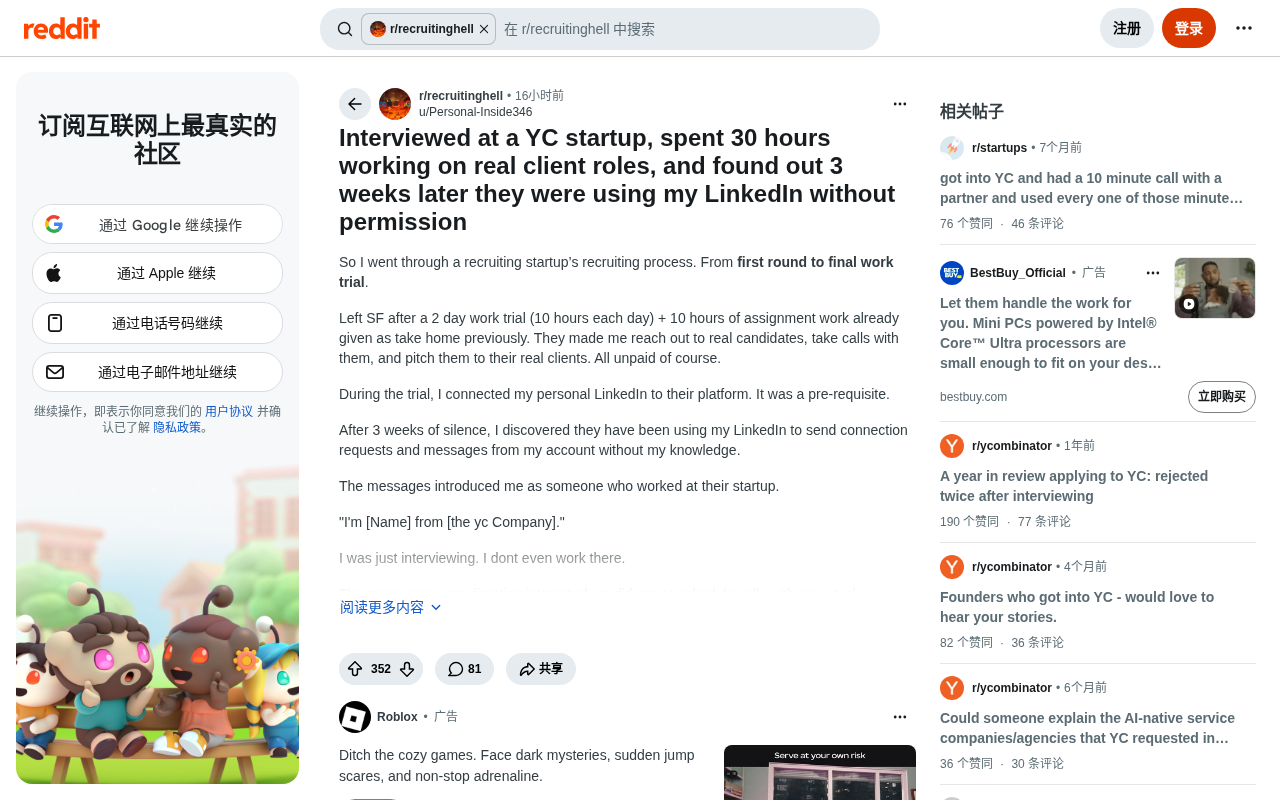
A job seeker on Reddit's r/recruitinghell described spending about 30 hours interviewing at a YC-backed startup, only to discover the company had used their LinkedIn profile without permission. The post gained 326 points and 70 comments on Hacker News, resonating widely with tech professionals on recruiters misusing candidate data. The article examines the gray area of candidate data, the trust gap from YC's brand endorsement, and the time cost of intense interviews, offering advice on setting boundaries, spotting red flags, and documenting issues—plus a reminder to startups about employer reputation.
A job seeker posted on Reddit's r/recruitinghell about a bizarre experience interviewing at a YC (Y Combinator)-backed startup: after investing a significant amount of time completing the interview process, they discovered the company had used their LinkedIn profile without permission. The post gained 326 points and 70 comments on Hacker News, sparking discussion about startup hiring ethics and job seekers' data rights.
The Story: A High-Investment Interview
According to the original post, the job seeker invested a substantial amount of time in interviewing with this YC startup—the title mentions "spent 30 hours." However, during or after the interview process, they discovered the company had used their LinkedIn information without their authorization.
The post did not disclose the company's name or detail exactly how the LinkedIn profile was used. But from the poster's wording and the choice to post in r/recruitinghell (a community dedicated to calling out recruiting horror stories), it's clear this behavior made them feel violated.
One detail worth noting: this incident generated far more discussion on Hacker News than on the original Reddit post—326 points and 70 comments—showing that "recruiters misusing candidate data" is a topic that resonates widely with tech professionals.
Why This Deserves Attention
The Gray Area of Candidate Data
During the hiring process, candidates typically provide their resumes, portfolios, social media accounts, and other information voluntarily. But "providing" and "authorizing use" are two different things. As a professional social platform, LinkedIn's user agreement has explicit restrictions on third-party scraping and use of data. Even if a candidate mentions or shares their LinkedIn profile during an interview, that doesn't mean they consent to it being used for other purposes.
What makes this tricky is that candidates are often in a disadvantaged position. It's hard to question the recruiter during the interview for fear of affecting the outcome, and pursuing the matter afterward lacks a clear path to recourse.
LinkedIn's User Agreement explicitly prohibits unauthorized third-party data scraping and bulk use, and its Professional Community Policies also place constraints on automated collection and copying of user profiles. However, these terms primarily govern the legal relationship between the platform and scrapers—whether a recruiter viewing or referencing a candidate's public profile in an interview context constitutes a violation is often left vague by platform rules. It's worth noting that information on a LinkedIn profile is mostly content users have voluntarily made public; in most jurisdictions, "viewing" public information itself typically does not constitute infringement. What may actually cross the line is secondary use beyond legitimate recruiting purposes—for example, using a candidate's career history, network connections, or work samples for internal referrals, client materials, or even product demos. Therefore, when discussing such incidents, one should distinguish between "accessing public information" and "using information for unauthorized purposes."
The Trust Gap Created by the YC Backing
As a well-known startup incubator, YC's portfolio companies are generally viewed by job seekers as "more reliable" choices. Precisely because of this, when a YC-backed company exhibits this kind of behavior, the disappointment is amplified. It also serves as a reminder to job seekers: an investment firm's brand endorsement does not equal a company's individual code of conduct.
Y Combinator is one of the world's most influential startup accelerators, known for seed-stage investment, intensive three-month incubation, and a vast alumni network. Its portfolio includes companies like Airbnb, Stripe, and Dropbox. Because of YC's selective standards and reputational backing, job seekers often treat "YC-backed" as an implicit signal of a company's governance and professionalism. But structurally, YC provides capital, mentorship, and network resources—it does not continuously monitor member companies' day-to-day operations, HR processes, or compliance details. In other words, the YC label reflects an assessment of a company's potential during fundraising and growth stages, not the maturity of its human resources management. Job seekers equating institutional brand with employer conduct standards is a common cognitive bias—and this is precisely the structural reason the "trust gap" arises.
The 30-Hour Time Cost
The original post's title deliberately emphasized "spent 30 hours." In technical hiring, with take-home assignments, multiple rounds of technical interviews, and system design sessions stacked together, it's not uncommon for candidates to invest dozens of hours. When this investment is contrasted with unprofessional treatment, the emotional backlash is stronger.
A take-home assignment is a common screening method in technical hiring: the company gives the candidate a programming or design problem close to real business needs, requiring independent completion and submission within a few days. Its intent is to replace whiteboard interviews and be closer to real work scenarios, but in practice it's often criticized as "free labor"—some companies use it to extract solution ideas or offload prototype work that should be paid onto candidates. Thirty hours is roughly equivalent to nearly four standard workdays; for a candidate who is still employed or interviewing with multiple companies simultaneously, this investment approaches a considerable opportunity cost. Precisely because the input-to-return ratio is so asymmetric, the emotional backlash is especially intense when candidates discover their information has been used for other purposes.
What Job Seekers Can Do
Before the Interview: Clarify the Boundaries of Information Use
If the recruiter asks for LinkedIn or other social profiles, you can politely ask about the purpose. For take-home projects, be sure to retain your own intellectual property statement.
During the Interview: Watch for Red Flags
If you discover the other party using your public information without informing you (for example, showing a screenshot of your LinkedIn as discussion material during the interview), you can directly ask about the source of the information. This is both self-protection and a test of the recruiter's professionalism.
After the Interview: Document and Provide Feedback
Keep records of communications during the interview process. If you confirm unauthorized use of your information, you can report it to the platform (such as LinkedIn's infringement complaint channels), and you can also share your experience in recruiting communities—which is exactly what the original poster did.
A Reminder for Startups
Hiring is a two-way choice. Using a candidate's LinkedIn profile without permission may seem like just a "convenience" in the short term, but in the long term it damages the company's reputation. In a fiercely competitive environment for technical talent, word-of-mouth among candidates spreads faster than you can imagine—one Reddit post plus a spot on the Hacker News front page is enough to leave a negative impression of a startup among job seekers.
The original post's comment thread (70 HN comments) also reflects that this is not an isolated issue. For startups, establishing clear guidelines for candidate data use is more effective than post-hoc PR.
Conclusion
The core of this incident is not a specific technical problem, but basic respect and boundary awareness in the hiring process. Job seekers invest time and trust, and recruiters should treat candidates' personal information in a corresponding manner. For tech professionals currently job hunting, this case offers a practical reminder: while presenting yourself, pay attention to how the other party uses your information.
One-line Summary
A job seeker spent 30 hours interviewing at a YC startup, only to discover their LinkedIn profile had been used without authorization—sparking heated discussion on HN.
Paragraph Summary
A job seeker posted on Reddit's r/recruitinghell about spending roughly 30 hours interviewing at a YC-backed startup, only to discover the company had used their LinkedIn profile without permission. The post gained 326 points and 70 comments on Hacker News, resonating widely with tech professionals on the issue of recruiters misusing candidate data. The article analyzes the incident from three angles—the gray area of candidate data, the trust gap created by the YC brand endorsement, and the time cost of high-intensity interviews—and offers practical advice: clarify information use boundaries before the interview, watch for red flags during it, and document and provide feedback afterward. It also reminds startups that candidate data use guidelines are tied to long-term employer reputation.
Related articles

A 19-Year-Old's Rental Horror Story: Ceiling Collapse, Bug Infestation, and the Lessons It Taught Me
At 19, my first off-campus rental brought bug infestations, no heat, a collapsed ceiling, and a ruined laptop with no renter's insurance. Here are the hard-won lessons for first-time student renters.

Veda Nurse's Cranial Nerve Exam: Why ASMR Role-Play Is Going Viral
Bilibili creator Veda's cranial nerve exam ASMR video goes viral, blending humor and sensory triggers through nurse role-play. This article analyzes its unique appeal and the audience psychology behind ASMR role-play.

LG Cinebeam AI Review: 120-Inch Giant Screen + 3000 Lumens, a New Choice for the Living Room Theater
LG Cinebeam AI projector review: 3000 ANSI lumens, 4K, 100 inches from about 8 cm and 120 inches from about 18 cm. Built-in webOS, AI Concierge voice recommendations, AI Sound Pro 11.1.2 virtual surround, and Game Optimizer—positioned for fixed living room installation, complementing the portable Cinebeam S.