Intrascope 2.0 Review: Multi-Model AI Agents and Smart Routing

Intrascope 2.0 tackles AI vendor lock-in with multi-model orchestration and an enterprise control plane.
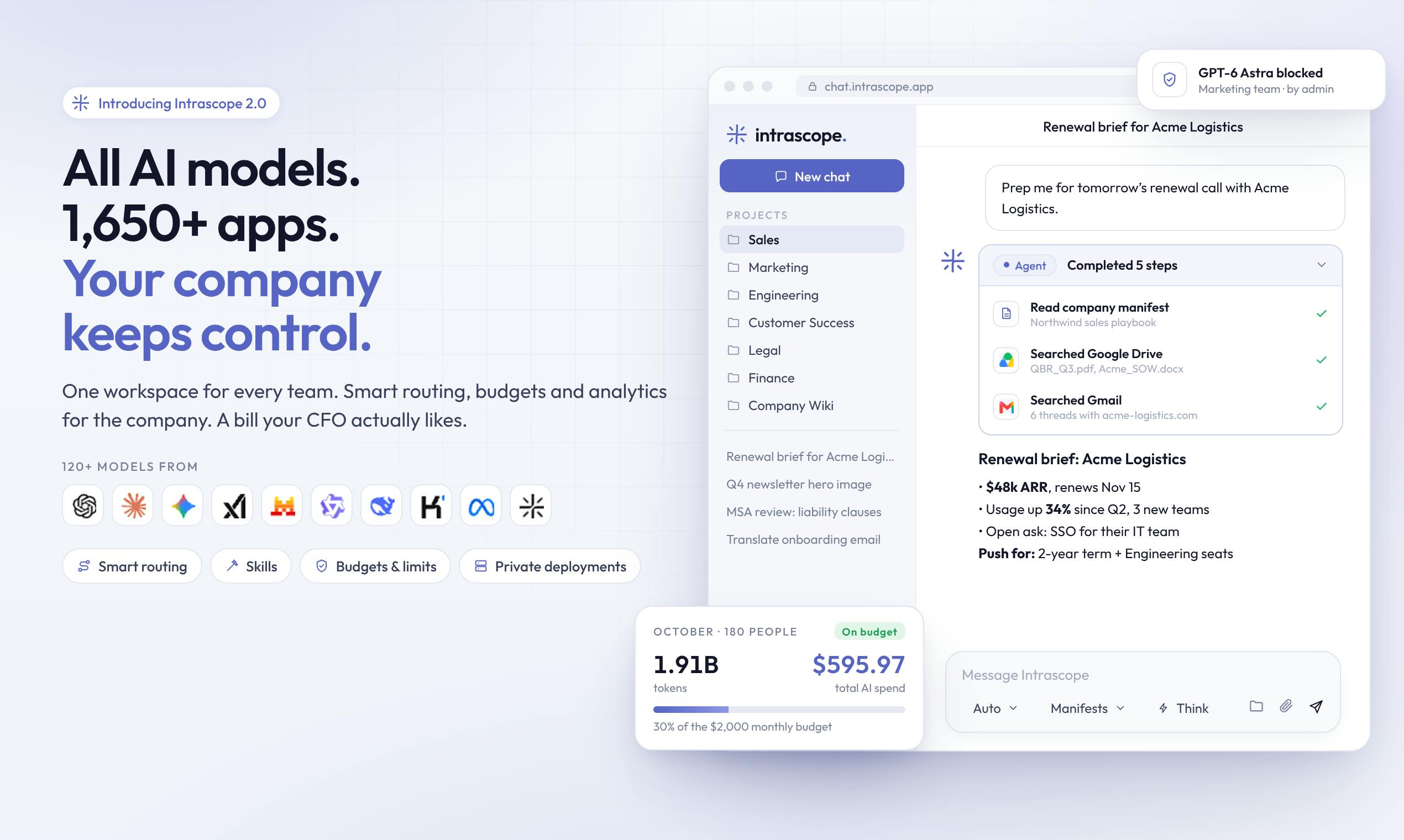
Intrascope 2.0 launched on Product Hunt as an enterprise multi-model orchestration platform supporting 120+ models and 1,650+ apps. Version 2.0 adds AI agents, connectors, Skills, and Auto routing so AI can act across apps and pick models by task complexity to balance quality and cost. It emphasizes enterprise controls—app and model approval, team/project/individual budgets, token and spend tracking—plus private and on-prem deployment. Product Hunt traction is moderate (77 votes, #12), and third-party validation remains limited.
From Single-Model Lock-In to Multi-Model Orchestration: What Problem Intrascope 2.0 Solves
When enterprises adopt AI, they often face an awkward situation: ChatGPT and Claude each build closed ecosystems, and once a team picks a vendor, it becomes very difficult to switch flexibly between different models. When Intrascope 2.0 launched on Product Hunt, it took direct aim at this problem—it lets teams access 120+ models, including mainstream options such as GPT-6, Claude, Gemini, Grok, and Qwen, and uses an AI agent to execute tasks across more than 1,650 apps (such as Gmail, Slack, Drive, and Notion).
This positioning is not just that of a "model aggregator." It also provides a management control plane: administrators can approve which apps and models are available, set budgets by team, project, and individual, and track every token and every dollar consumed. For enterprises that need to balance innovation and compliance, this "delegate authority without losing control" design approach has more practical value than simply providing API access.
Model Orchestration refers to building a scheduling layer on top of multiple AI models that dynamically selects or combines different models to complete tasks based on factors such as task type, cost budget, and latency requirements. Unlike a simple "model aggregator," an orchestration layer typically includes capabilities such as routing policies, fallback mechanisms, result validation, and cost accounting. The core motivation for enterprises to adopt multi-model orchestration is to avoid vendor lock-in: when a model raises prices, degrades, or no longer meets compliance requirements, they can smoothly migrate to an alternative model without having to rewrite upper-layer applications. Intrascope 2.0's Auto routing and unified control plane are precisely the productized embodiment of the model orchestration approach in enterprise scenarios.
Core Updates in Version 2.0: Agents, Connectors, and Skills
According to information on the Product Hunt page, Intrascope 2.0 brings four main updates: AI agents, connectors, Skills, and Auto routing. Among them, agents and connectors are the key to making AI truly "move"—agents are no longer limited to a chat window but can perform operations across apps; connectors are responsible for connecting external services such as Gmail, Slack, Drive, and Notion.
Skills is another design worth noting. It allows teams to encapsulate specific workflows into reusable capability modules for agents to call. This approach is becoming increasingly common at the AI application layer; in essence, it upgrades "prompt engineering" to "capability asset management," reducing the cost of repeated configuration.
Auto routing corresponds to the "smart model routing" mentioned in the title. Different tasks vary greatly in their requirements for model capability: simple classification tasks can use lightweight models, while complex reasoning requires flagship models. The value of automatic routing lies in its attempt to find a balance between performance and cost, rather than routing all requests through the most expensive channel.
Auto routing is a mechanism that dynamically selects models based on request characteristics. A typical implementation first performs lightweight classification of the input (such as intent recognition and complexity assessment), then combines preset rules or learned policies to route requests to models that match cost and capability. For example, simple summaries go to small models, while multi-step reasoning goes to flagship models. The difficulty of automatic routing lies in judgment accuracy: routing errors may lead to degraded performance or wasted cost, so confidence thresholds and fallback strategies are usually required. The value to enterprises is that it turns "which model to use" from a manual decision into a system decision, reducing call costs and also reducing the team's trial-and-error burden in model selection.
Enterprise-Grade Controls and Deployment Options
In its product description, Intrascope 2.0 repeatedly emphasizes that "companies retain control." This is reflected at three levels: approval authority for apps and models belongs to administrators; budgets can be set at three levels of granularity—team, project, and individual; and usage and spending are fully visible.
For data-sensitive enterprises, it also offers private and on-prem deployment options. This is a differentiating selling point in the current AI tool market—many SaaS products only offer cloud versions, while industries such as finance, healthcare, and legal often impose strict restrictions on cross-border data transfers.
Among similar products, platforms such as OpenRouter also provide multi-model access, but they lean more toward the developer API level; Intrascope, by contrast, focuses on enterprise collaboration and management. Their target users do not entirely overlap.
On-prem deployment refers to installing software on an enterprise's own servers or private cloud environment, so that data does not pass through a third-party SaaS platform. For heavily regulated industries such as finance, healthcare, and legal, cross-border data transfers and third-party processing are often subject to strict restrictions under the Personal Information Protection Law, GDPR, or industry regulatory rules, and cloud multi-tenant SaaS may fail compliance review. On-prem deployment allows enterprises to fully control data storage and network boundaries, but the cost is that they must bear operation and maintenance, upgrades, and security hardening themselves. Intrascope 2.0's provision of this option means it is trying to cover medium and large customers that are sensitive to data sovereignty, rather than serving only lightweight teams.
Hands-On Experience and Limitations
Judging from feedback on Product Hunt, Intrascope 2.0 received 77 votes and 13 comments, ranking #12, which represents moderate-to-good popularity. This data shows that the product has some attention but has not yet achieved explosive spread.
One additional point: currently, public information mainly comes from the product team's own description, and third-party reviews and user cases are still relatively limited. The coverage of 120+ models and 1,650+ apps sounds comprehensive, but actual connection quality, the reliability of agents in complex tasks, and the judgment accuracy of automatic routing all require more real-world usage data for verification.
Another potential issue is complexity. The more comprehensive the features, the higher the configuration and management costs. For small teams, this kind of enterprise-grade control may instead be a burden; it is better suited to medium and large organizations that already have a certain scale of AI usage and need governance and cost control.
Who Should Pay Attention to Intrascope 2.0
If your team is using multiple AI models at the same time and is struggling with the inability to manage usage and budgets in a unified way, Intrascope 2.0 offers an option worth evaluating. Its multi-model access, cross-app agent execution, and fine-grained cost tracking hit the pain points of enterprise AI governance.
But if your need is simply to call a certain model, or your team is very small and not sensitive to cost, then an off-the-shelf single-model subscription may be more cost-effective. The value of a tool depends on the use case, and the positioning of Intrascope 2.0 has been clear from the start: it targets organizational customers that need a "control plane."
One-line Summary
Intrascope 2.0 uses multi-model orchestration and an enterprise control plane to solve the AI vendor lock-in problem.
Paragraph Summary
Intrascope 2.0 launched on Product Hunt and is positioned as an enterprise-grade multi-model orchestration platform supporting access to 120+ models and 1,650+ apps. Version 2.0 adds four features—AI agents, connectors, Skills, and Auto routing—enabling AI to execute tasks across apps and automatically select models based on task complexity to balance performance and cost. The product emphasizes enterprise controls: administrators can approve apps and models, set budgets by team/project/individual, track tokens and spending, and it offers private and on-prem deployment options. Compared with developer API-oriented platforms such as OpenRouter, Intrascope focuses more on enterprise collaboration and governance. Currently, its Product Hunt popularity is moderate (77 votes, #12), third-party validation data is limited, and actual connection quality and routing accuracy remain to be seen.
Related articles

T3 Code: The Open-Source AI Coding Assistant's Comeback Story
T3 Code is an open-source AI coding assistant that unifies subscriptions like Codex and Claude, with powerful remote control and parallel task management.

Never Elected, Yet Ruled New York for 30 Years: The Ultimate Case Study in the Mechanics of Power
Robert Caro's biographies reveal how unelected Robert Moses ruled New York for 30 years through legal drafting and public authorities, and how Lyndon Johnson built leverage as a "powerless" Senate Majority Leader. Unpacking the underlying logic of accumulating and sustaining power.

The CPython 3.10 Recursion Trap and Synthetic Recovery in TokenGuard, an LLM Circuit Breaker
TokenGuard's author recounts a recursion crash caused by OrderedDict.pop in CPython 3.10 and introduces v0.3.0's Loop Nudge synthetic recovery, inline DLP scanning, and other new LLM agent circuit-breaker capabilities.