Introduction to Time Series Causal Discovery: A Unified Perspective from Signal Processing to AI Systems

A survey tutorial offers a unified cross-disciplinary framework for the fragmented field of time series causal discovery.
Time series causal discovery aims to identify causal relationships between variables from temporal data, rooted in signal processing research from over half a century ago and now spanning statistics, dynamical systems, and machine learning. A newly published survey-style tutorial bridges this fragmentation by systematically reviewing classical methods like Granger Causality, key assumptions such as causal sufficiency and the Markov condition, and their limitations — while devoting special attention to the often-overlooked topic of evaluation and benchmarking. The tutorial also highlights downstream applications in agriculture, earth science, healthcare, and AI systems, and extends an invitation to the signal processing community for cross-disciplinary collaboration, backed by an open-source resource repository.
Introduction to Time Series Causal Discovery: A Unified Perspective from Signal Processing to AI Systems
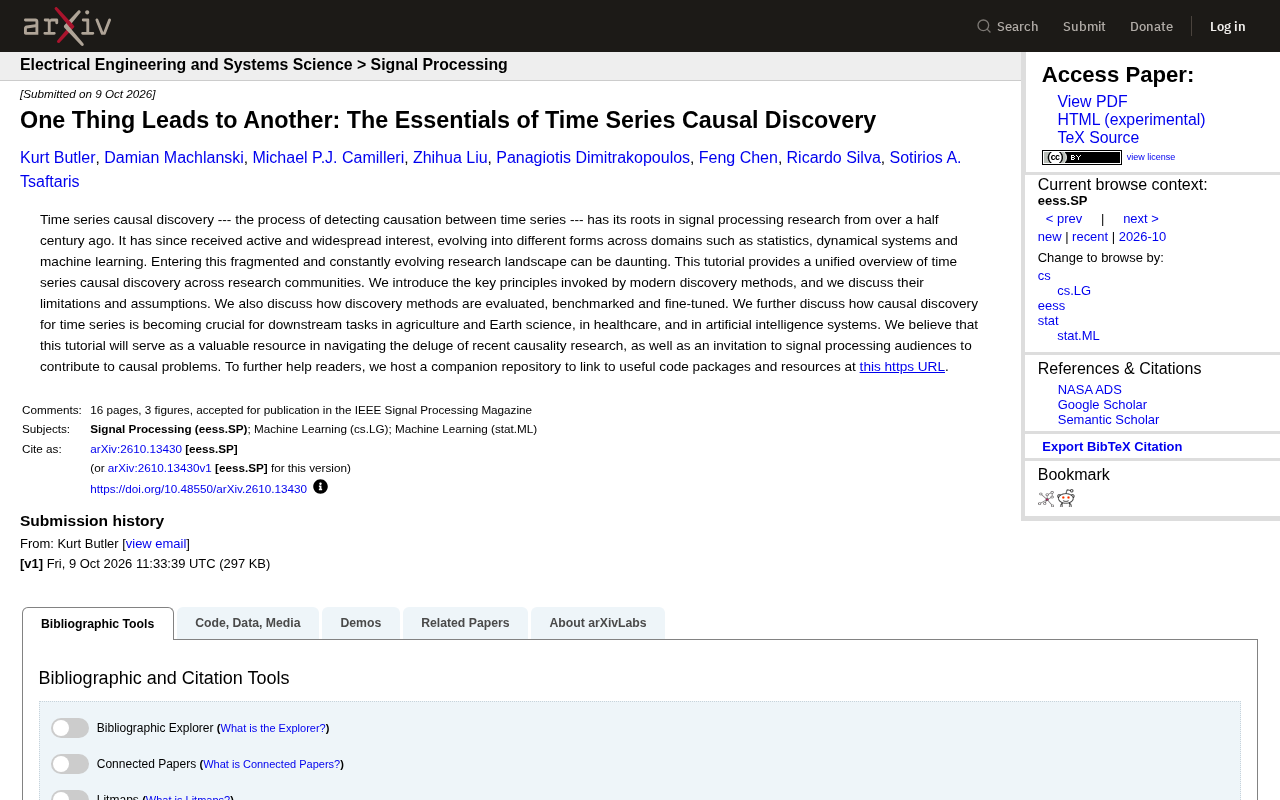
Time Series Causal Discovery — the process of detecting causal relationships between variables from time series data — is rapidly emerging as an interdisciplinary research hotspot connecting statistics, dynamical systems, and machine learning. A newly published survey-style tutorial aims to provide a unified organizational framework for this fragmented, fast-evolving field, helping researchers find clear footing amid the sprawling causal inference literature.
A Research Problem with Over Half a Century of History
Time series causal discovery is far from a new topic. Its roots trace back to signal processing research from more than half a century ago — researchers have long wanted to infer "who influences whom" from signals that change over time. Over the decades, this problem evolved independently across different disciplines, spawning methodologies that look very different from one another.
The challenge is that precisely because this field spans multiple communities — statistics, dynamical systems theory, and machine learning — the research has become highly scattered. Different fields use different terminology, different assumptions, and different evaluation standards, leaving newcomers with little sense of where to begin. The core value of this tutorial lies in bringing all these scattered threads from various communities onto a single map for comparison.
The earliest landmark contribution to time series causal discovery is Granger Causality, proposed in 1969 by Nobel laureate Clive Granger: if including the historical information of variable X significantly reduces the prediction error for variable Y, then X is said to Granger-cause Y. This definition operationalizes "causality" as "predictive improvement" and has been widely applied in economics and neuroscience. However, Granger causality is fundamentally a statistical dependence relationship, not true physical causation — it cannot handle latent confounding variables, nor can it distinguish direct causation from indirect causation. The information-theoretic perspective later introduced Transfer Entropy to capture nonlinear dependencies, while the dynamical systems community developed methods such as Convergent Cross Mapping (CCM) based on state-space reconstruction. This independent evolution is precisely what has produced today's fragmented landscape of incompatible terminology and assumptions.
Core Principles and Limitations of Modern Causal Discovery Methods
The tutorial systematically introduces the key principles underpinning modern causal discovery methods and candidly discusses their assumptions and limitations. This is particularly important: any causal inference method is built on specific assumptions — such as causal sufficiency, temporal directionality constraints, and noise structure assumptions. If these assumptions fail to hold in real data, the inferred "causal relationships" may be spurious.
Evaluation, Benchmarking, and Fine-Tuning
Beyond the methods themselves, the tutorial devotes substantial space to how causal discovery methods should be evaluated, benchmarked, and fine-tuned. This is a critically important yet often overlooked aspect of causal research — unlike prediction tasks, the "ground truth" in causal discovery is often difficult to obtain, and constructing a credible evaluation framework is itself an open problem. By incorporating this content, the authors demonstrate a commitment to practical applicability rather than remaining at the theoretical level.
Modern causal discovery typically uses Directed Acyclic Graphs (DAGs) or their temporal extensions — temporal causal graphs (as used in SVAR models and the PCMCI framework) — as representations of causal structure. In temporal settings, causal relationships must also distinguish between instantaneous effects (influences between variables at the same time step) and lagged effects (influences from past time steps on the current one). The Causal Sufficiency Assumption requires that no unobserved common causes (latent variables) exist in the system; if violated, algorithms may misidentify spurious correlations induced by confounders as causal relationships. Additionally, the Markov Condition and Faithfulness Assumption form the theoretical foundation for classical constraint-based methods such as the PC and FCI algorithms — the former assumes that variables are conditionally independent given their causal parents, while the latter assumes that all conditional independencies in the data correspond to separations in the true causal graph. Understanding the boundary conditions of these assumptions is a prerequisite for correctly selecting and interpreting causal discovery methods.
The fundamental difficulty in evaluating causal discovery stems from the counterfactual problem: in the real world, we cannot simultaneously observe both the outcome when an intervention occurs and when it does not, making a "gold standard" for causal structure extremely difficult to obtain. Commonly used evaluation strategies include: testing on synthetic data (where the true causal graph can be precisely controlled, though a gap with real data distributions may exist); using semi-real datasets as reference points (such as the C. elegans connectome in neuroscience, or physically consensual causal relationships in climate science); and indirect validation via randomized controlled trial results. Beyond common metrics like accuracy, precision, and recall, evaluation must also account for directional accuracy (distinguishing A→B from B→A) and the precision of identifying temporal lag orders. Benchmarking platforms such as CauseMe and the Causal Discovery Toolbox are pushing standardization of evaluation in the field, but constructing benchmarks that truly reflect the complexity of real-world applications remains an open challenge.
From Agriculture and Earth Science to Healthcare and AI Systems
The significance of time series causal discovery is increasingly manifested in downstream applications. The tutorial highlights several key domains:
- Agriculture and Earth Science: Understanding the causal drivers among climate variables and ecosystems has direct value for prediction and intervention.
- Healthcare: Identifying causal mechanisms from physiological signals or patient time series data can support diagnosis and treatment decisions.
- AI Systems: Causal discovery is becoming an important tool for improving the interpretability, robustness, and generalization of AI systems.
These application domains illustrate that causal discovery is no longer a matter of purely academic curiosity — it is a foundational capability with direct bearing on real-world decision-making and system reliability. The ability to distinguish correlation from causation means that models can make reliable judgments even under distribution shift.
The value of causal discovery for AI systems stems largely from its natural capacity to address Distribution Shift. Traditional machine learning models rely on statistical correlations; when the test data distribution differs from the training distribution (e.g., new regions, new populations, new time periods), model performance can degrade significantly. Models grounded in causal mechanisms, however, capture stable structures in the data-generating process and are theoretically more robust to environmental changes — an idea that has been systematically developed in research directions such as Invariant Causal Prediction (ICP) and causal representation learning. On the interpretability front, causal graphs provide a human-understandable map of variable influence relationships that, compared to post-hoc explanation methods like neural network feature importance, are semantically much closer to how domain experts reason.
An Invitation to the Signal Processing Community
The tutorial carries another layer of purpose: it extends an invitation to researchers in the signal processing community. Given that the historical roots of time series causal discovery lie in signal processing, the authors argue that this community possesses unique tools and perspectives that have the potential to make meaningful contributions to current causal problems. This cross-community appeal also echoes the overarching theme of the tutorial — a unified perspective.
To help readers go deeper, the authors maintain a companion open-source repository collecting relevant software packages and resources at CHAI-UK/Awesome-Time-Series-Causal-Discovery. For researchers looking to get hands-on, this is a valuable starting point.
Summary
The positioning of this tutorial is clear: it serves both as a navigation map helping newcomers traverse the fragmented causal research literature, and as a call to action for the signal processing community. In an era of rapidly expanding causal research, a unified conceptual framework, honest discussion of assumptions and limitations, and serious attention to evaluation methodology are what distinguish a work like this from an ordinary survey. For readers interested in AI interpretability, temporal modeling, or cross-disciplinary data analysis, it offers a perspective well worth exploring.
Related articles

Gemini 4 Argon Launches Globally: Key Highlights from the AI Daily Brief
Google opens Gemini 4 Argon globally across Pro and Ultra subscriptions and the API, and demonstrates robot control. This article rounds up open-source models, Agent infrastructure, cost transparency, and safety governance updates.

OpenCode Surpasses Cursor with 213.5k Stars: The Three-Way AI Coding War Behind a $60 Billion Sale
OpenCode overtakes Cursor with 213.5k stars as Cursor reportedly seeks a $60B sale. We break down the business models, user scenarios, and moats of open-source OpenCode, commercial IDE Cursor, and Anthropic's Claude Code, plus three possible endings for the AI coding tool landscape.

Vercel CEO's AI Coding Workflow: 7 Key Principles
Vercel CEO shares his complete workflow for collaborating with AI agents: validate ideas with an MVP, use the direction command to prevent drift, scan security debt with DeepSec, use a breaker agent to attack the app, test from a first-visit user perspective, and close the customer feedback loop through MCP—plus seven actionable AI coding practices.