iOS 27.2 Released: Siri AI Adds New Languages and Security Fixes

iOS 27.2 released, Siri AI expands multilingual support and fixes important security vulnerabilities.
Apple has released the iOS 27.2 system update to iPhone and iPad users. The official description is brief but contains two core changes: Siri's AI capabilities are extended to more languages, allowing users in more regions to use intelligent features in their native language; and a batch of important security fixes is included. The article notes that Siri's AI capabilities rely heavily on local device processing, and each additional language requires model retraining and optimization, reflecting Apple's progress in on-device AI language adaptation. However, the original material did not disclose the new language list, covered regions, or vulnerability details. The article recommends users back up and upgrade as soon as possible, and believes multilingual coverage breadth will affect Siri's global competitiveness, making future versions worth watching.
iOS 27.2 Released: Siri AI Adds New Language Support and Security Fixes
Apple has recently released the iOS 27.2 system update to iPhone and iPad users. Although the official description is only a few words long, this update contains two noteworthy changes: Siri's AI capabilities have been extended to more languages, and a batch of important security fixes.
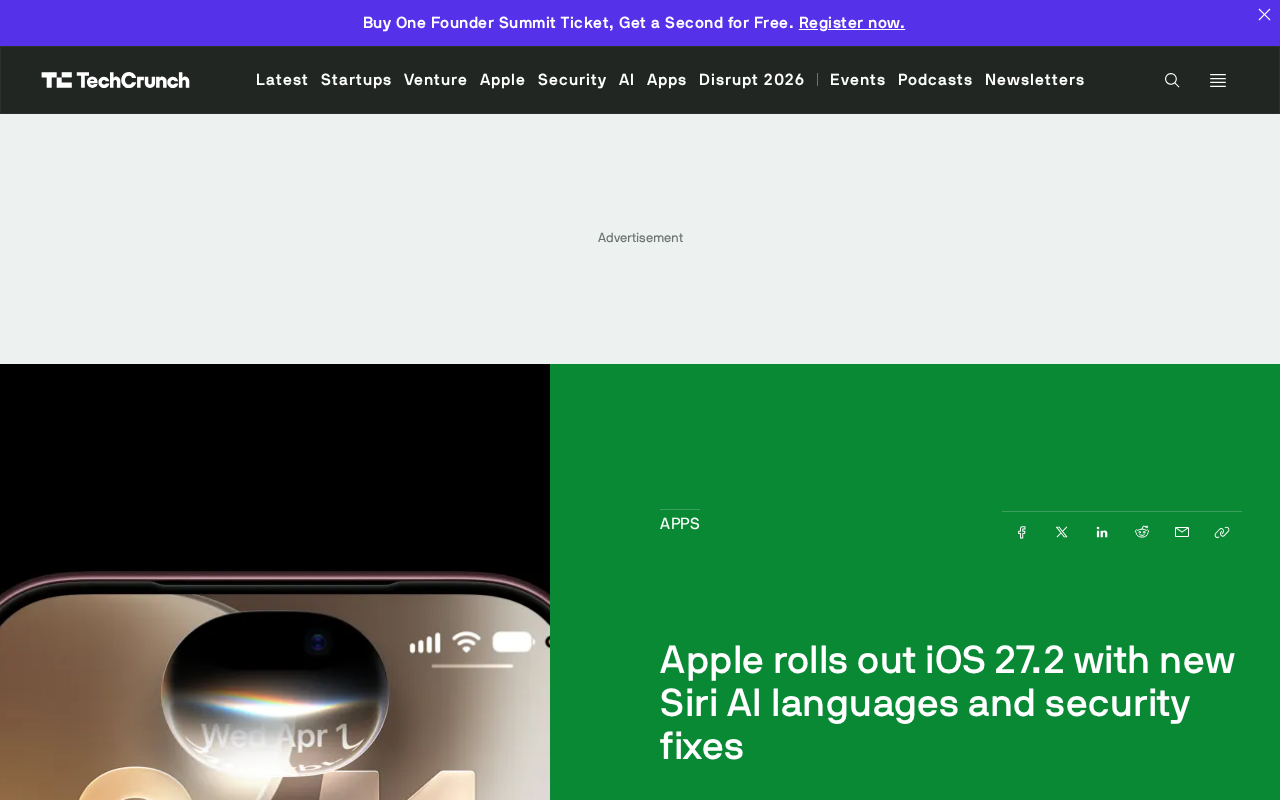
Siri AI Language Support Expanded: Voice Assistant Accelerates Localization
According to the original information, iOS 27.2 brings new AI language support to Siri. This means users in more regions can directly invoke Siri's intelligent features in their native language, without having to switch to one of the few supported languages such as English.
From an industry trend perspective, multilingual capability of voice assistants has always been a key bottleneck constraining their global adoption. Apple's expansion of language coverage this time shows that it has made progress in language adaptation for on-device AI models—after all, Siri's AI capabilities rely heavily on local device processing, and each additional language requires retraining and optimization at the model level.
You may not have noticed that the original material did not disclose which specific languages were added or how many regions are covered. For users in non-English markets, this is still information that requires waiting for official detailed explanation. But what is certain is that the expansion of language support directly affects the actual usability of Siri AI features, rather than being simple interface translation.
The difference between on-device AI and cloud AI: On-device AI means the model runs inference directly on the local device (such as the iPhone's neural engine), without uploading voice data to the cloud. Its advantages lie in low latency, privacy protection, and offline availability, but limited by device computing power and storage, the model size is usually far smaller than cloud-based large models. Siri's AI capabilities have long been mainly based on on-device processing, which is also the technical reason for the slower progress of its multilingual expansion—each new language supported requires retraining, compressing, and deploying the corresponding speech recognition and semantic understanding models under limited device resource constraints. In recent years, Apple has adopted a device-cloud collaborative strategy, with some complex requests handled by the cloud "Private Cloud Compute," but basic wake word recognition and simple commands are still completed locally. Understanding this architecture helps to judge the engineering difficulty behind the iOS 27.2 language expansion.
Security Fixes: A Key Part of Routine Updates
In addition to the Siri update, iOS 27.2 also includes important security updates. The original information clearly lists this as one of the core contents of this rollout.
Apple's system updates usually list the number and types of fixed vulnerabilities in security advisories, but this material did not provide specific details. For ordinary users, the value of security fixes is often underestimated—such updates usually patch system vulnerabilities that may be maliciously exploited, and timely installation is the most direct way to reduce device risk.
Combined with the Siri AI language update, this rollout covers both feature expansion and security hardening, making it a routine update with relatively complete content.
CVE and the security advisory mechanism: After each system update, Apple publishes a security content document on its official support page, listing fixed vulnerabilities one by one with CVE (Common Vulnerabilities and Exposures) numbers, marking the affected components (such as WebKit, kernel, Bluetooth module) and vulnerability types (such as memory out-of-bounds, use-after-free, privilege escalation, etc.). CVE numbers are a globally unified security vulnerability identification system, making it easier for enterprises and security researchers to track the same vulnerability across vendors. Users can use this to assess the urgency of updating: if a vulnerability has been exploited in the wild (Apple will mark it as "may have been actively exploited"), it should be installed first. The specific CVE list for iOS 27.2 this time needs to be checked in Apple's official security advisory; the original material did not provide this part of the information.
Update Recommendations and Outlook
For users who have already received the update, it is recommended to complete the upgrade as soon as possible after backing up. Siri's new language support may vary by region, and actual availability is subject to the language options in device settings.
From a longer timeline, the language expansion in iOS 27.2 is only a small step in Apple's AI strategy. Siri's AI transformation is still ongoing, and the breadth of multilingual coverage will directly affect its competitive position against rivals in the global market. Whether subsequent versions will bring more substantial Siri feature upgrades is worth continued attention.
One-line Summary
iOS 27.2 released, Siri AI expands multilingual support and fixes important security vulnerabilities.
Paragraph Summary
Apple has released the iOS 27.2 system update to iPhone and iPad users. The official description is brief but contains two core changes: first, Siri's AI capabilities have been extended to more languages, enabling users in more regions to invoke intelligent features in their native language; second, a batch of important security fixes is included. The article notes that Siri's AI capabilities rely heavily on local device processing, and each additional language requires retraining and optimization at the model level. This expansion reflects Apple's progress in language adaptation for on-device AI. However, the original material did not disclose the list of newly added languages, covered regions, or vulnerability details. The article recommends users back up and upgrade as soon as possible, and believes that the breadth of multilingual coverage will affect Siri's competitive position against rivals in the global market, making subsequent versions worth continued attention.
Related articles

Qwen4 Architecture Preview Open-Sourced: 125B Parameters, 512 Experts, Designed for VRAM-Constrained Hardware
Qwen4 isn't released yet, but its architecture is previewed via open-source Qwen3.8 Flash Next: 125B params, 6B activated per token, 512 experts, 262K context, built for VRAM-limited hardware. This article covers official confirmations, key config.json metrics, and local deployment tests on 24G memory.

Run 8K Images on 6GB VRAM! Hands-On Test of Fudan's Open-Source MOSS-Image Model
Fudan OpenMouse team and Shanghai MOSS Intelligence open-source MOSS-Image, a 500M-parameter DT architecture text-to-image model that runs locally on 6GB VRAM with precise text rendering, structured layout control, and 4K Token prompt support—ideal for e-commerce posters and local deployment by individual creators.

Overseas Blogger Tests Local Deployment of 100B-Parameter MoE Model: Key Lessons on Quantization and Tool Calling
Overseas blogger tests local deployment of Alibaba's Qwen 3.8 Flash Next 100B MoE model on a Strix Halo mini PC and CUDA workstation, revealing how quantization precision affects tool-calling success and the real-world performance of the Strata and GUFO inference engines.