iOS 27 Siri Overhaul Review: Apple's Voice Assistant Is Finally Worth Using
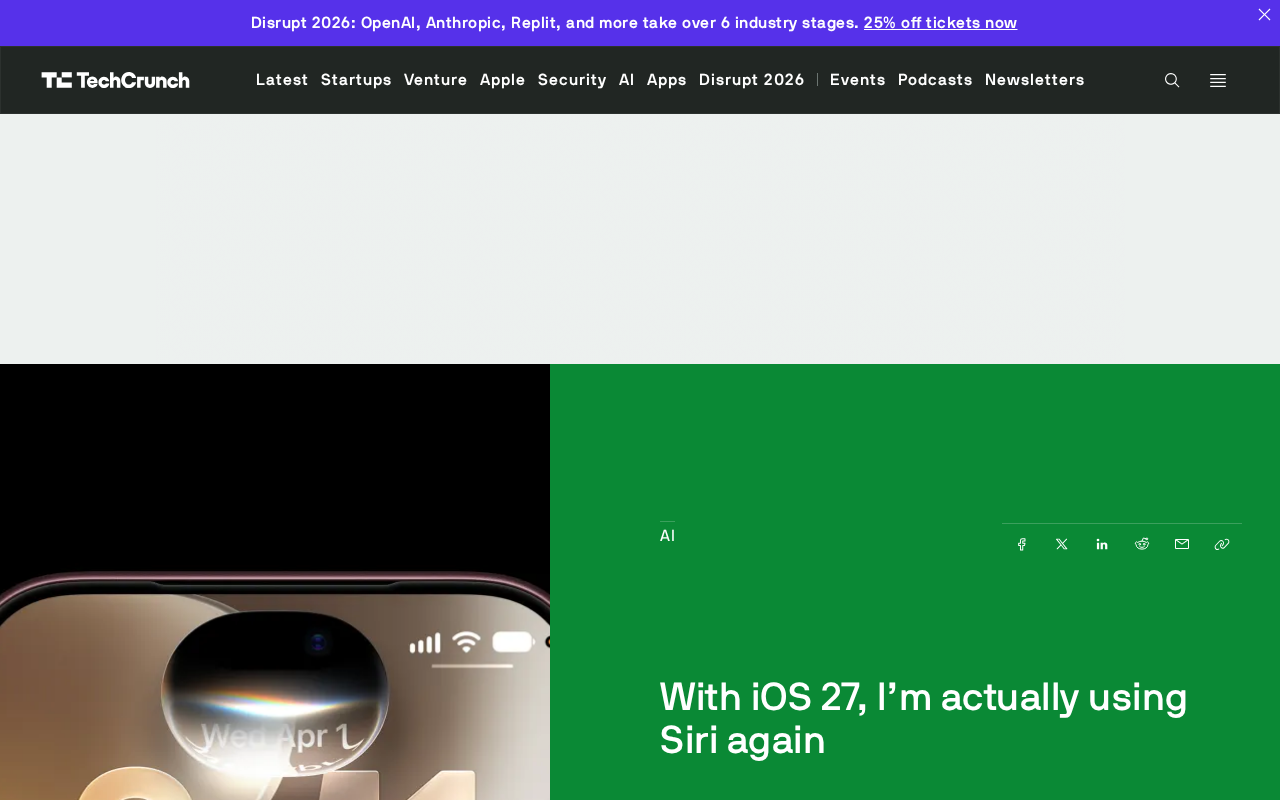
iOS 27 deeply rebuilds Siri, aiming to win back iPhone users who long gave up on it.
Apple's iOS 27 delivers a long-anticipated full overhaul of Siri, with the core focus on day-to-day usability rather than feature additions. Over the past few years, many iPhone users abandoned Siri due to frequent misunderstandings, slow responses, and limited capability, defaulting to manual workflows or third-party apps. The update aligns with a broader shift in voice assistant technology — from rule-based command recognition to LLM-powered natural conversation. Since Siri is the unified interaction layer across iPhone, Apple Watch, HomePod, and CarPlay, improved usability has a multiplier effect across the entire ecosystem and represents a key moment for Apple to reassert itself in the on-device AI race.
Apple's long-awaited Siri overhaul has officially landed with iOS 27, and this upgrade meaningfully changes what the voice assistant is like to use day-to-day. For many users, Siri has been the feature they ignore — or actively disable — on their iPhone. iOS 27 seems to be changing that.
A Long-Overdue Rebuild
Apple's comprehensive Siri redesign has been discussed and anticipated for quite some time. As one of the earliest voice assistants to reach the consumer market, Siri has gradually fallen behind competitors in both practical usefulness and overall intelligence. The iOS 27 update is positioned as a deep reconstruction, not a cosmetic touch-up.
The most important change, based on the core signals from early impressions, is day-to-day usability — Siri is no longer just a tool for setting timers or checking the weather, but is beginning to genuinely integrate into how people actually use their devices. That shift from "technically capable" to "something I actually want to use" is precisely what every previous version of Siri has been missing.
From "Abandoned" to "Actually Using It Again"
One particularly telling line from early coverage: "With iOS 27, I actually started using Siri again." That statement reflects a widespread reality — a large share of iPhone users have effectively given up on Siri over the past few years, defaulting to manual navigation or third-party apps instead.
The value of a voice assistant isn't in how long its feature list is — it's whether the assistant can deliver a reliable, timely response when it actually matters. Siri has historically frustrated users with misunderstood commands, sluggish responses, and hard limitations. If iOS 27 meaningfully addresses these pain points, it means Apple has rebuilt trust at the human-computer interaction layer.
Why Day-to-Day Usability Is the Real Metric
For voice assistants, "capable" and "actually good" are two very different dimensions. An assistant can be feature-rich and still be unusable if it can't parse natural language, lacks context awareness, or responds too slowly. The direction of iOS 27's update clearly prioritizes the latter.
This aligns with where AI technology is heading more broadly: voice assistants are evolving away from rule-based command recognition toward natural conversation understanding powered by large language models (LLMs). Apple's Siri rebuild almost certainly moves in this direction — letting users express what they need in natural language, rather than memorizing specific "magic phrase" commands.
The fundamental difference between LLMs and traditional voice assistants lies in how they understand input. Traditional Siri relied on predefined Intent Classification and Slot Filling — users had to say specific phrases the system could recognize to trigger the right function. LLM-based conversational systems, by contrast, use deep semantic understanding to handle open-ended input, inferring user intent even without explicit keywords. Crucially, LLMs maintain context across multiple turns — a user can say "send that last message to him" without restating the contact's name. This shift is the technical inflection point between a voice assistant that "works" and one that's genuinely worth using. Apple faces dual constraints in deploying LLMs on-device — compute power and privacy — but the Neural Engine architecture in Apple Silicon provides a hardware foundation for local inference.
What This Means for the Apple Ecosystem
Improved Siri usability isn't just a feature update — it's about the interaction logic of Apple's entire ecosystem. From iPhone to Apple Watch, HomePod, and CarPlay, Siri is the unified entry point across all these devices. When that entry point becomes genuinely useful, the experience across the whole ecosystem improves with it.
It's worth noting that Apple has been widely perceived as lagging in the AI race. If the iOS 27 Siri upgrade delivers on its promise of making users want to pick Siri back up, it would be a significant demonstration of Apple's ability to compete on on-device AI experiences.
The Siri experience on CarPlay and HomePod has been especially constrained for years. In-car or smart speaker scenarios have extremely high costs for screen-based interaction — voice is often the only practical input method, which makes Siri misunderstandings far more painful in those contexts. HomePod, as a voice-first device, has its usage rates directly tied to Siri's reliability. Compared to Amazon Echo's deep integration with the Alexa ecosystem, Apple has consistently punched below its weight in voice-controlled smart home. A meaningful Siri improvement in iOS 27, migrated to HomePod and CarPlay, would be a critical step in strengthening the entire Apple ecosystem.
Final Thoughts
Given the limited source material, this piece can't go deep on specific feature details or real-world benchmarks. But the core signal is clear: iOS 27's Siri rebuild marks a turning point — from a feature users forgot existed to one they're actively adopting again. For anyone who gave up on Siri a long time ago, this might finally be the moment to give it another shot.
Related articles

Deep Dive into Agent Eval Harnesses: Build vs. Buy?
A deep dive into the four core components of an agent eval harness — Cases, Runner, Capture, and Graders — with practical guidance on when to build vs. adopt existing frameworks.

Getting Started with Krea 2 Image Generation: A Beginner's Guide to LoRA and Checkpoints
A beginner's guide to Krea 2 image generation: how to start with free open-source workflows, understand LoRA vs Checkpoint on Civitai, and achieve consistent realistic image generation.

Nintendo 'Customer Appreciation' Sale: Switch Games and Accessories Price Cuts Roundup
Nintendo's Customer Appreciation sale discounts Switch games and accessories at Amazon, Best Buy, Walmart, and its digital store — funded by tariff refunds. Ends Sept 26.