iPhone 18 Pro In-Depth Review: Double the Performance, AI Features Steal the Show

The iPhone 18 Pro looks nearly identical, but A20 Pro, battery life, and AI deliver the biggest performance leap in years.
Based on Linus Tech Tips' in-depth review, this article notes that while the iPhone 18 Pro is nearly indistinguishable from its predecessor externally, the internal upgrades are significant. The A20 Pro adopts a new 4 efficiency + 2 super core architecture, beating all phone chips and even some desktop cores in Geekbench single-core; GPU leads the previous generation by over 50% in 3DMark, with chassis only about 1°C hotter in a 20-loop test. Battery life and charging improve substantially—Pro Max Wi-Fi video playback reaches 34 hours 18 minutes, and 15 minutes gets to 50%. The camera introduces variable aperture for the first time, but real-world gains are limited; in AI, Shortcut generation and Siri's personal context are becoming genuinely practical. The article warns that QLC flash in 1TB/2TB versions may slow during sustained writes, and offers buying advice by user segment.
iPhone 18 Pro's external changes are so minor they're hard to get excited about—that was the first reaction of many tech creators upon getting their hands on the device. But test data from LTT Labs reveals a completely different story: this may be the biggest performance leap in smartphones in recent years. Based on Linus Tech Tips' in-depth review and corroborating test data from multiple sources, this article breaks down the real-world performance of the A20 Pro chip, the camera system, and the AI features.
Exterior "Incremental," Performance "Engine Swap"
According to Linus Tech Tips (LTT) in his video, the external differences between the iPhone 18 Pro and the 17 Pro are so minimal they're "almost indistinguishable"—so much so that he initially decided to skip covering it. What changed his mind was a set of test results on lttlabs.com: the A20 Pro chip not only comprehensively outperforms the previous generation A19 Pro, but also achieves simultaneous improvements in thermal management and real-world battery life.
In his words, this is "a wolf in burgundy sheep's clothing." The restrained exterior and aggressive internals form a stark contrast, and this tension is the core narrative of this generation.
Worth highlighting separately is the change in CPU core architecture. Apple abandoned the "4 efficiency + 2 performance" layout it had used for years, switching to 4 efficiency cores plus 2 so-called "super cores." LTT Labs' tests show that this super core beats every phone chip in Geekbench single-core, and according to Tom's comparison data, even surpasses the fastest desktop core designs.
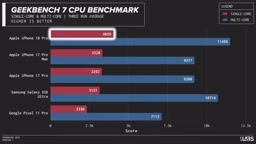
Super Core is the CPU core designation Apple introduced with the A20 Pro, referring to a new generation of high-IPC cores that replace traditional "performance cores." Compared to previous performance cores, the super core increases reorder buffer size and execution unit width, with major optimizations to branch prediction and out-of-order execution, achieving higher instructions per clock (IPC) in single-threaded workloads. The Android camp's Cortex-X series also pursues extreme single-core performance, but typically at the cost of higher power consumption; Apple's strategy is to approach desktop-class single-core performance while maintaining mobile energy efficiency through a wider architecture and finer-grained power gating. This also explains why Geekbench single-core scores can surpass some desktop processors—single-core benchmarks are essentially short-burst workloads with lower demands on thermal dissipation and sustained power.
Gaming and Storage: The Truth Beyond Benchmarks
The GPU improvements are equally aggressive. In the 3DMark Steel Nomad test, the 18 Pro is over 50% faster than the previous generation, more than 30% faster than the Galaxy S26 Ultra, and three times the performance of the Pixel 11 Pro. However, LTT points out a key issue: Steel Nomad only runs for a few minutes and cannot reflect performance under sustained load.
He therefore places more weight on the Wildlife Extreme 20-loop stress test. The results are consistent: the 18 Pro holds steady above 6000 points, about 50% faster than all tested models. The hottest point on the chassis is only about 1 degree Celsius higher than the 17 Pro, confirming that Apple's enlarged vapor chamber is doing its job.
There's an easily overlooked pitfall in storage. According to analysis by Bilibili creator "HomoLab" (cited by LTT in the video), the QLC flash chips used in the 1TB and 2TB versions can see write speeds plummet to an average of 45MB/s once the buffer is exhausted. This is imperceptible in daily use, but the difference becomes very obvious when recording ProRes video for extended periods or restoring large backups. Users "spending the price of a used car on a phone" would do well to note this detail.
QLC (Quad-Level Cell) flash stores 4 bits of data per cell, offering higher density and lower cost than TLC (3 bits), but with shorter write endurance and slower write speeds—especially after the SLC cache is exhausted. Phone manufacturers typically use dynamic SLC caching on QLC dies to absorb burst writes; once sustained writes exceed cache capacity (for example, recording high-bitrate ProRes video for extended periods or restoring large backups), write speeds drop to native QLC levels, producing the ~45MB/s magnitude described in the article. TLC dies degrade less in the same scenarios, so using QLC in high-capacity versions is a cost-versus-experience tradeoff. Average users taking photos and using social apps will hardly notice any difference.
Battery Life and Charging: This Generation's Most Underrated Upgrade
For non-mobile gamers, LTT considers battery life the most satisfying aspect of the 18 Pro. Test data shows the new Pro's endurance has approached that of the old Pro Max, while the new Pro Max played 1080p video continuously over Wi-Fi at 200 nits brightness for 34 hours and 18 minutes—an unprecedented result.
Charging speed has also improved substantially. The 17 Pro reaches half charge in about 20 minutes, while the 18 Pro hits 50% in 15 minutes, and the 18 Pro Max in 16 minutes.
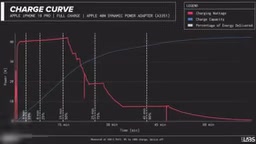
The improvement mainly comes from higher peak power in the early charging phase. Although Apple's official statement comes with a slew of footnotes, the measured results largely match the marketing claims.
Camera: Variable Aperture Arrives, But Don't Expect Too Much
The main camera on the 18 Pro and Pro Max uses a new 48MP Sony sensor and introduces variable aperture to the iPhone for the first time—from f/1.48 to f/4. LTT's photography colleague offered a relatively measured assessment after real-world testing: stopping down to f/4 yields deeper depth of field and sharper images, while wide-open f/1.48 slightly improves low-light performance, but "it needs to be very, very dark" to perceive a substantive difference.
Regarding bokeh, the natural light spots from the physical aperture are indeed superior to computational blur, but limited by sensor size, the effect remains subtle. Shooting distance should be kept within two feet, otherwise returns diminish.
The addition of a manual control mode is commendable, but the lack of ISO adjustment makes the system "like a tripod with only two legs." A more telling example came from a comparison shoot: LTT's wife, using the older 17 Pro with the third-party app Halide's Process Zero mode, got sharper shots of moving vehicles than he did—because Halide captures a single photo rather than Apple's Photonic Engine multi-frame composite. A contemporaneous DP Review article corroborates a similar phenomenon: when shutter speed is set manually, Apple reduces the number of frames captured.

On the positive side, Photographic Styles 3's new texture control lets users adjust sharpening, halation, and grain themselves, returning to ordinary users control that was previously only available through third-party apps. The direction is right, but LTT's verdict is clear: this is not enough reason to upgrade, unless you're still on an iPhone 14 or 15 Pro.
Variable aperture refers to aperture blades in the lens that can physically open and close, thereby changing the light-passing aperture and depth of field. Variable aperture on phones typically offers only two or three stops (such as f/1.48 and f/4), rather than the continuous adjustment of camera lenses. Wide open, light intake is maximized, benefiting low-light shooting, but depth of field is shallower and edge image quality may degrade; stopping down improves sharpness and depth of field but reduces light intake. Because phone sensors are far smaller than those in DSLRs, the impact of physical aperture on background blur is limited—this is the fundamental reason the article describes the effect as "subtle." Additionally, the variable aperture module increases lens thickness and mechanical complexity, a tradeoff in body design.
AI Features: From Gimmick to Genuinely Useful
LTT's assessment of Apple Intelligence has clearly shifted. What surprised him most was plain-text Shortcut generation: describe what you need, and the system directly generates a working shortcut. After three attempts, he built an automated workflow—photograph a receipt, call a cloud model to recognize the date, convert to JPEG, save to a folder, and name it by date. This is exactly what AI was promised to be years ago: doing tedious chores on people's behalf.

The cloud quality mode of the photo cleanup tool is also clearly superior to the previous generation's on-device model, even recognizing logical relationships like "to remove the duck, you first need to handle the water reflection." Siri's personal context feature is likewise starting to show practical value: LTT asked Siri to infer his grandmother's birthday from an iMessage dated August 9 last year, and the answer was accurate.
He admits that over the past few years, Siri's declining performance had gradually eroded his muscle memory for using it, but this time "I once again feel the urge to keep testing."
On-device vs. cloud models are the two inference paths of Apple Intelligence. On-device models run locally (such as on the A20 Pro's neural engine), offering low latency, strong privacy protection, and offline availability, but with limited parameter count and knowledge coverage; cloud models (Private Cloud Compute) call Apple's custom server chips to handle more complex requests, without retaining user data before returning results. The "cloud quality mode" of the photo cleanup tool described in the article calls the latter, which is why it can understand contextual logic like "removing the duck requires handling the water reflection"—something the previous generation's purely on-device model struggled to do. Dynamically routing tasks by complexity is Apple's layered strategy between privacy and capability.
Is It Worth Buying?
The iPhone 18 Pro is a phone with an almost unchanged exterior and almost entirely changed internals. The A20 Pro's performance leap, substantial battery life improvements, faster charging, and AI features going from demo to daily utility make a solid case for upgrading. But the variable aperture's marginal benefits are limited, and iOS 27's animation smoothness may even drag down the perceived hardware responsiveness (mitigable via "Reduce Motion" in Accessibility).
If you're a mobile gamer, a heavy user, or still on an iPhone 14/15 Pro, this generation is worth considering; if you're holding a 17 Pro and don't need extreme performance, waiting is the more rational choice.
(This article is based on Linus Tech Tips' video content and sources cited therein, including LTT Labs, Tom's, HomoLab, and DP Review.)
Related articles

Open-Source AI Assistant Showdown: Claude Code, OpenClaw, Hermes, and Grok Bot Tested
A power user tests Claude Code, OpenClaw, Hermes, and Grok Bot, comparing open-source customizability vs. managed convenience, plus token costs, stability, and privacy trade-offs.
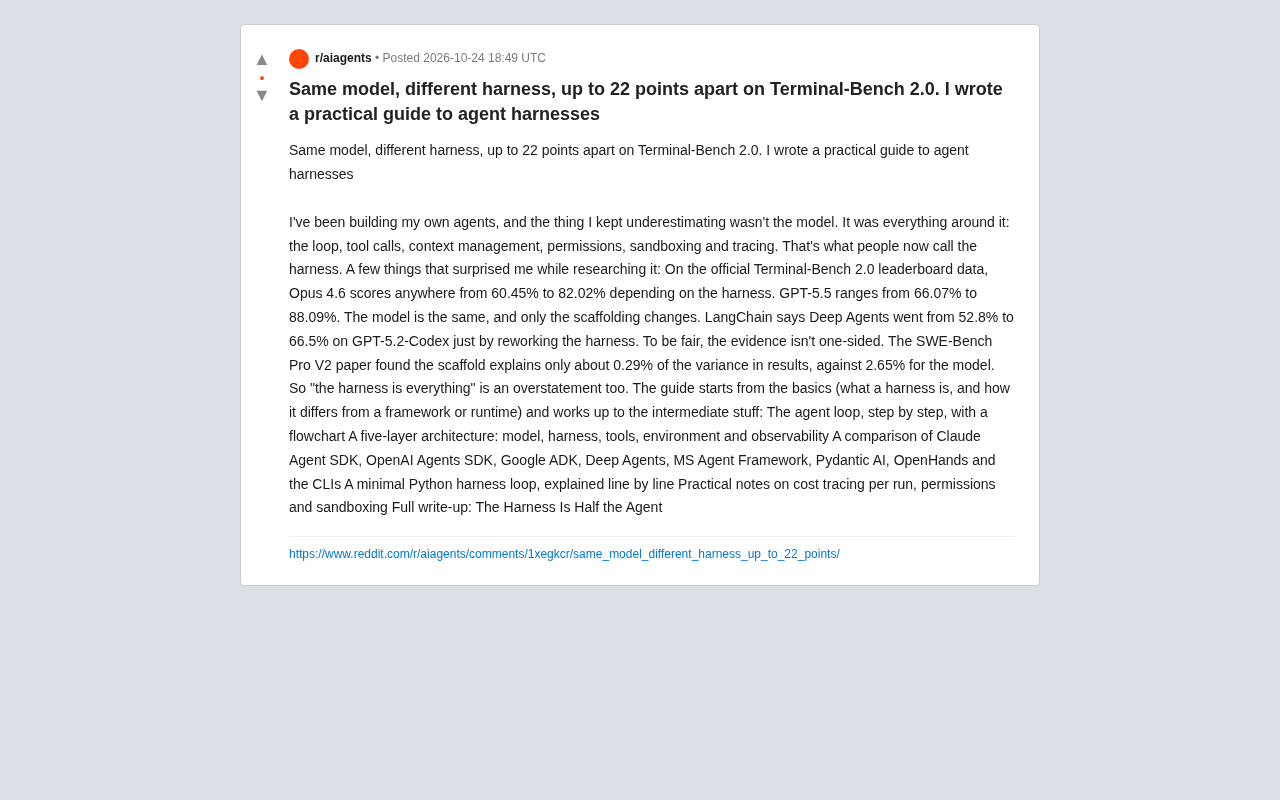
Same Model, 22-Point Score Gap: Agent Harness Is the Key Variable
Same model, different harness: Terminal-Bench 2.0 scores differ by 22 points—Opus 4.6 from 60.45% to 82.02%, GPT-5.5 from 66.07% to 88.09%. A look at agent harness architecture, SDKs, and a minimal Python loop.

Pennsylvania Signs AI Advertising Disclosure Bill, Requiring Labels on Generated Content
Pennsylvania signs the AI Deceptive Advertising Act, requiring labels on AI-generated or significantly modified ads across images, video, audio, and text. This article explains key provisions, industry impact, and regulatory trends.