Pennsylvania Signs AI Advertising Disclosure Bill, Requiring Labels on Generated Content

Pennsylvania signed the AI Deceptive Advertising Act, requiring labels on ads generated or significantly modified by AI, covering images, video, audio, and text.
Pennsylvania Governor Josh Shapiro signed the AI Deceptive Advertising Act, making the state the latest to regulate AI-generated advertising. The law requires all ad content significantly modified or generated by AI to carry clear labels, covering static images, video, audio, and text. The criterion is AI's degree of involvement in the final presentation, not tool usage. Legislators chose advertising due to existing consumer protection frameworks and mature enforcement paths. The bill reflects state legislation filling federal gaps, but details like the "significant modification" standard, label visibility, and penalties remain unclear. Advertisers and AI tool providers need AI content review mechanisms and labeling features, and transparency may become a trust selling point.
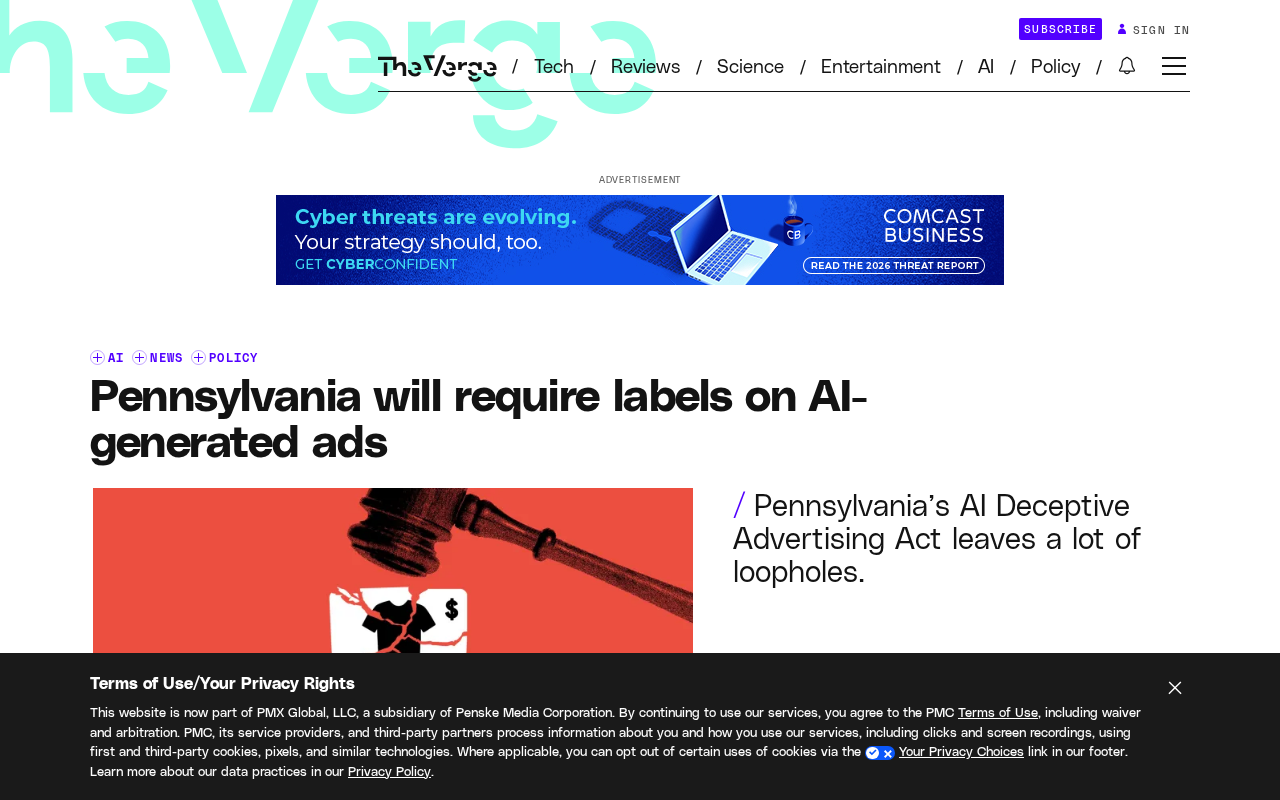
Pennsylvania has become the latest jurisdiction to regulate AI-generated advertising. Governor Josh Shapiro signed the "AI Deceptive Advertising Act" on Thursday, requiring all advertising content that is significantly modified or generated by AI to carry clear labels. The law covers multiple media formats including images, video, audio, and text, marking a shift from discussion to implementation in regulators' attention to AI's use in commercial communication.
Bill Core: What Counts as "AI Advertising"
According to public information, the law targets advertising content "significantly modified or generated by artificial intelligence." The criterion is not whether AI tools were used, but the degree of AI's involvement in the final presentation—if AI only performed simple cropping or color grading, disclosure obligations may not be triggered; but if AI generated imagery, reshaped a person's likeness, or synthesized speech, labels are mandatory.
The label format requirements align with other disclosure standards referenced in the bill, ensuring consumers can intuitively identify the AI nature of content. This "same-format" requirement means labels won't be vague footnotes but must be clearly visible notices within the advertisement.
Scope and Boundaries
The law explicitly lists four media types: static images, video, audio, and text. This means not only visual content is constrained—AI-generated voiceover ads and automatically written promotional copy also fall within regulatory scope. For advertisers and creative agencies, an AI usage review step needs to be added to workflows.
Interestingly, the word "deceptive" in the bill's name hints at legislative intent: preventing consumers from being misled because they cannot discern content sources. This is similar in approach to the EU AI Act's transparency requirements for deepfakes, but Pennsylvania's approach focuses more specifically on the advertising scenario.
Why Advertising
Advertising is one of the fastest-commercializing areas for AI-generated content. Brands can use AI to mass-produce product images, create synthetic videos of brand spokespeople, and even use voice cloning technology to make deceased celebrities "speak." While these applications boost efficiency, they also create new trust problems: the "real person recommendations" consumers see may never have existed.
Pennsylvania legislators chose advertising as an entry point for practical reasons. Advertising is constrained by existing consumer protection frameworks, regulators have mature enforcement paths, and advertisers have clear compliance budgets and legal teams to handle new requirements. Compared to comprehensive legislation on AI-generated content, focusing on advertising is an easier-to-execute starting point.
Industry Impact
For ad tech companies and creative agencies, this law means establishing AI content review mechanisms. Which materials used generative AI and which only used traditional post-processing needs to be documented in production workflows. Some companies may choose to proactively label AI usage in ads, turning it into a brand selling point for transparency.
For AI tool providers, product design may need built-in labeling features. For example, generative video tools could attach metadata or watermarks on export to help advertisers meet disclosure requirements.
Deepfake refers to highly realistic fake audio-visual content synthesized using deep learning techniques (such as generative adversarial networks, GANs). It can not only swap faces but also clone voices and simulate lip movements, making fictional scenes appear as if actually filmed. The technical barrier to deepfakes has dropped significantly—open-source tools and commercial APIs allow non-professionals to create convincing fake content. This has directly spawned the "synthetic spokesperson" phenomenon: brands can generate virtual characters or resurrect deceased celebrities for product endorsements without real-person authorization. The EU AI Act classifies deepfakes as high-risk applications requiring explicit disclosure; multiple US states have also legislated against deepfakes in election and pornography contexts. Although Pennsylvania's advertising law doesn't directly use the term "deepfake," its constraints on AI-synthesized speech and reshaped person likenesses essentially address the trust crisis deepfakes create in advertising scenarios.
Regulatory Trend: From Principles to Details
Pennsylvania's bill is not an isolated event. Multiple US states are advancing AI transparency legislation, covering directions including election advertising disclosure, criminalization of deepfakes, and watermarking requirements for AI-generated content. Although federal-level discussion is active, concrete legislative progress is slow, and state-level actions are filling the gap.
This fragmented regulatory landscape poses challenges for businesses operating across states. Different states may have different definitions of "significant modification" and specific label presentation requirements, requiring compliance teams to sort through requirements state by state. Industry organizations may push for unified standards to reduce compliance friction.
Unresolved Enforcement Questions
Signing the law is only the first step. How to determine whether an ad is "significantly" AI-generated, how enforcement resources will be allocated, and what the consequences of violations are—these details will determine the bill's actual effect. If penalties are insufficient, some advertisers may view labeling requirements as bearable compliance costs and selectively ignore them.
Another issue is label visibility standards. If labels are placed in scrolling credits at the end of a video, consumers will find it practically difficult to notice. Subsequent implementation rules may need to specify label position, size, and duration.
Content watermarking and metadata are technical means for AI-generated content transparency governance. Watermarks can be visible identifiers or invisible digital fingerprints (embedded in pixels or audio spectrums) used to trace content sources. Metadata records information such as generation tools, timestamps, and modification history in file properties. C2PA (Coalition for Content Provenance and Authenticity) has launched an open standard allowing verifiable provenance credentials to be attached to images and videos. The Pennsylvania bill requires labels to be "consistent with referenced standard formats" but does not mandate technical watermarks; however, in industry practice, tool providers are proactively adding watermarks or metadata on export to help advertisers comply. Future implementation rules may require labels to be machine-readable so platforms can automatically identify and filter undisclosed AI ads. Watermark robustness (resistance to cropping and compression) and cross-platform mutual recognition remain technical challenges.
The criterion for "significant modification" is a key enforcement difficulty. The law provides no quantitative threshold, relying instead on the principled description of "the degree of AI's involvement in the final presentation." In practice, regulators may need to reference industry guidelines or expert assessment to distinguish "assistive editing" (such as automatic color grading, smart cropping) from "generative transformation" (such as face-swapping, voice synthesis, scene generation). This is similar to the "substantial similarity" judgment in copyright law, requiring case-by-case analysis. For advertisers, maintaining an AI usage ledger (recording tools, parameters, modification scope) helps demonstrate compliance. If standards are vague, a "chilling effect" may occur—advertisers over-labeling conservative content, or conversely, exploiting gray areas to avoid disclosure. Subsequent rules may draw on bills like California's AB 2655 to list exempt scenarios (such as using AI only to optimize layout) and non-exempt scenarios (such as generating fictional character endorsements).
Implications for Content Creators and Marketers
For content teams using AI tools daily, this law sends a clear signal: AI involvement in content production is no longer purely a technical choice but a compliance matter requiring disclosure to audiences. Maintaining an AI usage ledger and confirming whether labeling is needed before publishing will become standard practice.
At the same time, transparency may also bring positive value. When consumers are generally wary of AI content, proactive disclosure can actually build trust. Turning "this ad uses AI generation" from a compliance burden into an expression of brand honesty is a direction some marketing teams are exploring.
Pennsylvania's bill provides an observable sample for other jurisdictions. Its enforcement effects, industry reactions, and consumer feedback will influence subsequent legislators' choices—whether to follow with similar requirements or adjust regulatory intensity. For every party in the AI advertising ecosystem, now is a window to establish compliance habits.
One-line Summary
Pennsylvania signed the AI Deceptive Advertising Act, requiring labels on ads generated or significantly modified by AI, covering images, video, audio, and text.
Paragraph Summary
Pennsylvania Governor Josh Shapiro signed the AI Deceptive Advertising Act, making the state the latest to regulate AI-generated advertising. The law requires all advertising content significantly modified or generated by AI to carry clear labels, covering static images, video, audio, and text. The criterion is the degree of AI's involvement in the final presentation, not whether tools were used. Legislators chose advertising because it is constrained by existing consumer protection frameworks and has mature enforcement paths. The bill reflects the trend of state-level legislation filling federal gaps, but enforcement details such as the "significant modification" criterion, label visibility standards, and penalty severity remain unclear. For advertisers and AI tool providers, establishing AI content review mechanisms and labeling features is necessary, and transparency may also become a brand trust selling point.
Related articles

One Person Producing 90 Episodes of AI Anime Shorts: The Complete Production Workflow in 10 Hours for 10 Yuan
No screenwriting experience needed for AI anime shorts: 10 hours and 10 yuan in costs, 4,200 yuan earnings per work on Hongguo. This article breaks down the complete six-step workflow from AI-generated scripts and storyboard scripts to the finished film, with a universal questioning formula and beginner pitfall guide.

Build a Quote Calculator with Doubao Agent: Stop Guessing Your Freelance Rates
A Bilibili creator uses Doubao Agent to build a no-code quote calculator that auto-generates itemized quotes with rush and copyright buyout rates, one-click copy, and mobile quoting.

WorkBuddy Hands-On Tutorial: 10 Agent Projects from Beginner to Resume-Worthy
WorkBuddy tutorial: a Chinese-language AI work assistant with simpler setup than Codex or Claude Code. 10 hands-on Agent projects for beginners, resume-ready.