Open-Source AI Assistant Showdown: Claude Code, OpenClaw, Hermes, and Grok Bot Tested

As personal AI assistants explode, open-source and managed paths each have costs, and users are re-weighing due to maintenance and token expenses.
Starting from a Reddit power user's real experience, the article maps the boom in personal AI assistants across two paths: the open-source, customizable "Linux model" (OpenClaw, Hermes) and the managed, hassle-free "Mac model" (Grok Bot, Muse, Dots, Claude Duet). Open source offers model-agnostic freedom but demands self-managed infrastructure, community-dependent stability, and drives up token consumption; managed is seamless but sacrifices flexibility and blurs privacy. The user is considering leaving Hermes due to maintenance and token bills. The conclusion: no all-around champion—it depends on how much you're willing to manage.
When There Are Too Many AI Assistants to Keep Up With, Who Should We Actually Choose?
Every day he opens Claude Code, treats Codex as a research partner, and can't resist trying OpenClawAd twice—only to give up both times because it kept crashing. This isn't an isolated case; it's the real complaint of a power user on Reddit. He recently switched to the Hermes agent team and saw some improvement, but he's still troubled by token consumption and Codex's mediocre performance as the "brain." Meanwhile, new products like Grok Bot, Muse, Dots, and Claude Duet keep launching, leaving people dazzled.
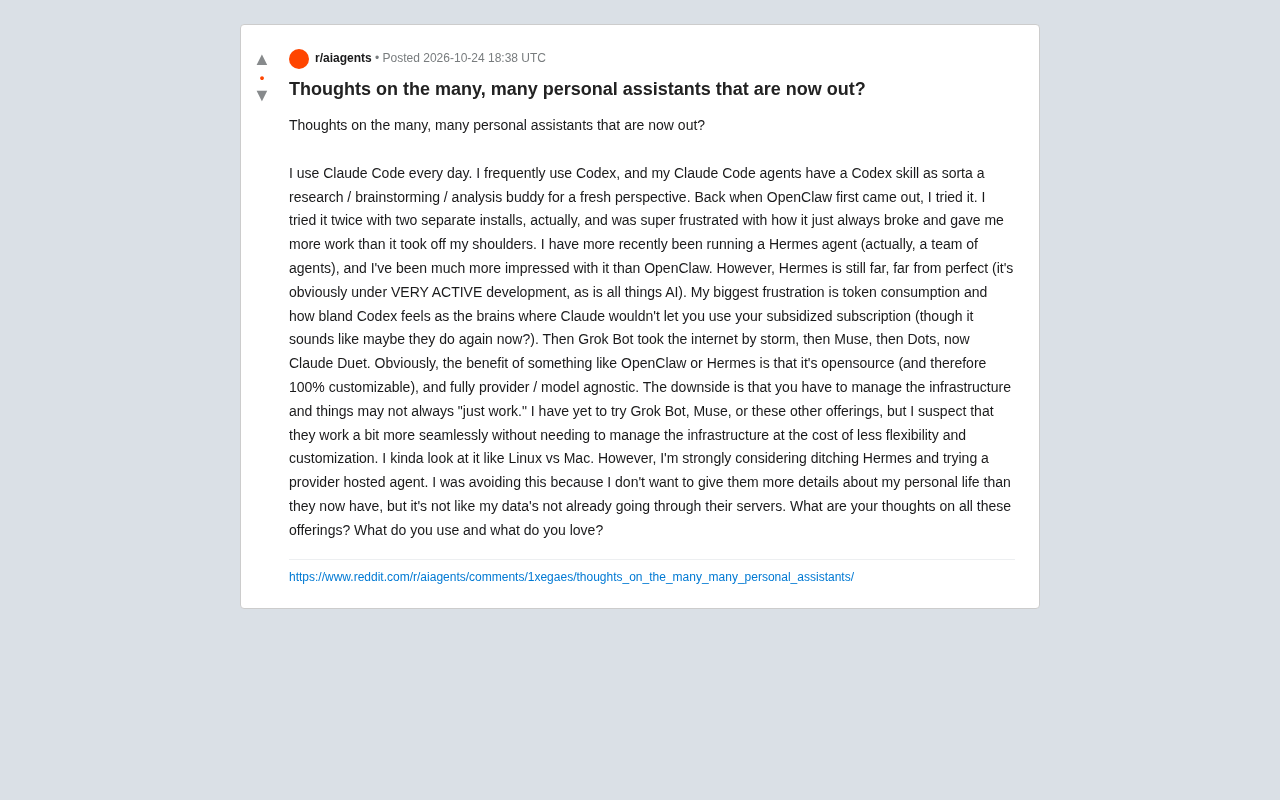
This explosion of personal AI assistants looks like a feature race on the surface, but underneath it's a showdown between two approaches: the open-source, customizable "Linux model" versus the managed, hassle-free "Mac model."
The Open-Source Camp: Freedom and Its Price
OpenClaw and Hermes represent the open-source camp. They're fully customizable and not tied to any model provider—you can freely switch between Claude, Codex, or local models. But the price is direct: you have to manage the infrastructure yourself, and stability depends entirely on the community's update cadence. This user ran into "always breaking" issues on both OpenClaw installs, which actually added to his workload.
Hermes performed slightly better. He was running an agent team rather than a single assistant, and his overall impression was better than OpenClaw. But Hermes is far from perfect either—the project is in a very active development phase, and token consumption remains high. More subtly, when he used Codex as the "brain," the answers felt bland; Claude performed better, but for a while it didn't allow subsidized subscriptions (though that seems to have opened up again recently).
How OpenClaw and Hermes Differ in Positioning
OpenClaw is an open-source "personal AI assistant framework" whose core idea is to assemble different models, tools, and plugins into a self-hostable assistant; Hermes is closer to the concept of an "agent team"—not a single assistant, but multiple agents dividing labor to complete tasks like research and coding. Both emphasize being model-agnostic, meaning they aren't locked to Claude, GPT, or local models. The cost of this architecture: deployment requires your own API keys, vector store, and runtime environment; version updates are frequent and may introduce breaking changes; and community docs often lag behind the code—so "always breaking" isn't an isolated case but the norm for early-stage open-source projects.
The Managed Camp: Seamless but Closed
Grok Bot, Muse, Dots, and the latest Claude Duet belong to the other approach. The user hasn't deeply tried these products yet, but suspects they're "more seamless at runtime and don't require managing infrastructure," at the cost of reduced flexibility and customization. He compares the two to Linux versus Mac—open source gives you control, managed gives you peace of mind.
One real dilemma is privacy. He admits he's always avoided handing personal life details to managed services, but then reconsidered: "My data has already passed through their servers anyway." This is probably the psychological portrait of many power users: the boundary between convenience and privacy is getting blurrier.
What Exactly Is Being "Managed"
Managed personal assistants (Grok Bot, Muse, Dots, Claude Duet) encapsulate model calls, conversation memory, tool integration, and infrastructure operations on the vendor side—users just log in and go. Their "closed" nature shows up in three places: models are usually locked to the vendor's own or partner models; memory and context are stored on vendor servers, hard to export or migrate; and behavior and plugin ecosystems are defined by the vendor, so users can't modify code the way they can with open-source solutions. Products like Claude Duet further productize "multi-assistant collaboration," but the collaboration logic is preset by the platform, leaving users with limited parameters to adjust. That's the meaning of the "Mac model": smooth experience, but reduced replaceability and room for deep customization.
The User's Real Dilemma: Should He Give Up on Hermes?
The user explicitly says he's seriously considering abandoning Hermes and switching to a provider-hosted agent. The driver isn't missing features but the fatigue from maintenance costs and token consumption. What he wants is a tool that "actually reduces the burden," not a project that needs constant debugging. This also raises a broader question: for ordinary developers, is the appeal of open source enough to offset the operational burden?
Why Token Consumption Is a Hidden Cost of Open-Source Assistants
The agent-team model significantly amplifies token consumption: a single task may trigger multiple agents to repeatedly plan, call tools, and cross-review results, with context re-sent to the model at every step. Open-source solutions don't subsidize inference costs—users pay API list prices, and long sessions and complex toolchains make bills pile up fast. By contrast, managed products often bundle subscriptions, trading subsidized pricing for user stickiness—the mention that "Claude once didn't allow subsidized subscriptions" shows that subscription eligibility directly affects a solution's viability. So "operational burden + token cost" forms the double hidden cost of the open-source path, and it's the core reason this user is considering switching to managed.
Your Choice Depends on How Much You're Willing to Manage
From community feedback, there's no all-around champion. If you enjoy tuning, need model-agnosticism, and are sensitive to data flows, open-source solutions are still the first choice. If you value out-of-the-box usability and are willing to trade some control for stability, managed agents are maturing fast. The only certainty is that this field won't stop—all products are in "very active development," and today's shortcomings may be fixed next month.
So which one are you using? Are you holding the open-source line, or have you already defected to the managed camp?
One-line Summary
With personal AI assistants booming, open-source and managed paths each have their costs, and users are re-weighing due to operational and token expenses.
Paragraph Summary
Starting from the real experience of a power user on Reddit, the article maps out the current explosion of personal AI assistants. The author divides products into two paths: the open-source, customizable "Linux model" represented by OpenClaw and Hermes, and the managed, hassle-free "Mac model" represented by Grok Bot, Muse, Dots, and Claude Duet. Open-source solutions are model-agnostic and highly flexible, but require self-managed infrastructure, depend on the community for stability, and the agent-team model drives up token consumption; managed solutions are seamless and hassle-free, but sacrifice flexibility and customization and blur privacy boundaries. This user is seriously considering abandoning Hermes for managed due to maintenance costs and token bills. The article concludes that there's no all-around champion today—the choice depends on how much the user is willing to manage, and all products are iterating rapidly.
Related articles

The Other Side of the Agricultural Revolution: How Disease Helped Farmers Defeat Hunter-Gatherers
Historian Kyle Harper explains how agricultural societies defeated hunter-gatherers: not only through population growth from superior energy extraction per unit of land, but also through pathogens bred by settled life that caused extra mortality during expansion—a dual replacement mechanism.

Why Is AI-Generated Language So Hard to Understand?
Why is AI-generated language fluent yet hard to understand? Based on a Hacker News discussion, this article analyzes the cognitive load of AI text from three angles—imbalanced semantic density, lack of common ground, and side effects of alignment training—and offers practical advice for getting along with AI language.

Progressive Disclosure Makes Agents 2.3x Faster: A New Approach to Context Engineering
A Hacker News discussion proposes using progressive disclosure to optimize AI agent context, achieving a 2.3x speedup. This article analyzes the three performance costs of context bloat and introduces practical approaches such as layered tool catalogs, on-demand retrieval, and history compression, along with implementation considerations.