iPhone Duo First-Gen Review: Why the Matte Inner Display Is the Biggest Highlight

The iPhone Duo's matte inner display trades a bit of transparency for stable visibility under complex lighting—the most practical highlight of the first-gen foldable.
Based on a week of real-world use, the article reviews Apple's first foldable iPhone Duo. The author finds the matte inner display—not the hinge or outer screen—most impressive: it significantly suppresses reflections in harsh airplane-window light and complex cabin lighting, preserving immersive large-screen viewing. Compared with the Galaxy Z Fold's glossy display, it sacrifices some peak-brightness transparency for more stable visibility—a smart trade-off for large-screen devices. The author also notes the Duo still carries first-gen messiness, with the matte screen among the few clearly affirmed highlights.
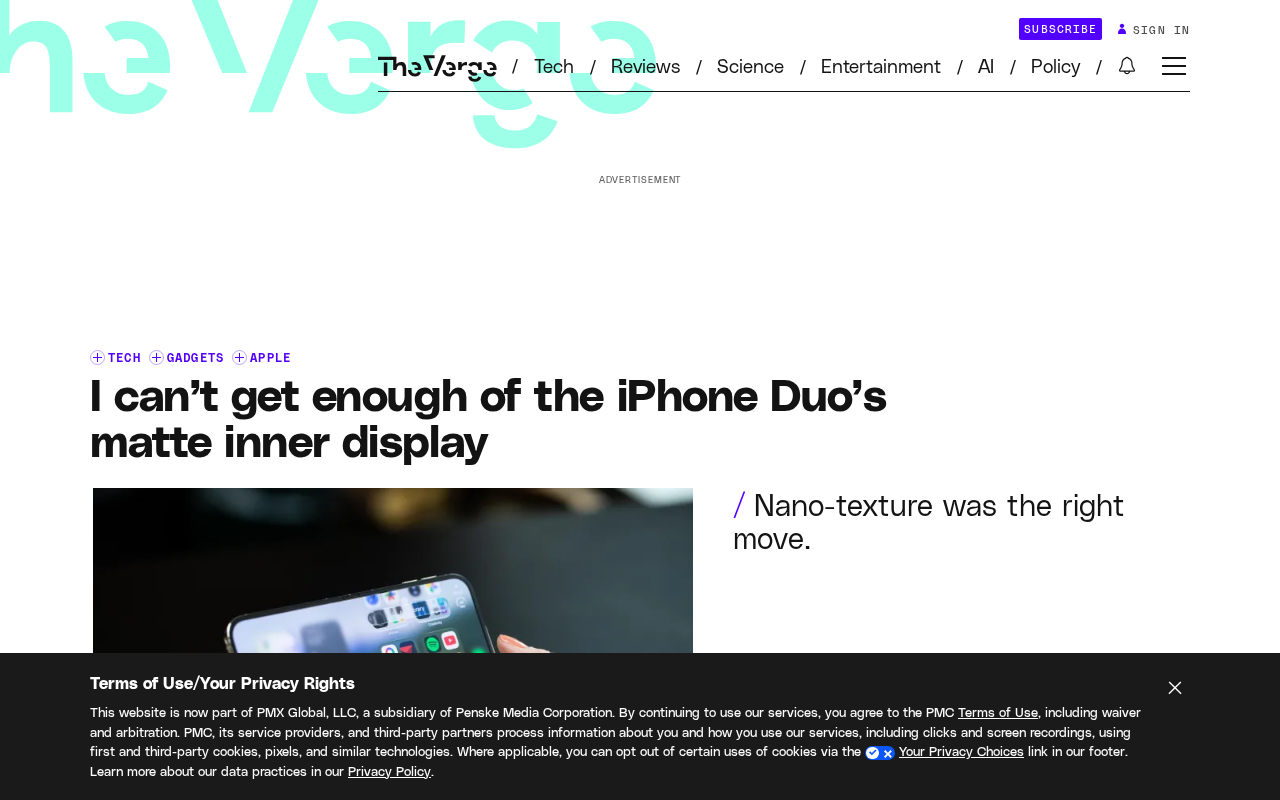
Apple's first foldable device, the iPhone Duo, arrives with obvious first-generation characteristics. After a week of real-world use—including watching movies on a plane and everyday browsing—the most impressive thing isn't the hinge structure or the outer screen size, but the matte treatment of the inner display. This seemingly minor choice happens to solve a core pain point that foldable phones have long struggled with.
Matte Inner Display: A Small Change Solves a Big Problem
Foldable phone inner displays have always faced a dilemma: glossy glass offers strong transparency but reflects heavily; matte treatment reduces glare but may sacrifice clarity. The iPhone Duo opts for a matte finish on its inner display, and in practice, you can still see the picture clearly under the harsh light from an airplane window, and while watching movies you aren't constantly distracted by your own reflection.
Compared with the glossy inner display of the Galaxy Z Fold series, the difference is immediately obvious. Samsung's approach delivers more vivid colors in low light, but once ambient light gets complex, users have to keep adjusting the angle. The iPhone Duo's matte screen sacrifices a bit of transparency at peak brightness in exchange for more stable visibility. For a large-screen foldable device, this trade-off is smart.
The cover material of a foldable inner display is fundamentally different from that of a slab phone. The mainstream approach today is to layer a surface-treatment layer on top of ultra-thin flexible glass (UTG) or a transparent polyimide (CPI) film. The distinction between glossy and matte comes from the microstructure of this treatment layer: a glossy surface achieves mirror reflection through nanoscale flatness, while a matte surface uses micron-scale roughness to scatter incoming light into diffuse reflection.
The problem is that a foldable cover must simultaneously satisfy three conditions—foldability, scratch resistance, and high transmittance—and roughening introduces haze, which directly lowers transmittance and contrast. This is why most manufacturers would rather tolerate reflections than easily apply matte treatment to foldable inner displays—it tests the stability of the coating process after repeated folding. The fact that the iPhone Duo can bring matte treatment to the inner display shows that Apple has found a balance between haze and clarity in its cover stack design, rather than simply applying a frosted film.
Another often-overlooked variable is the crease. A matte surface weakens the specular highlight of the crease, making it visually less noticeable—this may be a hidden benefit of Apple's choice of matte.
The Roughness of a First-Gen Product Still Exists
According to the original author's feedback, the iPhone Duo still carries a "first-generation" sense of messiness in many design decisions. The original article doesn't elaborate on which specific design issues there are, but states clearly that they are "not sure they like all of Apple's design decisions." This aligns with the typical performance of Apple's first-gen products in new categories—core experience has highlights, but detail polishing falls short.
Interestingly, the original author singles out the matte inner display for praise, suggesting other aspects may lack surprises of the same level. For a foldable iPhone, users expect more than just screen treatment—they also want interaction logic, app adaptation, battery performance, and more. How these aspects actually perform requires more long-term use to judge.
A Week of Use Cases: In-Flight Movie Watching as the Litmus Test
An airplane cabin is an extreme scenario for testing screen quality: overhead lights shining directly, side light from the window, and limited seating angles. The author watched movies on the iPhone Duo on a plane, which happens to hit the most commonly complained-about use case for foldables. In this environment, the matte inner display reduces reflections, preserving the immersion of large-screen viewing.
This detail has implications for the product positioning of foldables. The core selling point of a foldable is the large-screen experience, and if the large screen is constantly disrupted by reflections, the frequency of unfolding it will decline. Apple starts with the screen surface treatment, essentially improving the practical usability of the large screen rather than chasing peak brightness specs.
The quantitative metric for screen reflection is reflectance. Ordinary glossy glass covers are about 4%–8%, and adding an anti-reflection coating can bring it down to 1%–2%, but coatings address specular reflection and have limited effect on wide-angle diffuse light. An airplane cabin happens to be an extreme sample of diffuse light: parallel side light from the window, angled direct light from the overhead reading lamp, and multiple reflections off the cabin walls all add up—any specular component gets amplified into reflections visible to the human eye.
Matte surfaces work differently: they distribute reflected energy across the hemispherical space, greatly reducing luminance per unit solid angle, at the cost of slightly raised black levels and a loss of some "glassy" feel. This is why matte screens look stable in bright environments but are less sharp than glossy screens in a dark room. For foldables, the weight of this trade-off clearly leans toward matte—large-screen devices are used in varied postures, and users can rarely fix the angle of incidence as they would with a monitor.
It's worth adding that matte treatment is also more forgiving of stylus use and fingerprint residue—smudges are less visible on a diffusely reflecting surface than on a mirror-like one.
The Trade-off Logic of First-Gen Foldables
The iPhone Duo's choice of a matte inner display reflects a product philosophy: at a stage when the foldable form factor is not yet mature, prioritize solving basic experience problems rather than stacking flashy features. The coexistence of first-gen "messiness" and a single point done "right" is precisely the real state of early foldable devices.
For potential users, whether the matte inner display is enough of a reason to buy depends on usage habits. Those who frequently use the large screen outdoors or under complex lighting will clearly perceive the value of this design. Users chasing ultimate color performance may feel a glossy screen suits them better. Apple's choice this time isn't a universal solution, but the direction is right.
A foldable's hinge and screen stress are two sides of the same coin. The inner display is bent to an extremely small radius when closed, and the flexible cover and polarizer endure alternating stress over time—any surface coating must pass hundreds of thousands of folding tests. If the matte coating has insufficient adhesion, microcracks or delamination will appear first in the crease area, forming visible bright spots. Therefore, when applying surface treatment to a foldable inner display, manufacturers usually need to simultaneously adjust the neutral layer position and the modulus of the OCA optical adhesive.
This also explains the "messiness" of first-gen foldable products: the hinge, cover, coating, and crease compensation form a coupled constraint system—change one and you must re-validate the entire chain. As a latecomer, Apple can skip early trial and error in materials and processes, but still faces the trilemma of weight, thickness, and durability. First-gen products often excel in one dimension and compromise in others—the matte inner display is precisely the chosen point of excellence.
One-line Summary
The iPhone Duo's matte inner display trades a bit of transparency for stable visibility under complex lighting, becoming the most practical highlight of the first-gen foldable.
Paragraph Summary
Based on a week of real-world use, the article reviews Apple's first foldable iPhone, the Duo. The author finds the most impressive aspect isn't the hinge or outer screen size, but the matte treatment of the inner display: it significantly suppresses reflections under the harsh light of an airplane window and complex cabin lighting, preserving the immersion of large-screen viewing. Compared with the Galaxy Z Fold's glossy inner display, the iPhone Duo sacrifices some transparency at peak brightness for more stable visibility—a smart trade-off for a large-screen device. At the same time, the author notes that the iPhone Duo overall still carries a first-gen sense of messiness, with many questionable design decisions, and the matte screen is one of the few clearly affirmed highlights. The article distills the trade-off logic of first-gen foldables: solve basic experience first, then talk about flashy features.
Related articles

Amphibious Transforming Drone: Beyond 100x Power Savings, What Are the Real Needs?
Is the amphibious transforming drone just a gimmick? Starting from the 100x power difference of the M4 Morphobot, explore real application scenarios and thesis topic ideas, analyzing boundary conditions where pure drones and pure ground robots both fail.

Warhound Raises $200 Million: Genetically Engineered "War Dogs" Paired with Anduril Gear
Warhound raises $200M, backed by Ben Lamm and Palmer Luckey, to genetically engineer dogs for military and law enforcement use and equip them with Anduril gear. This article analyzes its technology direction, funding logic, and ethical controversy.

Claude API Comes to Google Cloud: IAM Integration and SDK Access Guide
Anthropic hosts the full Claude API on Google Cloud with IAM-controlled permissions and unified billing. This guide covers the Vertex AI and Anthropic-hosted entry points, IAM role configuration, and SDK access.