iPhone Duo Foldable Screen Cracks Reported Frequently, User Frustration Grows

Early iPhone Duo users report screen cracking, pressuring Apple's foldable reputation.
Apple's first foldable iPhone Duo has drawn screen cracking complaints from a few early users. Though not a large-scale failure, the issue has escalated due to high expectations. Foldable reliability—material fatigue, encapsulation aging, and hinge dust protection—remains an industry-wide challenge. Public details are limited, and whether it is a design defect awaits official investigation. If confirmed as a batch quality issue, Apple could face repair, warranty, or recall pressure.
Title
iPhone Duo Foldable Screen Cracks Reported Frequently, User Frustration Grows
Meta Description
Apple's foldable iPhone Duo has been reported to have screen cracking issues among early users, fueling growing frustration. This article reviews the current complaints, the reliability challenges of foldable screens, and the potential impact on Apple's product line.
Article Content
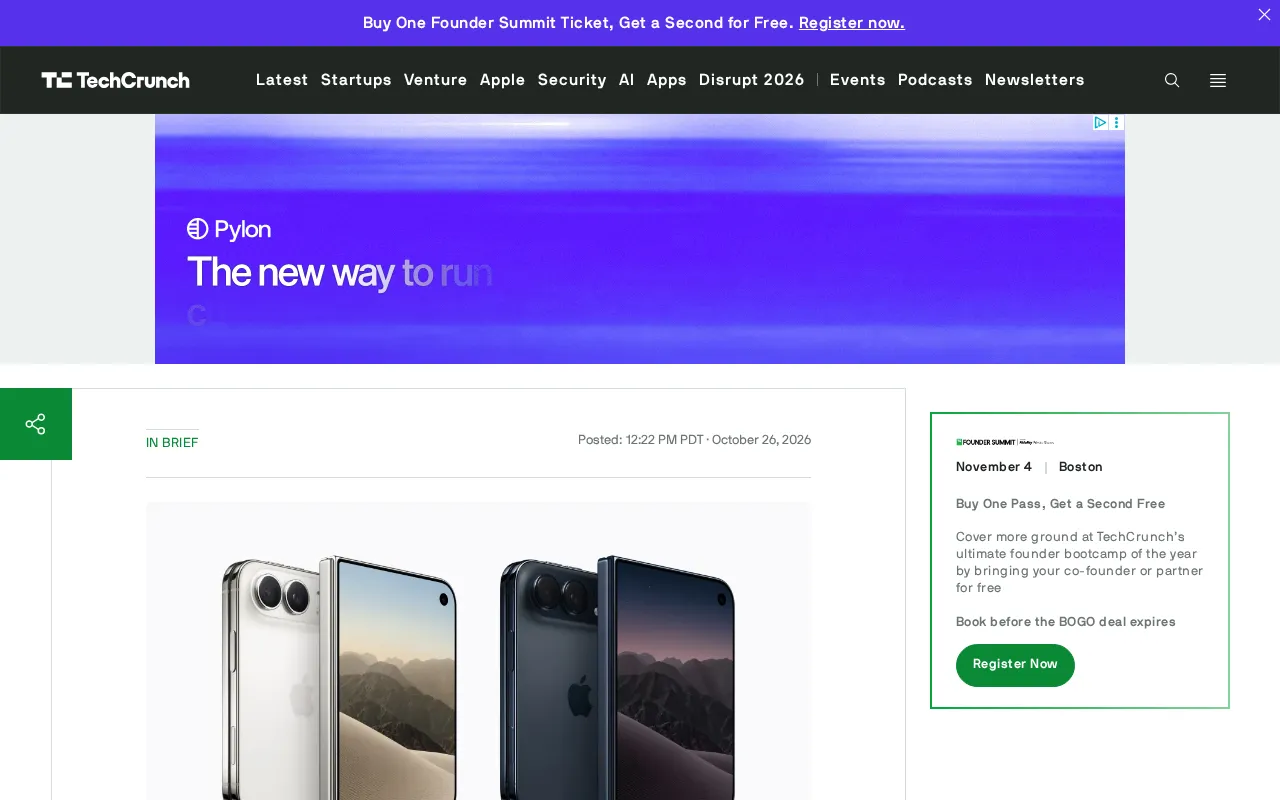
Apple's first foldable phone, the iPhone Duo, is facing a reputation crisis among early users. According to an RSS source, a small number of users who got their hands on the highly anticipated device first have reported screen cracking issues. For a high-end foldable device, screen reliability is precisely the pain point users are most sensitive to, and the emergence of early complaints is enough to make potential buyers hesitate.
Cracking Issue Comes to Light
The report notes that complaints are currently concentrated among "a few early adopters" and do not constitute a large-scale failure. However, the structural peculiarities of foldable phones mean that any screen-level complaint will be amplified in interpretation. Unlike traditional bar phones, the flexible panel of a foldable screen must withstand the mechanical stress of repeated bending, and material fatigue in the hinge area or aging of the protective layer can become the starting point of cracks. Early users tend to be those who use the device most intensively, and the problems they encounter are likely to foreshadow hidden risks in broader usage scenarios.
Apple has invested substantial marketing resources in this product, and market expectations have been pushed very high. Against this backdrop, feedback about screen cracking stands in sharp contrast to the heavily hyped image of the product, making users' frustration easy to understand.
The reason foldable flexible display panels can bend lies in replacing the traditional rigid glass backplane with a bendable polyimide (PI) substrate, and covering the surface with ultra-thin glass (UTG) or a polymer protective film. The problem is that this protective material has limited elastic recovery: each fold introduces tiny plastic deformation in the region with the smallest bending radius, and after thousands to hundreds of thousands of cycles, microcracks initiate from the edges or hinge crease and gradually propagate, ultimately appearing as visible cracks. Manufacturers typically set a design target of more than 200,000 folds, but there is a gap between laboratory conditions and real-world use—low temperatures, dust, sweat, and pocket compression all accelerate material degradation. This is also why early high-intensity users tend to be the first to expose problems, as their usage frequency and probability of bumps are above average.
The Long-Standing Reliability Challenge of Foldable Screens
Foldable screens are not a new concept; manufacturers such as Samsung have iterated through multiple generations of products, but screen durability has always been a recognized industry difficulty. Flexible OLED panels need to be covered with ultra-thin glass or polymer protective layers, and these materials are prone to microcrack accumulation under repeated folding; if the dustproof design of hinge gaps is inadequate, foreign objects entering can also scratch the panel. As a latecomer, Apple was originally expected to solve these chronic issues with more mature engineering solutions, and early cracking reports have clearly weakened this expectation.
It should be emphasized that currently public information only mentions the phenomenon of "screen cracking" and does not disclose the specific model batch, crack location, or triggering conditions. Before Apple gives an official investigation conclusion, individual cases should not be directly equated with design defects.
Flexible OLED and ordinary OLED share the same light-emitting principle, with the difference mainly in the substrate and encapsulation. Flexible panels use thin-film encapsulation (TFE) with alternating multilayer inorganic/organic structures to block water and oxygen, but the barrier performance of thin-film encapsulation is inherently weaker than rigid glass encapsulation. Once microcracks penetrate the encapsulation layer, moisture intrusion can cause light-emitting pixels to fail and produce dark spots. In addition, the hinge of a foldable screen is another key failure point: it must provide a stable bending trajectory to avoid localized stress concentration on the panel while also providing dust protection. Samsung's early Galaxy Fold suffered widespread damage when foreign objects entered through hinge gaps, after which manufacturers generally added brush-type dustproof structures. For Apple, the challenge lies in how to strike a balance among thinness, water resistance rating, and hinge durability, and these engineering trade-offs often determine the upper limit of screen cracking risk.
What It Means for Apple
Foldables are a category with both high prices and high profit margins in Apple's product line, and the reputation of first-batch users will directly affect the subsequent sales pace. If the cracking issue is confirmed to be a batch quality problem, Apple may face pressure regarding repair solutions, extended warranty policies, or even recalls. For competitors, this is also an observation window—the focus of competition in the foldable market is shifting from "can it fold" to "how long does it last."
The incident is still in an early stage of development, and subsequent progress depends on Apple's official response and the scope of the problem. For consumers waiting on the sidelines, it is advisable to pay attention to official diagnostic results before making a decision.
One-line Summary
Apple's first foldable iPhone Duo has drawn early screen cracking complaints, putting pressure on its reputation pending official characterization.
Paragraph Summary
Apple's first foldable phone, the iPhone Duo, has drawn screen cracking complaints from a small number of early users. Although it is not a large-scale failure, it has rapidly escalated due to the product's high positioning and high expectations. Flexible panels in foldables must withstand repeated bending stress, and material fatigue, encapsulation aging, and hinge dust protection are common industry challenges that even pioneers such as Samsung have not fully solved. As a latecomer, Apple was expected to break through with more mature engineering solutions, but early cracking reports have weakened that expectation. Public information is currently limited, with no disclosure of batch, crack location, or triggering conditions, and whether it constitutes a design defect awaits official investigation. If confirmed as a batch quality issue, Apple will face pressure over repairs, extended warranties, or even recalls, and first-batch reputation will also affect the subsequent sales pace and the competitive focus of the foldable market.
Related articles

DeepSeek Open-Sources DeepInfer: What Is an Inference Framework Actually For?
DeepSeek open-sources its inference framework DeepInfer under Apache 2.0, supporting DeepSeek V4.1 Flash offline inference. This article explains its request scheduling, FlashMLA/DeepGEMM compute optimization, DSPark speculative verification acceleration, and what it means for developers and ordinary users.
Open-Source AI Learning Agent: A Full Workflow Experience from Topology Graphs to Exam Generation
Explore an open-source AI learning agent: built on DeepSeek API, it constructs knowledge systems via topology graphs, with automatic document generation, notes, super documents, and exams. Learn about its Agent workflow and design highlights.

DeepSeek Whale Girl Open-Source MV Meme: AI Industry Coded Slang About Pivoting to Closed Source
Bilibili's DeepSeek Whale Girl rap MV uses fictional memes to tease the AI open-source vs. closed-source debate, with lyrics full of industry slang. This article explains the meme culture, the Whale Girl symbol, and the open/closed tension.