iPhone Duo Has Issues Right at Launch: Screen Cracking Near the Hinge Exposed

Multiple users reported inner-screen failures near the hinge on iPhone Duo's first day of sales, with consistent locations pointing to a systematic problem.
On the day iPhone Duo officially went on sale, multiple Reddit users reported abnormalities in the inner screen near the hinge, with highly consistent failure locations. This consistency suggests the problem may stem from a systematic deviation in design or manufacturing rather than occasional yield fluctuation. The hinge area is inherently the most stress-concentrated and fragile part of a foldable's structure, and repeated bending places extremely high demands on materials and processes. Apple has not yet announced investigation findings or a replacement policy, and first-batch buyers should pay attention to the warranty process and whether later batches improve. The article notes that the reliability challenge of foldables remains unsolved, and form-factor innovation must be built on the premise of sound structural design.
Quality Control Crisis on Launch Day: iPhone Duo Screen Failures Erupt
The iPhone Duo officially went on sale today, but some of the first buyers are already running into trouble. According to multiple posts on Reddit, some devices are showing similar screen problems near the hinge. From what users have shared, the failures aren't randomly distributed—they're concentrated in the same area of the inner screen close to the hinge, showing a certain pattern.
This isn't Apple's first foray into foldables, but as the first product to carry the "Duo" name, its launch-day quality control clearly hasn't met outside expectations. For a high-end folding device, multiple screen failure reports on the very first day of sales—whether ultimately attributed to design, manufacturing, or shipping—are enough to make potential buyers cautious.
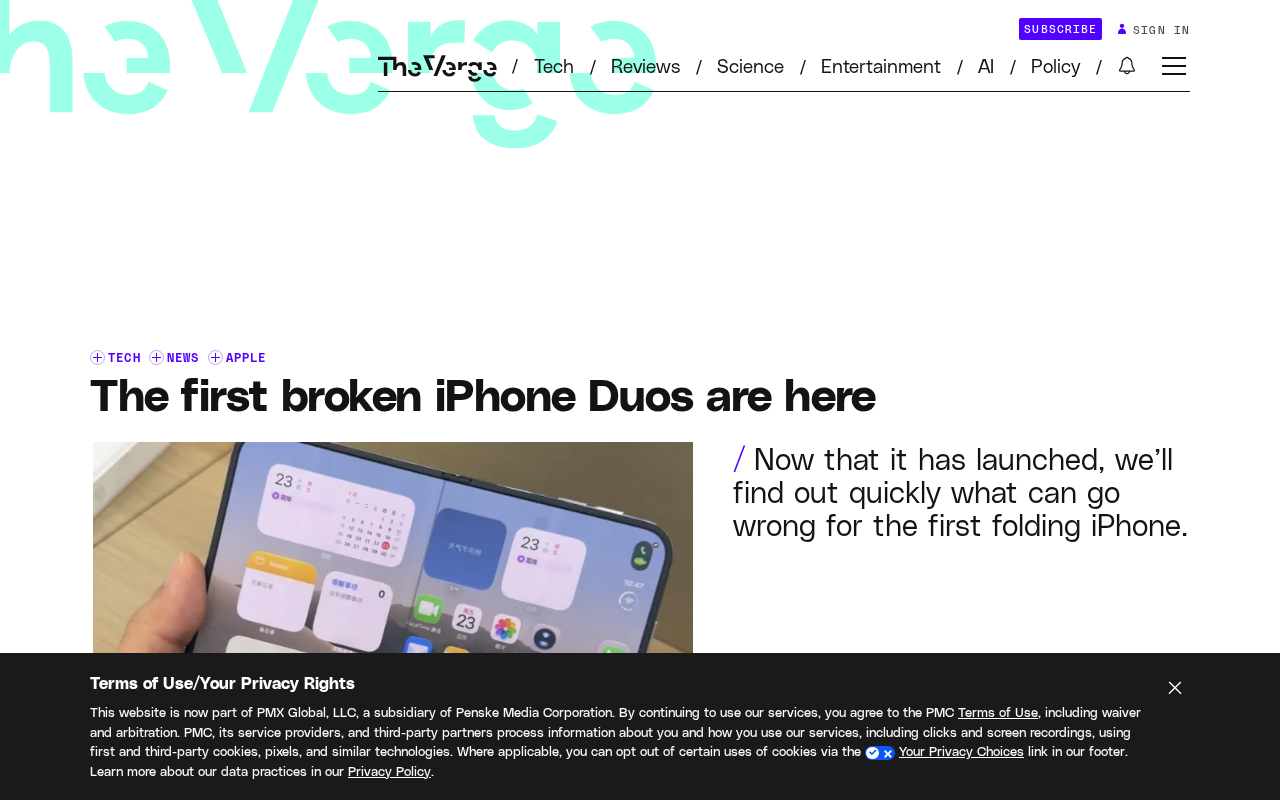
Failure Characteristics: Not Isolated Cases, but "the Same Kind of Damage"
According to descriptions from affected users on Reddit, the problem is consistent: the inner screen shows some kind of abnormality near the hinge, accompanied by "strange phenomena"—the original text cuts off at this point, but given common failure modes in foldables, this kind of display abnormality near the hinge is usually related to concentrated bending stress, hinge structural tolerances, or the screen lamination process.
Consistency is the most noteworthy aspect of this incident. If only a few scattered units had dead pixels or loose cables, that would look more like an occasional error during shipping or assembly. But when multiple independent users report failures at "the same location," the nature of the problem changes—it points to a systematic deviation in design or manufacturing rather than simple yield fluctuation.
For foldable phones, the hinge area is inherently the most fragile and stress-complex part of the entire structure. The screen needs to bend here hundreds of thousands of times, and any tiny accumulation of tolerance can be amplified in a particular batch.
Bending Stress and Failure Modes in Foldables
A foldable inner screen typically consists of multiple layers: an ultra-thin flexible glass (UTG) or polymer film on top, a polarizer and touch layer in the middle, a light-emitting display layer at the bottom, and a support layer for cushioning. Near the hinge, the screen must bend repeatedly at a very small radius, and the stress distribution in this area is far more complex than in flat regions—the outer layer is stretched, the inner layer is compressed, and shear stress arises between layers. When the bending radius is too small, hinge tolerances are too large, or lamination between layers is uneven, stress concentrates at specific locations, and over time this can lead to delamination, microcrack propagation, or broken display traces. This is also the root cause of recurring failures in early foldable products, such as "broken lines at the crease" and "bright spots next to the hinge."
Tolerance Stack-Up and Batch Consistency
In consumer electronics manufacturing, every component has an allowable dimensional deviation range, and the accumulation of deviations across multiple parts is called "tolerance stack-up." A foldable hinge consists of dozens or even hundreds of precision parts, and screen lamination involves multiple bonding steps. If tolerance stack-up at any stage exceeds the design margin, a given batch of devices may show a consistent weak point in the hinge area. This is the engineering logic behind why "failures concentrated in the same location" often points to systematic deviation rather than random yield fluctuation.
What This Means for First-Batch Buyers
It's still unclear how many devices are affected, and it's uncertain whether Apple has launched an investigation or introduced a replacement policy. For users who have already ordered or are planning to buy, there are several practical issues to weigh.
First is the warranty and replacement process. Launch-batch quality issues are usually prioritized by manufacturers, but users need to proactively report the problem and keep evidence—especially for screen failures, which are easily classified as "accidental damage." Second is the value of waiting—if the failure truly stems from structural design, whether later batches improve will directly affect purchase timing.
By industry convention, first-generation or early-batch foldable products often come with higher repair rates, a hurdle almost every manufacturer has to face. The problem for iPhone Duo is that it exposed this lesson on the very first day of sales.
Quality Control Traits of Launch Batches and "Accidental Damage" Determinations
Launch batches of consumer electronics usually face capacity ramp-up pressure, production lines are not yet stable, process parameter tuning and incoming material consistency are still being worked out, so higher repair rates in early batches than in mature batches are a common industry phenomenon. For users, the trickiest part of seeking redress for screen failures is the "accidental damage" determination—manufacturer after-sales service usually judges based on whether there are dents, liquid ingress traces, or unauthorized repairs, while display abnormalities near a foldable hinge are often hard to distinguish by appearance as being caused by structural stress or external squeezing. Therefore, keeping unboxing videos, records of the usage scenario when the failure occurred, and multi-angle photos is especially important when communicating with after-sales service. In addition, watching for whether the manufacturer issues a service bulletin or extends warranty coverage for related components is also a reference signal for judging the severity of the problem.
The "Hinge Curse" of Foldables Remains Unsolved
This incident once again brings foldable reliability to the forefront. The reason screen failures near the hinge keep recurring is that the folding form itself imposes almost contradictory demands on materials and structure: it must be soft enough to withstand bending, yet tough enough to resist pressure and foreign objects during daily use.
Public information on what hinge solution and screen stack design Apple used in the iPhone Duo is currently limited. But judging from the fact that failures are concentrated in the same area, there may be room for optimization in stress management or sealing processes at that location. For the foldable category as a whole, this is also a reminder: the experience upgrades brought by form-factor innovation must be built on the premise of structural reliability.
Feedback from first-batch users is often the most authentic quality signal. Whether iPhone Duo can resolve this issue in later batches, and how quickly Apple responds to community feedback, will determine the trajectory of this product's early reputation.
Related articles

WorkBuddy Agent in Action: From AI Q&A to Automated Office Work
WorkBuddy is Tencent's AI agent desktop workbench that reads local files, operates office software, executes multi-step tasks, and runs on schedules. This article explains its core features, key differences from traditional AI tools, and use cases.

Anthropic Research: LLMs Make Formal Software Verification at Scale Possible
Anthropic Frontier Red Team research shows LLMs can generate formal proofs at the RISC-V assembly level for over 100 real open-source libraries, covering 123 OSS-Fuzz libraries and 239 entry points, totaling about 180 million lines of Rocq proofs and finding hundreds of bugs. The article analyzes specification generation, the proof pipeline, trust boundaries, and cost reduction paths.

Prompt Engineering for Beginners: From Writing Prompts to Building AI Collaboration Skills
From the four functions of prompts to the six-step prompt engineering process, this article systematically covers core concepts, business value, and three layers of limitations to help beginners build a complete cognitive framework for prompt engineering.