iPhone Duo In-Depth Review: A $2,000 Foldable and Apple's Riskiest First-Generation Product

The iPhone Duo is Apple's riskiest $2,000 foldable debut—full of potential but not yet mature.
The iPhone Duo is Apple's first foldable phone, starting at $2,000, with a 1.4:1 passport-style wide-fold ratio, a 5.4-inch outer screen, and a 7.6-inch inner screen. The inner screen's nano-texture matte coating effectively hides the crease and looks better than competitors, but the tiny outer screen makes most apps feel cramped, and the software ecosystem is in a chaotic period with three coexisting states. Performance is adequate, but dual screens generate noticeable heat, battery life can't last a full day of heavy use, and the imaging system involves obvious compromises (no telephoto, only a 4-megapixel front camera). Compared with the Galaxy Z Fold 8, the Duo is heavier and thicker, harder to use one-handed, but has the advantage of IP68 dust and water resistance. The review's conclusion is that most people shouldn't buy it now; it needs at least another year of polish and is suited to geeks and early adopters.
iPhone Duo In-Depth Review: A $2,000 Foldable and Apple's Riskiest First-Generation Product
Apple has finally delivered its answer to the foldable phone. The iPhone Duo starts at $2,000 (256GB), with the top-spec 2TB model reaching $3,200. It may be Apple's most interesting—and riskiest—product in years. It made me rethink "how a phone should be used," yet it's also a first-generation device whose maturity is far from complete.
Why Apple Didn't Play It Safe This Time
The last true form-factor shake-up for the iPhone dates back to the iPhone X and its removal of the Home button. For nearly a decade, Apple's strategy has been "fine-tuning": bigger screens, faster chips, better cameras—but the overall interaction logic has barely budged. Even this year's iPhone 18 Pro is more of an incremental upgrade, with improvements like better cooling and a variable-aperture lens.
But a foldable can't play it safe. You have to decide the screen sizes, the respective purposes of the inner and outer displays, and how the inner screen works—every decision carries risk. The boldest move of the iPhone Duo is choosing a "passport-style" wide-and-short aspect ratio, a direction the entire industry had already begun to imitate before its launch. The outer screen is 5.4 inches and the inner screen is 7.6 inches, both with a 1.4:1 aspect ratio. This means the shape stays consistent whether open or closed, making the math for app adaptation simpler—but it also makes the outer screen feel rather small.
The "passport-style" ratio is a design direction that has emerged in the foldable industry in recent years, referring to an inner screen that, when unfolded, approximates a passport's aspect ratio (about 1.4:1), rather than the near-square 4:3 or tablet-style ratios of traditional foldables. The core logic of this design is to make the outer and inner screens the same shape, so apps don't need to recalculate their layout when opening or closing, reducing adaptation complexity. The trade-off is that the outer screen becomes wide and short, degrading one-handed grip and typing. Competitors such as the Samsung Galaxy Z Fold 8 and Google Pixel Fold either shifted to or tested similar ratios around the iPhone Duo's launch, suggesting this may be a collective pivot in foldable form factors.
Display: The Matte Inner Screen Is the Biggest Highlight
The inner screen's nano-texture matte coating is the Duo's most pleasing design element. It looks like a "sticker that should be peeled off," but in actual use it feels very solid—far better than the clearly visible crease on the Pixel Fold, and more subtle than the Galaxy Z Fold 8. Apple calls this "perceptually flat," which basically means "you can barely see the crease"—and that's true, though you can still feel it, and it's noticeable when viewing a white screen at an angle.
The outer screen is glossy and the inner screen is matte, a combination that's quite comfortable in practice. The hidden FaceTime camera reflects light in strong outdoor sunlight, but after a week of use, these details fade into the background. What really needs time to prove is long-term durability—and Duo users are destined to constantly open and close this screen.
Nano-texture is an anti-glare coating technology Apple uses on the Pro Display XDR and iPad Pro. It scatters ambient light through nano-scale bumps etched into the glass surface, rather than reducing clarity like a traditional matte screen protector. Applying it to a foldable's inner screen is harder because the foldable's UTG (ultra-thin glass) is itself very thin, and the etching process must balance bending lifespan. Apple's claimed "perceptually flat" is not physically crease-free; rather, the coating's scattering and light handling at the crease make it visually inconspicuous, though it remains perceptible to the touch and at oblique viewing angles.
The Outer Screen Is Too Small, and the Inner Screen Forces You to Open It
The Duo's usage logic is clear: the outer screen is a "status screen," and the inner screen is the main battlefield. The problem is that the outer screen is simply too small. Unadapted apps display as they would on an iPhone, with a black bar on the side—like "an iPhone 5 in a Pro Max world." Even adapted apps show only two or three messages while typing in Messages.
Apple claims the outer screen has about 90% of the screen area of the iPhone 18 Pro, but that's still cramped for today's apps. The result: you pull out your phone just to glance at a notification, and if you actually want to get something done, you have to unfold it. In a way, this actually makes you use your phone less—I spend noticeably less time scrolling Instagram and TikTok on the Duo than on my daily driver, because it simply isn't designed for mindless swiping.

Software: A Chaotic Period with Three Coexisting App Ecosystems
The Duo's software is where the first-generation "chaos" is most concentrated. Apps currently fall into three categories: ordinary iPhone apps with no adaptation at all (the vast majority), "intermediate" apps adapted for iOS 27 but not optimized for the Duo, and apps truly customized for the Duo. The hallmark of intermediate apps is that black bar on the right—Gmail and Lightroom both fall into this category: the screen is bigger but the layout hasn't changed, and editing controls sit directly on top of photos.
Apps truly optimized for the Duo demonstrate the value of a foldable: Instagram Edits unfolds into a full video editor, Flighty's large map is stunning, Netflix even uses the hinge sensor to make reflections shift as the screen moves, and Books' page-turn animation is excellent. But Apple did not choose the "unfold into an iPad" route, which means you'll be facing a large number of small phone apps and odd multitasking behavior for a long time.
Split-screen multitasking is only available in landscape mode; in portrait, doing two things at once requires a hidden gesture like the "floating video window." The keyboard also can't be pinched to shrink like on an iPad—I even poked the screen with my nose to type one-handed.
App adaptation for foldables usually goes through three stages: the first stage is the system forcibly stretching or running phone apps with black bars; the second stage is developers using the responsive-layout APIs provided by the system (such as Android's WindowSizeClass or iOS's size class) for basic adaptation, though UI elements are still arranged according to phone logic; the third stage is redesigning interactions specifically for the foldable form, such as using the hinge angle for tabletop mode or dual-screen linkage. The iPhone Duo is currently between the first and second stages. Apple did not adopt the "unfold into an iPad" route, meaning developers need to design separately for the Duo's 1.4:1 inner screen rather than directly reusing iPadOS apps, which lengthens the ecosystem's maturation cycle.
Head-to-Head with the Galaxy Z Fold 8
Samsung released the Galaxy Z Fold 8, also using the passport-style ratio, a few months before the Duo. The comparison is interesting: the Fold 8's front screen is slightly taller and narrower, clearly more comfortable in one hand; the Duo is awkward one-handed and requires "cradling" rather than "gripping." Samsung allows content to fill the entire width of the outer screen, while Apple insists on keeping a side control bar.
The Fold 8 is lighter and thinner, easier to forget in a pocket; the Duo is IP68 dust- and water-resistant, while the Fold 8 is only IP48, not fully dust-proof. Each has its trade-offs. Overall, Apple wants you to use the phone its way, while Samsung is more flexible on ratio and keyboard placement. As far as outer-screen experience goes, the Z Fold 8 is the more usable device.

IP68 and IP48 are protection ratings from the International Electrotechnical Commission (IEC): the first digit represents dust protection (0-6) and the second represents water protection (0-8). IP68 means completely dust-tight and immersible under certain conditions; IP48 means dust protection level 4 only (protecting against solid foreign objects larger than 1mm) and water protection level 8. Because foldables have moving gaps in the hinge structure, achieving IP68 is far harder than for a slab phone; the Fold 8's IP48 indicates that its hinge area is still not fully dust-proof. The iPhone Duo achieving IP68 is an engineering breakthrough by Apple in hinge sealing and display lamination, but how the seals age after long-term opening and closing remains unknown.
Compromises in Performance, Battery Life, and Imaging
The Duo is powered by the A20 Pro chip and features the same vapor-chamber cooling system as the iPhone 18 Pro. It's fast enough for daily use, but a thin phone driving two large screens does generate real heat: third-party apps (especially Google's) make the body warm, and prolonged camera use—especially with both screens previewing simultaneously—makes heat and stuttering more pronounced.
On battery life, the two reviewers' experiences diverge considerably. With heavy office work plus video, it needs a mid-day charge; with mainly Wi-Fi video and social media, about 30% remains after 6.5 hours of screen-on time. What's certain is that the Duo can't last a full day of heavy use, and how often you open and close it significantly affects battery life.
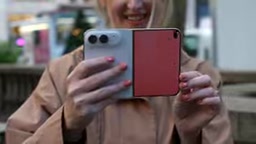
Imaging is the most obvious compromise. The main camera sensor is on par with the iPhone Air and smaller than the 18 Pro's; there's no telephoto, only 2x crop and up to 10x digital zoom; the inner screen's hidden front camera is only 4 megapixels and looks "like a potato" in low light. However, the foldable form enables unique tricks: every camera can be a selfie camera, you can record FaceTime calls on both screens at once, and KidQ uses Snoopy animations to draw children's gaze to the lens—things a slab phone can't do.
Should You Buy It? Not Yet
The Duo is an early-adopter device full of potential: expensive, full of compromises, and often frustrating to use. There were moments when picking up an iPhone 17 Pro to get things done quickly felt like a relief—which is exactly why Apple has been afraid to overhaul the iPhone for years.
But it also recalls the first MacBook Air: no one was enamored with it back then, until a redesign took the industry by storm. The Duo's thinking on foldables is more coherent than most competitors; its problem is that the outer screen isn't useful enough and the apps aren't ready. The dilemma of Android foldables is that the inner screen isn't useful enough, so there's no reason to unfold; the Duo's dilemma is that the outer screen isn't useful enough, so you always want to unfold. The real answer lies in between—both screens being interesting and useful.
Most people shouldn't buy the iPhone Duo now; it needs at least another year of polish. But if you're thoroughly bored with today's phones and want to experience a grand, chaotic, expensive journey of reimagining the smartphone, it's genuinely the most interesting choice available right now.
One-line Summary
The iPhone Duo is Apple's riskiest $2,000 foldable debut—full of potential but not yet mature.
Paragraph Summary
The iPhone Duo is Apple's first foldable phone, starting at $2,000, with a 1.4:1 passport-style wide-fold ratio, a 5.4-inch outer screen, and a 7.6-inch inner screen. The inner screen's nano-texture matte coating effectively hides the crease and looks better than competitors, but the tiny outer screen makes most apps feel cramped, and the software ecosystem is in a chaotic period with three coexisting states. Performance is adequate, but dual screens generate noticeable heat, battery life can't last a full day of heavy use, and the imaging system involves obvious compromises (no telephoto, only a 4-megapixel front camera). Compared with the Galaxy Z Fold 8, the Duo is heavier and thicker, harder to use one-handed, but has the advantage of IP68 dust and water resistance. The review's conclusion is that most people shouldn't buy it now; it needs at least another year of polish and is suited to geeks and early adopters.
Related articles

AWS Launches Official Agent Toolkit: Letting AI Agents Directly Build and Manage AWS Applications
AWS launches the official Agent Toolkit, letting AI coding agents directly build and manage AWS apps across CDK, CloudFormation, Serverless, Bedrock Agents, and DevSecOps.

Does Agentic AI Need Its Own "Second Foundation"? A Three-Loop Architecture Explored
Inspired by Asimov's Foundation series, a multi-agent AI architecture hypothesis proposes execute, verify, and adapt control loops to reduce correlated errors and improve trust in AI results.
Rewriting a Commercial Engine in Jai: The Trade-off Between Performance and Productivity
Exploring the engineering practice of rewriting a commercial game engine in Jai: compile-time metaprogramming and data-oriented design advantages, plus ecosystem maturity and learning curve challenges.