iPhone Duo Pre-Orders Sell Out Within an Hour: Delivery Dates Pushed to Next Year

Apple's first foldable iPhone Duo saw delivery dates slip to next year within an hour of pre-orders opening, with foldable demand far exceeding expectations.
Apple's first foldable phone, the iPhone Duo, opened pre-orders on Friday, and within less than an hour, delivery times for all configurations were pushed from around launch day to late January of the following year—a delay speed quite rare in Apple product history. This reflects both concentrated pent-up upgrade demand for a foldable iPhone and production capacity bottlenecks in core components like hinges and flexible displays. The iPhone Duo launches in retail stores on October 23; those who missed the first batch can watch for in-store inventory or order early to lock in a delivery slot, while being wary of secondary market premiums. The strong pre-order response may influence Apple's future production planning and product line strategy.
Apple's first foldable phone, the iPhone Duo, saw delivery times slip to next year less than an hour after pre-orders opened. According to RSS sources, Apple opened pre-orders at 8 AM ET on Friday, and estimated delivery dates for all configurations quickly slipped. As of publication, Apple's official website shows delivery times for all configurations have been pushed to late January.
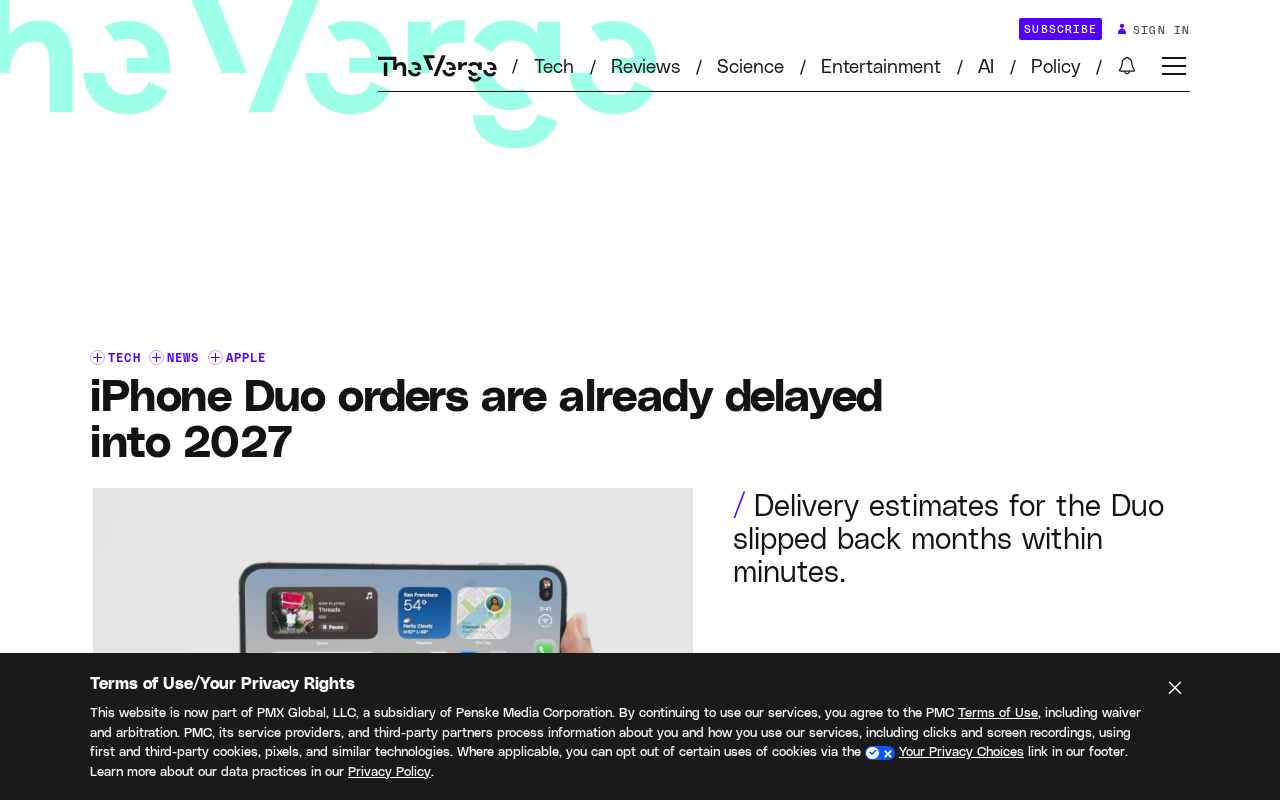
Pre-Orders Explode: Delivery Times Rapidly Slip
This speed of delay is quite rare in Apple product history. The iPhone Duo was originally scheduled to launch in retail stores on October 23, but less than 60 minutes after pre-orders opened, delivery windows for online orders shifted from around launch day all the way to late January of the following year.
From a consumer behavior perspective, the foldable form factor represents the most significant visual change to the iPhone lineup in years, and pent-up upgrade demand from multiple years was released all at once during the pre-order window. Every configuration on Apple's website (across different storage capacities and color options) experienced delivery delays without exception, indicating the shortage is not limited to any specific model but reflects overall supply constraints.
Why the Foldable iPhone Is So Hard to Get
The iPhone Duo marks Apple's first entry into the foldable space. Samsung, Huawei, and other manufacturers have been cultivating the foldable market for years, but Apple's brand appeal and iOS ecosystem integration give its first foldable device inherently high market attention.
Supply-side challenges are equally significant. Core components of foldable devices such as hinges and flexible displays involve complex manufacturing processes, and yield rate ramp-up typically takes months. As a newcomer to this category, Apple's initial production capacity is likely constrained by both component supply and assembly yield rates—a phenomenon that corroborates the delivery delays occurring within an hour of pre-orders opening.
The Technical Barriers of Foldable Hinges and Flexible Displays
The core difficulties of foldable phones center on two components: the hinge and the flexible display panel. The hinge must maintain structural stability through hundreds of thousands of open-close cycles while balancing thinness and crease control. Its precision mechanical structure involves hundreds of micro-components with extremely tight tolerances. Flexible displays rely on bendable substrate materials (such as polyimide) and thin-film encapsulation processes to prevent moisture and oxygen intrusion that would degrade luminescent materials. Yield rate ramp-up for these two component types typically takes months or even longer, with initial production often reaching only a fraction of designed capacity. As a newcomer to foldables, Apple lacks accumulated mass-production experience in this category, and both supplier coordination and assembly process optimization require time—making initial supply constraints an almost predictable outcome.
The Real Impact on Consumers
For users who missed the first batch of inventory, the choice becomes clear: either accept a late-January online delivery schedule, or wait and try your luck at a retail store when sales begin on October 23. Historical experience shows that Apple retail stores typically reserve some inventory for launch day, but quantities are limited, and queue competition can be equally fierce.
Users who have already placed orders but have later delivery dates can watch for in-store pickup inventory updates on Apple's website if they want to get their device sooner—retail store inventory and the online order pool are often independent of each other, and early stock releases occasionally occur.
Market Signal: Foldable Demand Far Exceeds Expectations
Delivery dates slipping to the following year within an hour of pre-orders sends a market signal worth noting. It reflects genuine consumer demand for a foldable iPhone and may also influence Apple's future production planning and product line strategy.
If delivery delays continue to widen, premiums in the resale and secondary markets are almost inevitable. For Apple, while the supply-demand imbalance for its first foldable device is unfavorable for user experience in the short term, it helps validate the market potential of this new category over the long term, providing a basis for pricing and production decisions for future iterations.
For those intending to buy, the most pragmatic approach right now is to place an order early to lock in a delivery slot, while keeping an eye on retail store stock arrivals to avoid paying excessive premiums in the secondary market.
How Secondary Market Premiums Form
When official channel delivery schedules are significantly delayed, the supply-demand gap quickly shifts to the secondary market. Scalpers and third-party sellers leverage information asymmetry and capital advantages to stock up in advance, then resell at prices above official retail, creating a premium. The premium margin typically correlates positively with the length of delivery delays: the further back the schedule, the more extra cost eager early adopters are willing to pay. Notably, Apple's in-store pickup inventory and the online order pool are independent of each other, and spot stock occasionally released by retail stores often becomes a short-term variable that suppresses premiums. For ordinary consumers, closely monitoring official channel stock arrivals is an effective strategy to avoid paying excessive premiums in the secondary market.
One-line Summary
Apple's first foldable iPhone Duo saw delivery dates pushed to next year within an hour of pre-orders opening, with foldable demand far exceeding expectations.
Paragraph Summary
Apple's first foldable phone, the iPhone Duo, opened pre-orders on Friday, and within less than an hour, delivery times for all configurations were pushed from around launch day all the way to late January of the following year—a delay speed quite rare in Apple product history. This phenomenon reflects both the concentrated release of pent-up upgrade demand for a foldable iPhone and exposes production capacity bottlenecks in core foldable components such as hinges and flexible displays. The iPhone Duo is set to launch in retail stores on October 23. Those who missed the first batch can watch for in-store inventory or place orders early to lock in a delivery slot, while remaining wary of secondary market premiums. The strong pre-order response sends a market signal that may influence Apple's future production planning and product line strategy.
Related articles

Amphibious Transforming Drone: Beyond 100x Power Savings, What Are the Real Needs?
Is the amphibious transforming drone just a gimmick? Starting from the 100x power difference of the M4 Morphobot, explore real application scenarios and thesis topic ideas, analyzing boundary conditions where pure drones and pure ground robots both fail.

Warhound Raises $200 Million: Genetically Engineered "War Dogs" Paired with Anduril Gear
Warhound raises $200M, backed by Ben Lamm and Palmer Luckey, to genetically engineer dogs for military and law enforcement use and equip them with Anduril gear. This article analyzes its technology direction, funding logic, and ethical controversy.

Claude API Comes to Google Cloud: IAM Integration and SDK Access Guide
Anthropic hosts the full Claude API on Google Cloud with IAM-controlled permissions and unified billing. This guide covers the Vertex AI and Anthropic-hosted entry points, IAM role configuration, and SDK access.