IQuest-Q1 Deep Dive: How a 320B MoE Model Is Reshaping Agentic Coding

IQuest-Q1 is a 320B MoE model for agentic coding with day-0 vLLM support via existing inference components.
IQuest-Q1 is a 320B MoE model from IQuest_research designed for agentic coding. It activates only 15B parameters per token across 256 experts (8 active at a time) and supports a 512K-token context window. Its day-0 vLLM support is achieved by reusing three existing framework components: a 3:1 hybrid sliding/full attention mechanism to reduce KV cache memory, sink attention for long-sequence stability, and EAGLE speculative decoding with recursive MTP heads for faster generation. This co-design approach with mature inference infrastructure sets a practical template for deploying large models at scale.
IQuest-Q1 Arrives: A 320B MoE Model Built for Agentic Coding
The IQuest-Q1 model, released by the IQuest_research team, ships with day-0 support on vLLM — meaning developers can run it on mainstream inference engines immediately, without waiting for any compatibility patches. IQuest-Q1 is a 320B-parameter Mixture-of-Experts (MoE) model designed specifically for agentic coding scenarios, with an architecture that strikes a careful balance between parameter scale and inference efficiency.
At its core, IQuest-Q1 has 320 billion total parameters, but activates only 15 billion per token. The model features 256 experts, with just 8 active during any given inference pass. This sparse activation mechanism is a hallmark of MoE architecture — it lets the model maintain a massive parameter capacity while keeping per-inference compute within manageable bounds, achieving both strong capability and practical running costs.
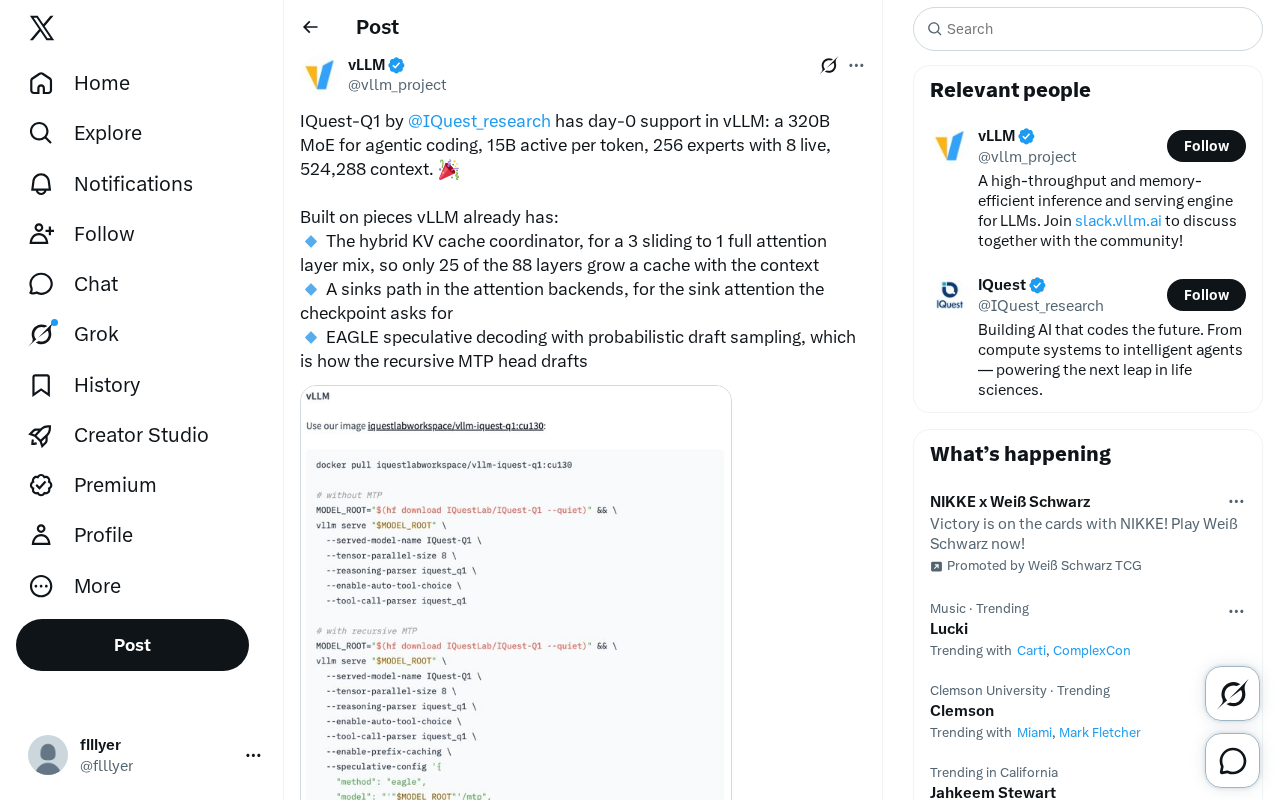
Ultra-Long Context: 524,288 Tokens
Long-context capability is critical for agentic coding tasks. Codebases are often large and deeply interconnected, requiring a model to understand context across a wide range to generate accurate completions or carry out multi-step programming tasks. IQuest-Q1 supports a context window of up to 524,288 tokens (512K), large enough to hold the contents of multiple files from a substantial project — laying the groundwork for truly agentic programming workflows.
Technical Breakdown: Built on Existing vLLM Components
IQuest-Q1's day-0 support is largely thanks to its deliberate reuse of infrastructure already present in the vLLM framework. Rather than inventing entirely new mechanisms from scratch, the model cleverly composes capabilities that the inference engine already provides.
Hybrid KV Cache Coordinator
IQuest-Q1 uses a 3:1 ratio of sliding window attention to full attention layers — meaning that across the model's 88 layers, only 25 layers expand the KV cache as context grows, while the rest use fixed-cost sliding window attention.
This design directly addresses the most painful problem in long-context scenarios: KV cache memory bloat. Under standard attention, a 512K context produces enormous cache overhead. By restricting most layers to sliding window attention, IQuest-Q1 limits KV cache growth to roughly 28% of its layers, dramatically reducing memory pressure. vLLM's hybrid KV cache coordinator is the key component that makes this mechanism work.
Sliding Window Attention (SWA) limits each token's attention to a fixed local window (e.g., W tokens on either side), rather than attending to every token in the sequence. This reduces per-layer KV cache size from O(sequence length) to O(window size), turning linear memory growth into a constant. The trade-off is that a single layer cannot directly capture long-range dependencies — but through multi-layer stacking, information propagates gradually, and the effective receptive field expands. IQuest-Q1's 3:1 hybrid ratio reflects a deliberate engineering choice: use a small number of full-attention layers (25/88) to maintain global semantic understanding, while the remaining layers handle local detail at low cost. This approach echoes how SWA is applied in models like Mistral and Gemma.
Sink Attention and the Attention Backend
The model's checkpoint requires sink attention, and vLLM's attention backend provides a corresponding sinks path to support it. Sink attention is a technique for maintaining stability during ultra-long sequence processing — by preserving a small number of "sink tokens" at the beginning of the sequence, it helps the model sustain output quality in sliding window settings and prevents performance degradation during long-context inference.
EAGLE Speculative Decoding with Recursive MTP Heads
Inference speed is another critical bottleneck for deploying large models in production. IQuest-Q1 leverages EAGLE speculative decoding in vLLM with probabilistic draft sampling, driven by recursive MTP (Multi-Token Prediction) heads for draft generation.
The core idea behind speculative decoding is to use a lightweight mechanism to rapidly "draft" multiple candidate tokens, then have the main model verify them in batch — boosting generation throughput without sacrificing quality. The recursive MTP head gives the model multi-token prediction capability, and combined with EAGLE's probabilistic draft sampling, it can significantly accelerate the decoding process. For coding scenarios that require generating large volumes of code, this speedup translates directly into a smoother, more responsive experience.
EAGLE (Extrapolation Algorithm for Greater Language-model Efficiency) is an efficient speculative decoding framework. Traditional speculative decoding uses an independent, smaller draft model to generate candidate sequences. EAGLE's innovation is to reuse the feature representations from the main model's final layer to drive the draft head — meaning the draft process shares the same semantic space as the main model, dramatically improving token acceptance rates. Recursive MTP heads allow the model to predict multiple future tokens in parallel within a single forward pass. Combined with EAGLE's verification mechanism, this can theoretically boost effective generation speed by 2–4× while keeping the output distribution consistent with standard autoregressive decoding. This is especially valuable for code generation — code contains many high-certainty segments (keywords, brackets, fixed syntactic structures) where speculative decoding achieves near-100% acceptance rates, yielding the most significant speedups.
The Engineering Philosophy Behind the Architecture
Perhaps the most noteworthy aspect of IQuest-Q1 is what it reveals about a "leverage what exists" engineering philosophy. Rather than inventing a new inference stack, the model team designed their architecture around three existing vLLM capabilities — the hybrid KV cache coordinator, the sink attention path, and EAGLE speculative decoding. This strategy of aligning with the existing ecosystem is precisely why day-0 support was achievable.
Zooming out, this reflects a broader trend in large model development: the co-design of model architectures and inference engines is growing ever tighter. When every feature of a new model can be mapped to a mature component in an established inference framework, the barrier to deployment drops significantly, and the community can validate and adopt the model far more quickly.
For developers and researchers focused on agentic coding, IQuest-Q1 offers an instructive case study: how to make a model as large as 320B both capable and practical to run, through a combination of sparse activation, hybrid attention, and speculative decoding.
Summary
IQuest-Q1 targets the high-value agentic coding space with 320B total parameters, 15B activated parameters per token, a 256-expert sparse architecture, and a 512K ultra-long context window. Its day-0 support on vLLM stems from thorough reuse of existing inference components — a reflection of engineering efficiency, and a reference paradigm for how future models can integrate seamlessly into the broader ecosystem from day one.
Related articles

Random Pruning of the DPO Computation Graph: 1.4x Training Speedup and Lower Peak Memory
DPO training too slow and memory-hungry? This paper proposes a random pruning framework for the DPO computation graph, sampling independently across position, sequence, and branch dimensions; branch pruning achieves a 1.426x step-time speedup and cuts training time by about 30%, with in-depth attribution of memory and time gains.

Why Does JEPA Underperform MLM in Longitudinal EHR Representation Learning?
New study compares JEPA and MLM for longitudinal EHR representation learning on MIMIC-IV: three JEPA variants train stably without collapse but underperform MLM; target size, not heterogeneity, drives prediction error.

Transfer Learning + Visible Light Communication: A New Approach to Energy-Efficient Indoor Positioning
A study proposes a transfer learning-based visible light communication indoor positioning method, achieving 47% accuracy improvement on the BOSCH factory dataset, 67.5% model efficiency under high noise, and introducing the ME composite metric for energy-efficient positioning in energy-constrained industrial IoT scenarios.