Is a Neural Network Essentially Linear Regression? Huawei's 300-Episode AI Course Instructor Explains Deep Learning with TensorFlow Playground

Huawei's AI course maps the AI landscape, clarifying ML vs. DL differences and the essence of neural networks.
Based on Huawei Group's AI deep learning tutorial on Bilibili, this article clarifies the AI knowledge landscape: deep learning is a subset of machine learning, with mainstream directions including CV, NLP, and speech recognition. It compares machine learning and deep learning, noting that feature engineering is the dividing line—ML relies on manual feature extraction, while DL packages feature extraction and classification into the network. It emphasizes that neural networks are essentially stacked linear regression, verified through TensorFlow Playground and Python plotting. Finally, it explains why 2012 became the turning point for deep learning and offers practical advice for beginners.
Starting from the AI Learning Roadmap: CV, NLP, and Speech Recognition Each Find Their Place
Many beginners facing the word "artificial intelligence" don't clearly understand what branches it contains. In a set of Huawei Group AI deep learning tutorials circulating on Bilibili, instructor Xu Ke uses a single diagram to map out the AI knowledge landscape: machine learning is a subset of AI, deep learning is a subset of machine learning, and deep learning further branches into mainstream directions including CV (computer vision), NLP (natural language processing), and voice recognition (note: not VR for virtual reality). Knowledge graphs and unsupervised learning also occupy a place in the diagram.
The significance of this classification is to help learners establish a coordinate system. For example, OpenCV covered earlier in the course belongs to traditional machine vision, while CV under the deep learning framework is more powerful in capability.
The instructor's reminder is quite practical: new students with no deep learning foundation at all will find it difficult to jump straight into this course, and should ideally start with machine learning fundamentals. This suggestion itself reflects the course positioning—300 episodes from beginner to hands-on practice, not letting you skip the foundation and build directly on top.
Machine Learning vs. Deep Learning: Feature Engineering Is the Dividing Line
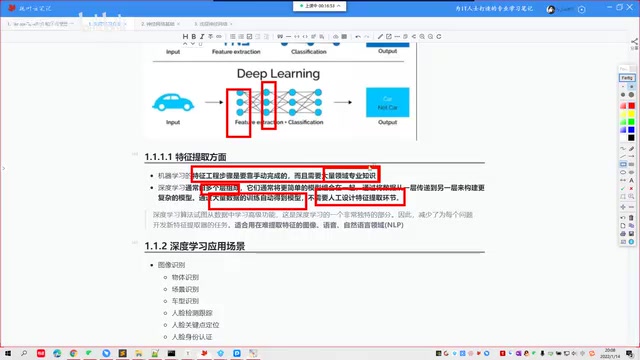
The core difference between the two technical approaches is explained clearly with a top-to-bottom comparison chart.
The machine learning workflow is: manual feature extraction → select classification or regression algorithm → train and predict. The difficulty lies in the first step—feature extraction requires domain expertise. For example, when working with financial data, you need to know what each feature represents, whether it can be processed, and how it should be processed. This isn't something you can solve by just calling a library.
Deep learning packages feature extraction and classification inside the network. Data goes in, and the network completes feature extraction and classification on its own, without requiring manually designed feature systems. The direct benefit: you can build a usable model without understanding the business background.
The instructor's summary of applicable scenarios for both is very practical: for small data volumes and simple tasks, traditional machine learning is sufficient for data mining; for complex problems with high accuracy requirements and difficult-to-extract features—such as speech, images, and natural language—that's when deep learning comes into play. As for drawbacks, long training times and susceptibility to overfitting—the instructor doesn't avoid these either.
Feature engineering refers to the process of extracting, constructing, and selecting the most useful features from raw data for model prediction. It typically includes data cleaning, missing value handling, feature encoding (such as one-hot encoding), feature scaling (normalization/standardization), feature crossing, and dimensionality reduction. The effectiveness of traditional machine learning algorithms depends heavily on feature quality, so domain experts need to experiment repeatedly to translate business knowledge into numerical features. Deep learning automatically learns hierarchical feature representations through multi-layer nonlinear transformations, reducing the burden of manual feature design—but it doesn't eliminate feature engineering entirely; data preprocessing, normalization, and other steps remain necessary.
Neural Networks: Loosely Mimicking the Brain, but Essentially Linear Regression
The course spends considerable time building an intuitive understanding of neural networks. Artificial neural networks (ANN, usually abbreviated as NN in code) reference the structure of biological neural networks—the eyes receive light signals, visual nerve cells convert them into chemical signals, and signals transmit between neurons interwoven into a network. This process corresponds to human brain thinking and also to neural network computation.
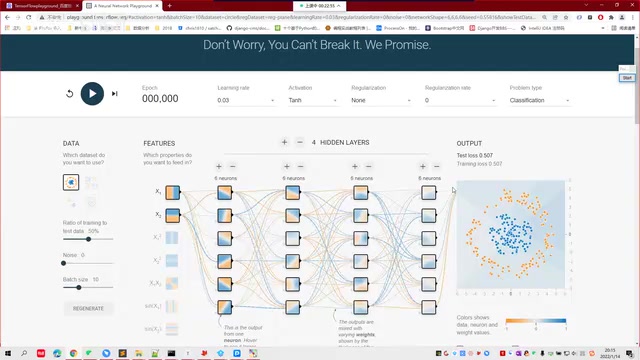
Google's TensorFlow Playground is the tool the instructor uses for demonstrations, accessible without a VPN. You can see data flowing in from the input layer, weights (W) on the lines changing as it passes through each neuron in the hidden layers, and classification results on the right updating in real time. Tensor is data, Flow is flowing—the naming logic of this framework is immediately clear.
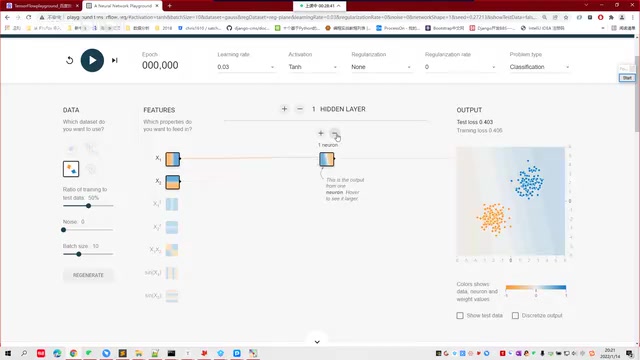
Next comes the most "counterintuitive" conclusion of the entire lesson: the essence of a neural network is linear regression. What each neuron does is WX+B, plus an activation function to handle nonlinear problems (which beginners can ignore for now). The more layers in the network, the more linear equations are stacked, and the more complex the model becomes.
The instructor uses two sets of controlled experiments in Playground to corroborate this point:
- A single layer with six neurons handling a nested binary classification problem can't separate the classes cleanly—yellow dots are mixed with blue dots, because "the neurons aren't smart enough";
- Adding to a three-layer network, the same task can basically separate the yellow and blue classes—the model has become "smarter," but the underlying mechanism hasn't changed; it's still a stack of linear computations.
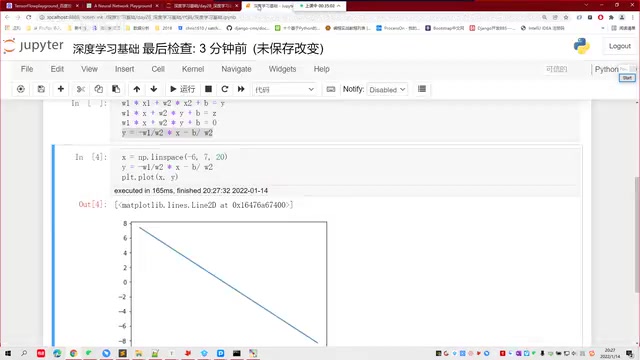
Afterward, the instructor switches to a Python environment, plugs the weights read from Playground (w1=-0.93, w2=-0.77, b=0.12) into a manually derived equation, uses matplotlib to draw the line, and the result matches the decision boundary in Playground perfectly—indirectly verifying the judgment that "a neural network is a linear equation."
There's a point here that's easy to misunderstand, and the instructor specifically corrects what's being said in the comments: more neurons doesn't mean more accurate. Adding neurons is a means to solve "the network can't handle it," but mindlessly stacking them doesn't guarantee improved results.
Activation functions are nonlinear functions applied after each neuron in a neural network completes its linear computation (WX+B); common ones include Sigmoid, Tanh, and ReLU. Without activation functions, stacked multi-layer networks are still equivalent to a single linear transformation and cannot fit complex functions. The instructor suggests ignoring activation functions at the beginner stage to highlight the core understanding that "linear computation is the foundation"; but in practical applications, activation functions are the key to a network's nonlinear expressive capability.
Why 2012 Became the Turning Point for Deep Learning
The course mentions an industry-recognized watershed: before 2012, traditional machine learning dominated, and SVM was the hottest algorithm; after 2012, the big data era arrived, data volumes grew, problems became more complex, and traditional algorithms hit a bottleneck—no matter how much more data you had, performance couldn't improve further.
The instructor uses a handwritten digit recognition example for quantitative comparison: SVM accuracy caps out at around 97%–98%; switch to a neural network with sufficient training iterations and data, and it easily reaches 99%, and the more advanced the algorithm, the fewer training rounds needed to reach 99%.
This comparison explains the underlying logic of deep learning's rise: it's not that traditional algorithms got worse, but that the growth in data scale and task complexity widened the capability ceiling gap between the two approaches.
SVM (Support Vector Machine) is one of the most popular traditional machine learning algorithms before 2012. Its core idea is to find a maximum-margin hyperplane in feature space to separate samples of different classes, and to handle nonlinear problems through kernel functions. SVM performs excellently on small-to-medium-scale data with complete theory, but has high computational complexity when facing massive data and requires manually designed appropriate features. In 2012, AlexNet's significant lead in the ImageNet competition marked the beginning of deep learning's advantages on large-scale data and high-precision tasks becoming apparent.
Practical Advice for Beginners
Several pieces of valuable information for beginners can be extracted from this open class:
- Build up machine learning fundamentals before touching deep learning, otherwise many concepts will be incomprehensible;
- You can learn without a GPU—at the beginner stage, ordinary devices can run things through, but you'll encounter inconvenience when reaching complex networks;
- Make good use of visualization tools to build intuition—tools like TensorFlow Playground let you understand what the network is doing without writing code;
- Understand the insight that "linear regression is the foundation"—all the activation functions, regularization, and complex network structures that come later are additions on top of this foundation.
The course itself covers modules including CV, NLP, speech recognition, OpenCV, and neural networks. The instructor writes "job-ready upon completion" in the title, but looking at the content arrangement, it's more like a progressive route from concepts to code. Whether it truly maps directly to employment still needs learners to verify themselves through projects.
This article is compiled based on the content of a public course video on Bilibili. The instructor in the video is Xu Ke, and the course is labeled as Huawei Group AI Deep Learning Tutorial. All technical viewpoints in the article come from the instructor's explanations and are for learning reference.
TensorFlow Playground is a browser-based interactive visualization tool where users can adjust hyperparameters such as network layers, neuron count, learning rate, and activation functions without writing code, and observe changes in the decision boundary in real time. It was developed by the TensorFlow team and is suitable for beginners to build an intuitive understanding of the neural network training process. The instructor uses it to demonstrate weight changes and classification results precisely to lower the entry barrier and let learners form a perceptual understanding before writing code by hand.
One-line Summary
Huawei's AI course maps out the AI knowledge landscape, clarifying the differences between machine learning and deep learning and the essence of neural networks.
Paragraph Summary
Based on Huawei Group's AI deep learning tutorial on Bilibili, this article first uses a diagram to clarify the AI knowledge landscape: deep learning is a subset of machine learning, with mainstream directions including CV, NLP, and speech recognition. It then compares machine learning and deep learning, pointing out that feature engineering is the dividing line—machine learning relies on manual feature extraction, while deep learning packages feature extraction and classification into the network. The article focuses on explaining that the essence of neural networks is stacked linear regression, verified through both TensorFlow Playground experiments and Python plotting. Finally, it explains why 2012 became the turning point for deep learning and provides practical advice for beginners.
Related articles

Breaking the AI Memory Wall: Five Stacked Memory Utilization Strategies
NVIDIA breaks down five ways to break the AI memory wall: NVFP4 quantization compresses weights to 4 bits, WideEP and NVLink distribute MoE experts, Dynamo reuses context, Vera CPU shortens tool-call idle time, and CMX enables cross-server context reuse—improving memory utilization across what to store, where to place it, and how much to reuse.

TED Speaker's Visual Secrets: When and How to Use Slides
TED speaking course reveals how to use visual aids effectively: when slides are needed, the three elements of strong visuals (revelation, explanatory power, aesthetic appeal), and how to avoid distraction for greater impact.

Windows 12 Is Taking Forever—What Is Microsoft Waiting For?
Microsoft didn't launch Windows 12 at the RTX Spark event. Growing frustration with Windows 11 and the muted response to Copilot Plus PCs turn anticipation for the next OS into a test of trust. This article analyzes why Microsoft needs "a bigger move."