Is AI Rewriting More Dangerous Than the Original? A Two-Phase Governance Model for Content Moderation

AI content rewriting introduces hidden risks that require a two-phase governance model to catch.
When AI moves from flagging weak content to actively rewriting it, the risk mechanism changes fundamentally: original flaws are visible, but AI rewrites can quietly introduce legal or commercial exposure. This article proposes a two-phase moderation model — Phase 1 asks "should this be changed?" (editorial filter), Phase 2 asks "is the rewrite permissible?" (governance filter) — and argues these phases must never be merged. Supporting mechanisms include standardized escalate labels for business/legal review, preserving "reject" as a valid outcome, freezing source links before rewrites run, and building a quantifiable operational rhythm through weekly failure pattern logs and health reports.
When AI enters the content moderation workflow, most teams have a straightforward goal: catch weak or inaccurate claims before they go live. But when the system upgrades from "flagging" to "rewriting," the nature of the problem changes entirely.
A vague or overstated original sentence is a visible risk. A sentence rewritten by AI may read cleaner and more professional — yet quietly cross legal, commercial, or editorial boundaries the original never touched. In other words, AI "fixes" the wording while covertly amplifying the risk. This is precisely why rewrite moderation must be treated as a distinct workflow, not a one-time approval action.
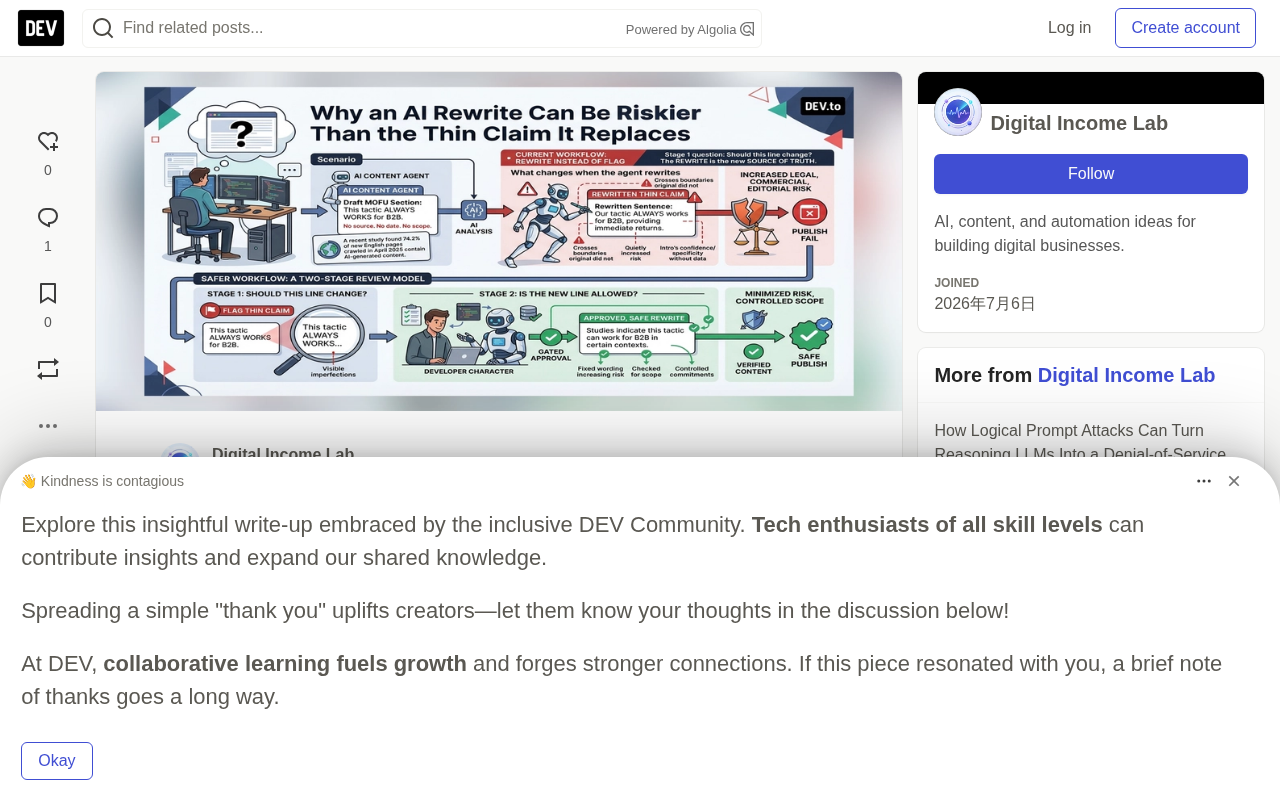
When AI Goes from "Flagging" to "Rewriting"
Flagging weak content asks only one question: Should this sentence be changed? Rewrite moderation asks a fundamentally different question: Is the new sentence actually permissible?
These are two separate decisions. The first is about need; the second is about authorization. Once you separate them, the risk mechanism becomes clear. The original text may be imperfect, but its flaws are visible. A rewrite, on the other hand, may introduce certainty, specificity, or implied commitments that never existed in the original. This means the moderation system is no longer just checking quality — it must also check scope.
For content operations and marketing teams, this distinction matters enormously. The failure mode is no longer "we missed a weak claim" — it's "we turned a manageable problem into a much harder one."
In legal and compliance circles, this risk has a specific name: scope creep of representation. A vague phrase in the original — say, "may help improve" — carries far less legal weight than an AI-rewritten version reading "proven to enhance." The former is opinion language; the latter may constitute a factual claim, triggering evidentiary obligations under consumer protection laws, advertising regulations, or industry-specific compliance requirements. This shift doesn't require extreme rewrites to occur — sometimes changing passive voice to active, or "research suggests" to "data proves," is enough to alter a sentence's legal character. This is why compliance teams tend to be wary of AI rewrites that "sound more professional": professionalism often derives from certainty, and certainty is exactly what regulators require you to substantiate.
The Two-Phase Moderation Model
The practical solution is to split moderation into two distinct phases.
Phase 1: Should this sentence be changed?
This is the editorial filter. It determines whether a sentence is weak, unclear, unsupported, or worth modifying. The output of this phase should not be a polished rewrite — it should be a decision state.
Phase 2: Is the rewritten sentence permissible?
This is the governance filter. It checks whether the replacement language is acceptable given the source material, the boundaries of the claim, and the business context. This phase must never be treated as a loose quality pass — it exists precisely to catch rewrites that "sound better but aren't safe to publish."
Splitting the workflow creates operational clarity. Teams can disagree about whether a sentence needs improvement while reaching consensus on whether a specific rewrite proposal is permissible. This prevents moderation from collapsing into a vague "approve everything" button.
Standardize Labels Before the Workflow Scales
For this mechanism to run reliably, labels must be explicit. One of the most useful labels is:
- escalate: A business or legal stakeholder must review before any language change is made.
This label matters because not every uncertain claim should be resolved automatically by the content team. Some rewrites aren't just editorial choices — they are business decisions.
Standardized labels prevent two common failure modes: reviewers independently setting their own thresholds, and uncertain cases being defaulted to "approved" just to keep the queue moving. The goal isn't to eliminate judgment — it's to make judgment visible.
The "escalate" label maps directly to a well-known governance problem: decision authority boundaries. In most organizations, content editors have the authority to adjust wording, but not to make commercial commitments or risk judgments on behalf of the company. When AI rewrites touch pricing language, efficacy claims, compliance obligations, or competitive comparisons, the decision has effectively moved outside the content team's purview. Without a formal escalation mechanism, these rewrites often get quietly approved to avoid blocking the queue — creating what might be called implicit authorization: no one explicitly approved it, but no one explicitly rejected it either, and the risk lands in production with no clear owner. Standardized labels turn this invisible authority boundary into a visible process node, ensuring that content requiring business judgment gets routed to someone with the authority to make that call.
Keep "Reject" as a Real Outcome
In a rewrite pipeline, "reject" must remain a first-class outcome. This means "no rewrite" is not a process failure — sometimes it's exactly the right endpoint.
This matters because both AI systems and human reviewers face pressure to produce clean outputs. But not every flagged sentence should be rewritten — some should stay as-is until the appropriate stakeholder reviews them; others should simply be rejected. If the system treats rejection as an exception, it will gradually drift toward over-editing. If rejection is treated as a normal outcome, the system retains the ability to be conservative when it needs to be.
The Weekly Operational Rhythm
A sustainable cadence isn't just processing tickets as they arrive — it requires a review loop. A practical approach:
- Review flagged and rewritten items within the week
- Log failure patterns every Friday
- Use those logs to identify which types of rewrites repeatedly cause problems
The Friday log matters because it converts scattered review pain points into something measurable. You're not just counting volume — you're identifying patterns where AI tends to "overstep." The source of truth for those patterns isn't anecdotal memory; it's the review record itself.
"Failure pattern logs" have a more formal counterpart in engineering and operations: post-mortems or error taxonomies. The core logic is that fixing individual mistakes is far less valuable than identifying systemic patterns in how mistakes occur. For AI rewrite moderation, failure patterns tend to cluster around a few predictable scenarios: boundary claims in specific product categories, statements involving numbers or percentages, and cases where AI tends to replace passive or hedged language with active and affirmative constructions. Once these patterns are identified, teams can choose to adjust the AI's prompts, narrow its rewriting permissions, or add a manual review node for that content type. No log means no pattern. No pattern means fighting fires case by case, with no ability to prevent them at the system level.
Freeze Before the Rewrite Runs
One of the simplest safeguards — and one of the most frequently skipped — is this: freeze the source links next to flagged sentences before the rewrite runs.
This small step matters because rewrites require context. If the original source changes later, reviewers still need to trace what was actually being evaluated at the time. Without that frozen reference point, moderation becomes slippery — people evaluate rewrites without a stable baseline for comparison, making it hard to see whether the AI preserved the original meaning or quietly shifted it.
In practice, this means your workflow should save the original context alongside the flag, not just the final rewrite proposal.
Publish a Short Weekly Health Report
Maintaining system health doesn't require lengthy reports. Consistency matters more than format. A single-line weekly update is enough, as long as it consistently includes:
- Volume processed
- Uncertain share
- Refused share
This weekly signal gives the team a simple operational pulse. If the uncertain share rises, the system may be drifting into murkier territory. If the refused share climbs, the team may be facing more cases that shouldn't be auto-rewritten in the first place. The value isn't in the format — it's in the discipline of reporting the same signals week after week.
The Real Trade-Off
The two-phase model adds structure, but it also adds friction — that's the trade-off. You sacrifice some speed in exchange for better decision boundaries. For content teams handling weak claims, especially where commercial or legal risk is involved, this is usually a worthwhile exchange.
The core lesson is simple: don't mistake a sentence that "sounds better" for one that is "safer." Once AI starts rewriting, the risk surface changes — and the moderation system must change with it. If you already have a review step, the next improvement isn't more confidence. It's fully separating the question "should this sentence be changed?" from the question "is the new sentence actually permissible?"
Related articles

5 Practical Ways Real Estate Agents Can Use AI to Boost Efficiency (2026 Edition)
How can real estate agents use AI to boost efficiency? Based on a YouTube walkthrough, this breaks down five methods — ChatGPT for listing descriptions, Canva for marketing materials, forms for open house leads, Zapier for automated follow-up, and seller meeting prep — and flags risk boundaries like fair housing laws, photo authenticity, and price verification.

Grok Bot vs ChatGPT Agent: Which AI Agent Is More Powerful?
How does Grok Bot differ from ChatGPT Agent? This comparison examines how they work: Grok Bot has a cloud computer and runs persistently inside tools to execute multi-step tasks automatically; ChatGPT Agent operates web pages in a browser and is more mature at general tasks. Includes selection advice.

Walmart Agent Gateway: AI Shops for You Automatically—Why Is Amazon Going the Opposite Way?
Walmart's Agent Gateway lets ChatGPT, Gemini and other AI assistants access its product catalog to search, compare and add to cart, with spending limits and per-purchase approval. Amazon blocks external AI agents—two retail giants, opposite paths. Currently US-only, India may follow.