Is ArtificialAnalysis Biased Against Open-Source Models?

Reddit users question whether ArtificialAnalysis recalibrates benchmarks when open-source models approach proprietary models, causing systematic ranking declines.
A Reddit post has sparked controversy, alleging that AI benchmarking platform ArtificialAnalysis is biased against open-weight models: whenever open-source models approach US proprietary model levels, the platform recalibrates its evaluation methods citing "benchmark saturation," with the practical effect of systematically suppressing open-source model rankings. The poster also points out that the platform's "Intelligence Index" promoted on social media places Claude and GPT at the top while ignoring the actual capabilities of DeepSeek, GLM, and others on key tasks like coding, potentially misleading enterprise decision-makers and implying commercial motivations. Community opinions are divided—some believe calibration is a normal phenomenon of technological development, while others agree with the bias allegation. Due to the lack of official response and independent data support, no definitive conclusion can be drawn, but the incident highlights the importance of benchmark transparency and fairness; enterprise selection should combine multiple evaluations and actual task performance.
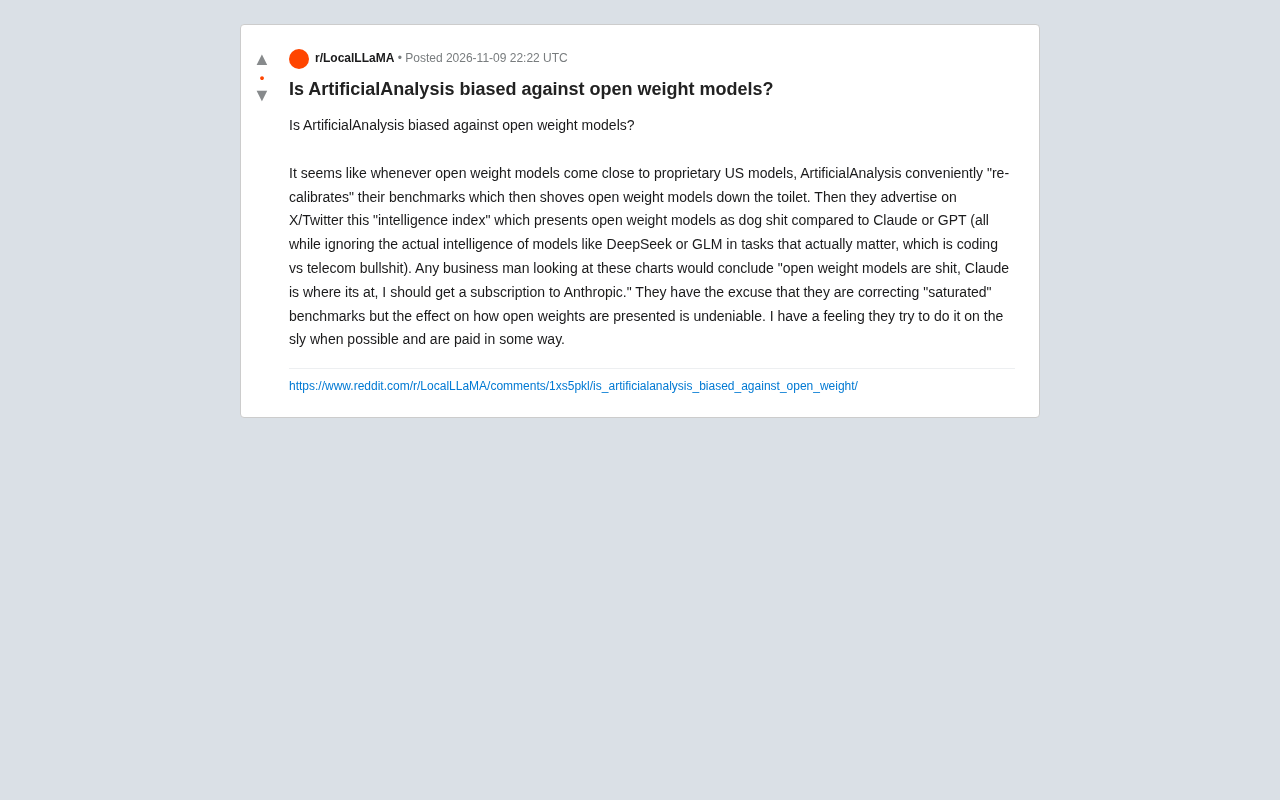
Recently, a post on Reddit sparked discussion about whether the AI benchmarking platform ArtificialAnalysis is biased against open-weight models. The poster pointed out that whenever open-source models approach the level of US proprietary models, ArtificialAnalysis "recalibrates" its benchmarks, causing open-source models' rankings to drop sharply. The platform then promotes its "Intelligence Index" on X/Twitter, portraying open-source models as far inferior to Claude or GPT. The poster argues that this behavior could mislead enterprise decision-makers and questions whether there are commercial motivations behind it.
The Core Controversy: Benchmark "Recalibration"
The poster claims that ArtificialAnalysis frequently adjusts its evaluation methodology when open-source models approach proprietary model performance, citing "saturated" benchmarks as justification. However, the practical effect of such adjustments is to systematically suppress open-source model rankings. For example, models that perform excellently on key tasks like coding—such as DeepSeekAd or GLM—are not adequately reflected in the "Intelligence Index," but are instead overshadowed by metrics weakly correlated with real-world applications. The poster questions whether this recalibration is transparent and whether it is influenced by external funding.
Benchmark Saturation is a common phenomenon in the evaluation field: when a benchmark's questions are "gamed" by models to near-perfect scores or its discriminative power drops significantly, that benchmark loses its ability to measure capability differences. At this point, evaluators typically switch to harder, newer question sets or adjust scoring weights and aggregation methods—this process is "recalibration." The problem is that the timing, method, and transparency of calibration directly affect the comparability of historical rankings—if old and new versions are mixed or change details are not fully disclosed, model rankings may fluctuate due to non-capability factors. Therefore, the industry widely calls for evaluation organizations to publish version change logs, retain historical snapshots, and explain the trigger conditions for adjustments, so users can distinguish between "the model got weaker" and "the ruler changed."
The Commercial Impact of the Intelligence Index
ArtificialAnalysis heavily promotes its "Intelligence Index" on social media, which places proprietary models like Claude and GPT at the top while open-source models rank lower. The poster worries that if enterprise decision-makers rely solely on these charts, they might conclude that "open-source models aren't good enough—we should subscribe to Anthropic," thereby influencing technology selection. This presentation may overlook open-source models' actual capabilities on specific tasks, leading to market underestimation of open-source models.
Aggregate metrics like the "Intelligence Index" typically combine scores from multiple sub-benchmarks (such as knowledge Q&A, mathematical reasoning, and coding) into a single weighted score for easy dissemination and comparison. However, the aggregation process involves benchmark selection, weight allocation, and normalization methods—different designs can significantly alter ranking results. Especially when some sub-benchmarks are weakly correlated with real business scenarios, aggregate scores may mask a model's advantages on specific tasks. For enterprise selection, a more prudent approach is to examine sub-scores, focus on sub-benchmarks that match one's own use cases, rather than relying solely on a single composite index; meanwhile, pay attention to whether the evaluation organization discloses the basis for weights and whether it accepts third-party reproduction.
Community Reactions and Multiple Perspectives
The post sparked extensive discussion on Reddit. Some users agreed with the poster's view, believing that benchmarking platforms may be biased; others pointed out that benchmark adjustments are a normal phenomenon in technological development, aimed at avoiding saturation and obsolescence. Currently, ArtificialAnalysis has not made a public response. Notably, these discussions are mostly based on individual users' observations and lack support from official data or independent investigations, so they should be viewed with caution.
Conclusion
The debate over whether ArtificialAnalysis is biased against open-source models reflects the AI community's concern about benchmark transparency and fairness. In the absence of conclusive evidence, we cannot断定 that bias exists, but this discussion reminds us that the development and interpretation of benchmarks need to be more open and diverse. For enterprise users, combining multiple evaluation methods and actual task performance for selection may be a more prudent strategy.
One-line Summary
Reddit users question whether ArtificialAnalysis recalibrates benchmarks when open-source models approach proprietary models, causing systematic ranking declines.
Paragraph Summary
A Reddit post has sparked controversy, alleging that AI benchmarking platform ArtificialAnalysis is biased against open-weight models: whenever open-source models approach US proprietary model levels, the platform recalibrates its evaluation methods citing "benchmark saturation," with the practical effect of systematically suppressing open-source model rankings. The poster also points out that the platform's "Intelligence Index" promoted on social media places Claude and GPT at the top while ignoring the actual capabilities of DeepSeek, GLM, and others on key tasks like coding, potentially misleading enterprise decision-makers and implying commercial motivations. Community opinions are divided—some believe calibration is a normal phenomenon of technological development, while others agree with the bias allegation. Due to the lack of official response and independent data support, no definitive conclusion can be drawn, but the incident highlights the importance of benchmark transparency and fairness; enterprise selection should combine multiple evaluations and actual task performance.
Related articles

OpenAI to Shut Down Agent Builder and Two Other Services on November 30, Developers Must Migrate Urgently
OpenAI will shut down Agent Builder, the evals dashboard, and reusable prompts on November 30; evals is already read-only. Here's the scope, OpenAI's migration paths (Agent SDK, PromptFu, your own code), and what developers should export and rebuild this week.

RankSpot: A Pay-Per-Use SEO & AI Search Execution Layer That Lets Agents Write, Publish, and Build Backlinks for You
RankSpot is an SEO & AI search execution layer for AI Agents. Connect via MCP to Claude or ChatGPT to write, publish & build backlinks. Pay-per-use, $3/article.

Appxiom: Giving AI Coding Assistants Production Context
Appxiom gives AI coding agents production context—crashes, jank, memory leaks, failed network calls—across Android, iOS, Flutter, KMP, and Web, ranking bugs by Goal Friction Impact.