Is Auto-Prompt Tuning on Its Way Out? Weighing the Costs Against the Benefits
Auto-prompt tuning is under fire for runaway token costs and randomness-driven instability — developers are rethinking the trade-offs.
A Reddit developer's question sparked a broader conversation about whether auto-prompt tuning is truly worth it. The core issues: multi-round self-calibration burns through tokens at scale, creating hidden costs; and model randomness causes tuning to trigger repeatedly, creating a vicious cycle of instability. The article explores how the developer community is shifting away from "let the model optimize itself" toward deterministic alternatives — frozen prompts, structured outputs, eval-driven iteration, and tiered model usage — while concluding that auto-tuning isn't dead, but needs clearly defined boundaries.
A Real Frustration from the Developer Community
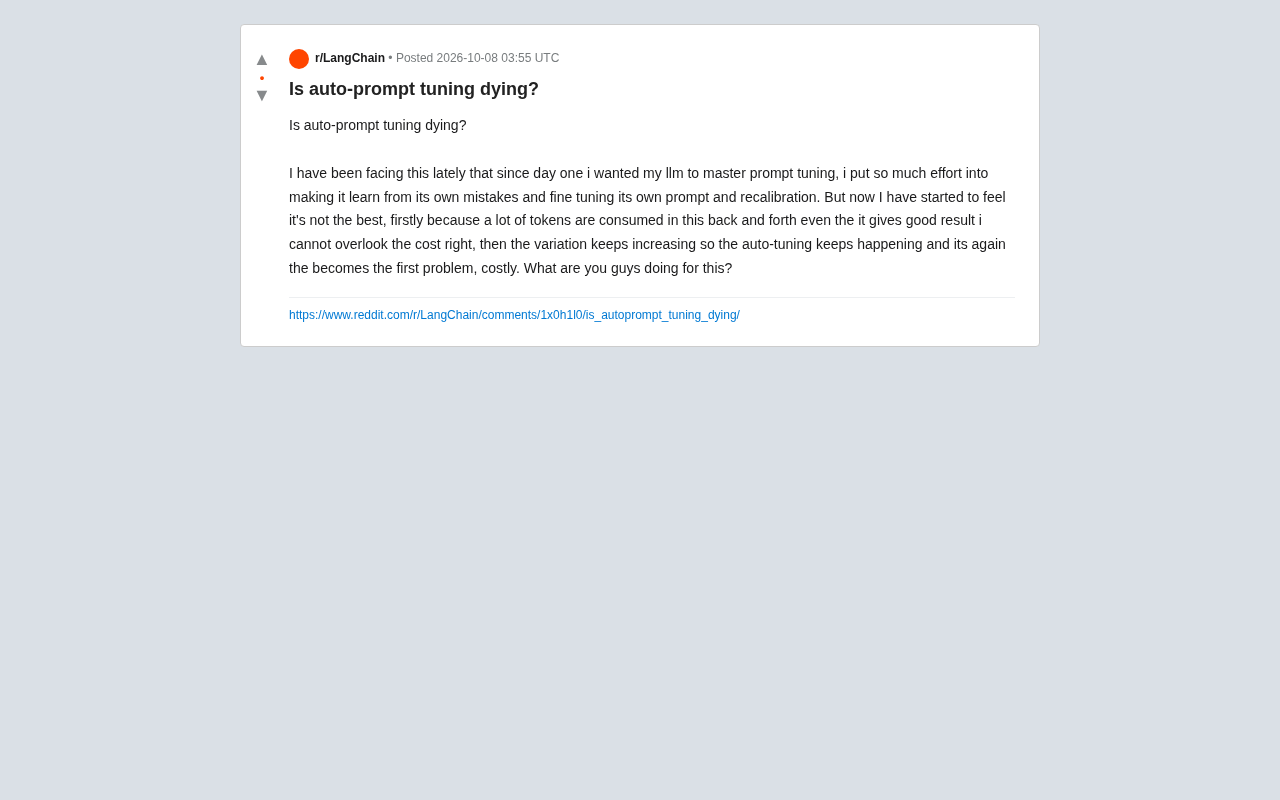
In a Reddit developer discussion, one developer raised a thought-provoking question: is auto-prompt tuning dying?
The developer admitted that from day one of working with large language models (LLMs), they wanted the model to master prompt tuning on its own — learning from its mistakes, automatically fine-tuning its prompts, and continuously recalibrating. They invested significant effort into making this work. But now, they've started to wonder whether this approach is truly worth it.
Their skepticism centers on two deeply intertwined pain points — questions that every team building LLM applications should take seriously.
Cost: The Hidden Overhead That Gets Underestimated
The core mechanism of auto-prompt tuning is having the model continuously evaluate and revise its own outputs and prompts through multiple rounds of interaction. This "self-reflection" process sounds appealing — the model optimizes itself, reducing the need for manual intervention.
But the original poster highlighted an unavoidable reality: a massive number of tokens get consumed in all this back-and-forth. Even when the final result is good, the cost simply cannot be ignored.
Every recalibration means additional API calls, additional input and output tokens, and added latency. For a personal experiment, this may be acceptable. But once you move into a production environment facing large-scale request volumes, the overhead of "self-tuning" multiplies rapidly. In other words, auto-prompt tuning trades compute cost for optimization gains — and that trade-off isn't always worth it.
The major technical approaches to auto-prompt tuning include frameworks like DSPy and APE (Automatic Prompt Engineer). Taking DSPy as an example, it treats prompts as optimizable parameters and automatically adjusts their wording and structure through multiple forward passes and reward signals (such as task scores). This process requires calling the model dozens or even hundreds of times for the same task during the training phase — and in some "runtime tuning" approaches, this overhead continues to accumulate during inference. Using GPT-4o's pricing as a reference — roughly $2.50 per million input tokens — if every user request triggers 10 rounds of self-evaluation and correction, token consumption increases by an order of magnitude. For a production service handling tens of thousands of calls per day, the math quickly becomes unsustainable.
Variability: The Vicious Cycle of Tuning Gone Wrong
Even more problematic than cost is the second issue the author raised: variation keeps increasing.
His description reveals a subtle vicious cycle: because model outputs are inherently non-deterministic, the auto-tuning mechanism keeps getting triggered — every detected deviation kicks off another round of tuning, which introduces new changes, which triggers tuning again. And that loops back to the first problem: cost.
This exposes a fundamental contradiction in auto-tuning. The whole point of prompt tuning is to help the system converge toward a more stable, reliable state. But when the tuning process itself relies on a stochastic generative model, it can actually become a source of instability. Instead of converging, the system endlessly "chases" a moving target, trapped in perpetual self-correction.
Why Is This Skepticism Emerging Now?
From a broader perspective, this developer's frustration is far from unique — it reflects a maturing shift in how the industry thinks about LLM application engineering.
In the early days, "letting the model optimize itself" was an enormously appealing vision — it promised to eliminate the drudgery of manual prompt engineering. But as practitioners dug deeper, more and more developers came to realize: automation is not free, and intelligence does not equal controllability.
When the cost and uncertainty of the optimization process itself begin to erode the benefits it delivers, the value proposition needs to be reassessed. This is the real anxiety behind the phrase "auto-prompt tuning is dying."
Alternative Approaches in Practice
While the original post was mostly raising questions rather than providing answers, several directions worth considering emerge from this kind of discussion:
Lock It Down Instead of Continuously Tuning
Rather than having the model continuously self-tune at runtime, run offline experiments during development to identify a stable, high-quality set of prompts — then "freeze" them. This avoids runtime token overhead entirely and eliminates the uncertainty introduced by variability.
Use Deterministic Mechanisms to Constrain Outputs
To address the variability problem, consider lowering the temperature parameter, using structured outputs (such as JSON Schema constraints), and incorporating few-shot examples. These techniques make outputs more predictable, reducing reliance on "continuous tuning."
The temperature parameter controls how much randomness the model uses during sampling: set to 0, the model always picks the highest-probability token, producing near-deterministic outputs; set to 1 or higher, randomness increases and the same prompt may yield vastly different responses. Structured output — enforced via JSON Schema or function calling — constrains the model to generate content only within predefined formats and fields, eliminating irrelevant output variations at the syntactic level. Used together, these two techniques can significantly improve output consistency and parseability without relying on repeated tuning cycles, making them especially well-suited for production scenarios that need to interface with downstream systems.
Evaluation-Driven Iteration
Build a clear evaluation benchmark (eval set) and shift prompt optimization from "the model's real-time self-assessment" to "offline iteration against a fixed test set." This makes optimization measurable and reproducible, rather than an endless automated loop.
An eval set is a collection of test cases covering typical input scenarios, paired with expected outputs or scoring criteria — similar to a unit test suite in software engineering. In prompt engineering, its role is to transform "is this prompt better?" from a subjective feeling into a quantifiable metric comparison. Common evaluation approaches include exact matching, automated model scoring (LLM-as-judge), and human-annotated sampling. Maintaining a stable eval set means every prompt change produces an objective regression test result, bringing prompt optimization into version control and CI/CD workflows — rather than relying on the model's in-flight "self-assessment" to decide whether to keep adjusting.
Tiered Handling for Cost-Sensitive Scenarios
For cost-sensitive use cases, consider routing routine tasks to smaller models and only invoking large models when necessary. This avoids spreading expensive tuning mechanisms across every single request.
Conclusion: Auto-Tuning Isn't Dead — But It Needs Boundaries
Is auto-prompt tuning "dying"? A more accurate description might be: it's transitioning from a blindly hyped ideal into a tool that requires carefully defined boundaries for appropriate use.
It still has value in certain exploratory, low-frequency, high-stakes scenarios — but in production environments where cost efficiency and stability are paramount, developers are rediscovering the value of determinism and controllability. The frustration expressed by this Reddit developer is precisely the kind of real-world challenge the entire industry must confront as it searches for engineering-grade paths to deploying LLM applications at scale.
Related articles
Underdog Saluki 27B: A Practical Guide to Tool Calling Under 2-Bit Quantization
An in-depth look at Underdog Saluki 27B's GSQ-RCO-based 2-bit quantization, covering GGUF header structure, memory usage analysis, and BFCL tool-calling test points under native llama.cpp.

GPU-unlock: Unlocking the FP/BF16 Instruction Issue Rate of Nvidia 3000-Series GPUs
gpu-unlock explores the FP16/BF16 instruction issue rate limits of Nvidia 3000-series GPUs, covering measurement methods, unlocking approaches, community debates, and implications for GPU performance optimization.

Cognition Open-Sources Devin Vulnerability Fixes Plugin: AI Agent Automatically Patches Critical PHP/Node.js/GitLab RCE Flaws
Cognition open-sources Devin Vulnerability Fixes, with 3 MIT-licensed agent skills targeting critical RCE flaws in PHP, Node.js, and self-hosted GitLab—automating inventory, patching, testing, and one PR per repo.