Is ChatGPT an AI Agent? The Agent Spectrum Through the Lens of Web Search

An Agent is not a label but a spectrum—ChatGPT with web search is already a basic Agent.
The article proposes understanding AI Agents as a continuous spectrum rather than a binary classification. An Agent's core traits are using tools and acting on behalf of the user, not the product name. When ChatGPT enables web search, it calls a search engine to retrieve real-time data for the user, already exhibiting basic tool-calling and agentic execution. The spectrum ranges from pure Q&A chat to chatbots with single tool calls to systems capable of autonomous multi-step planning, and a product's position shifts dynamically with usage. For users, focus on what the product can do for you; for developers, it suggests a progressive path starting with single tool calls, where stronger agency demands greater process visibility and user control.
An Underrated Question: Is ChatGPT Really an Agent?
When people talk about AI Agents, they often set them in opposition to chatbots like ChatGPT: Agents can use tools and solve problems step by step, while chatbots just answer questions. But a YouTube channel offered a more nuanced perspective in one analysis—an Agent isn't a black-and-white identity label, but a continuous spectrum. Even a product that seems to "just chat" like ChatGPT is already playing the role of an Agent once you flip on the web search toggle and have it retrieve real-time internet data on your behalf.
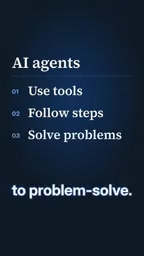
The key to this judgment lies in the nature of the behavior, not the name of the product. The core characteristics of an Agent can be broken down into two points: using tools, and performing actions on behalf of the user. ChatGPT's web search happens to satisfy both at once—the search engine is a tool, and retrieving real-time information for the user is an agentic action. It is, of course, a "very basic Agent," but basic doesn't mean it isn't one.
The Agent Spectrum: A Gradient from Q&A to Autonomous Execution
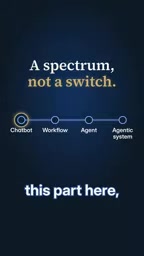
Understanding Agents as a spectrum rather than a binary classification explains many gray areas in product form. At one end of the spectrum is pure Q&A chat, where the user inputs a question and the model outputs text in a one-way flow of information; moving toward the middle, chatbots with tool invocation appear, where the user manually enables a capability (such as web search or a code interpreter) and the model completes a task with external dependencies accordingly; the far end of the spectrum is systems that can autonomously plan multiple steps and accomplish complex goals with minimal human intervention.

The value of this framework is that it doesn't get stuck on "does this product deserve to be called an Agent," but instead asks "where does it sit on the spectrum." The answer to that question changes with how it's used: the same ChatGPT sits near the pure-chat end when search is off, and moves one step toward the Agent end when search is on. A product's identity is dynamically defined by how users use it, not fixed by the vendor's marketing language.
Autonomous planning and multi-step execution are the core capabilities of systems at the far end of the spectrum. Unlike a single tool call, an autonomous Agent needs to decompose a vague top-level goal into an executable sequence of subtasks, decide the order and dependencies, observe the results of each step and dynamically adjust the plan, and backtrack or switch strategies when necessary. Common approaches include two paradigms: "plan first, then execute" and "plan while executing"—the former emphasizes global structure, the latter emphasizes responsiveness to environmental feedback. Such systems also involve memory management (saving intermediate states), error recovery, and self-verification. It is precisely the presence and strength of planning capability that separates "chatbots with tools" from "Agents that can independently accomplish complex goals," and it is also the fundamental reason the spectrum is continuous rather than fractured.
Web Search: The Most Overlooked Agent Capability
Web search is the best sample for understanding this spectrum. The user checks the search option in the dialog box, the model fetches real-time data from the internet, and then integrates the results into its answer. This process includes tool selection, external information acquisition, and result synthesis—already beyond the scope of "just answering your question."
The original article's wording is precise: "It uses tools for you." The agentic nature is embodied in the words "for you"—the user delegates a retrieval action, and the model executes it and returns the result. This is the prototype of an agency relationship. By contrast, pure language model Q&A has no structure of delegation and execution; it simply generates text based on training knowledge.

From an engineering perspective, the invocation chain involved in web search is also far more complex than pure generation: it needs to determine whether retrieval is needed, construct a query, process the returned results, integrate them into the final answer, and also handle cases where retrieval fails or returns nothing. Every step in this chain is a component of Agent capability.
Tool calling (Tool Calling / Function Calling) is a key technical concept for understanding Agent capability. In the context of large models, it refers to the model, during response generation, determining that it needs external capabilities (such as a search engine, calculator, database query, or third-party API) and outputting a call request in a structured format, which an external system executes and returns the result to the model, which then continues generating based on the result. Tool calling turns a "language model" from a closed parametric knowledge base into a system that can perceive and act on the external world. It usually involves several stages: intent recognition (whether a call is needed), tool selection, parameter construction, response parsing, result integration, and failure retry. Web search is the most typical implementation of tool calling, and precisely for this reason it becomes an important yardstick for judging where a product sits on the Agent spectrum.
Implications of the Spectrum Perspective for Products and Development
For ordinary users, the spectrum perspective means they don't need to agonize over "is what I'm using really an Agent," but should focus on what actions the product can currently complete on their behalf. Enabling search and allowing external tool calls are both pushing the chatbot toward the agentic direction, and users have a say in this.
For developers, this framework suggests a progressive product path: there's no need to build a fully autonomous complex Agent system from the start—you can begin with a single tool call—integrate search, integrate computation, integrate some API—and each step moves you rightward on the spectrum. The reliability of tool calling, error handling, and integration with the conversational experience—these engineering problems are more feasible to refine in simple scenarios than to solve all at once in a complex system.
What's more worth considering is the boundary of delegation. The stronger the agency, the higher the user's need for visibility and control over the process. Web search is easy to accept partly because the action is simple and the results are verifiable, whereas systems with multi-step autonomous execution require clearer progress feedback and interruption mechanisms. Each step to the right on the spectrum adds weight to trust design.
Human-in-the-loop is a design paradigm for balancing autonomy and controllability in agentic systems. It refers to introducing human confirmation, approval, or intervention at key nodes of Agent execution—for example, requesting authorization before executing high-risk operations, displaying intermediate steps for the user to verify, and providing entry points for interruption and rollback at any time. As Agent autonomy increases, the cost of errors and inexplicability rise accordingly, and human-in-the-loop mechanisms become infrastructure for building trust. In engineering terms, this manifests as observable execution traces, clear state feedback, fine-grained permission boundaries, and reversible operation design. Web search is widely accepted precisely because its results are easy to verify and its actions are reversible; when it comes to irreversible actions such as payments, deletions, or sending messages externally, human confirmation becomes almost mandatory.
FAQ
Is ChatGPT an Agent after enabling web search? Under the spectrum framework, yes. It uses a search engine as a tool and retrieves real-time data on the user's behalf, possessing basic tool-use and agentic-execution characteristics, placing it in a relatively basic tier on the spectrum.
What is the core difference between an Agent and a chatbot? A chatbot only answers questions, while an Agent uses tools and follows steps to solve problems. The difference lies not in the interface form, but in whether it performs actions on behalf of the user.
Why is an Agent a spectrum rather than a binary classification? Because there are numerous intermediate forms: chatbots with single tool calls, assistants with multi-step planning, fully autonomous systems. Describing them with a spectrum fits actual products better than "yes/no."
One-line Summary
An Agent is not a label but a spectrum—ChatGPT has already entered the ranks of basic Agents by enabling web search.
Paragraph Summary
The article proposes that AI Agents should be understood as a continuous spectrum rather than a binary classification. The core characteristics of an Agent are using tools and performing actions on behalf of the user, not the product name. When ChatGPT enables web search, the model calls a search engine to retrieve real-time data for the user, already possessing basic tool-calling and agentic-execution characteristics, placing it in a relatively basic tier on the spectrum. One end of the spectrum is pure Q&A chat, the middle is chatbots with single tool calls, and the far end is systems capable of autonomous multi-step planning. The position of the same product changes dynamically with how it is used. For users, the focus should be on what the product can complete on their behalf; for developers, it suggests a progressive path starting from single tool calls, and the stronger the agency, the higher the need for process visibility and user control.
Related articles

Private Key Set to 4? CA's Elementary Mistake Leaves TLS Exposed
CA eMudra set private keys to tiny values like 4, making TLS certificates brute-forceable. A Computerphile video demonstrates the full process from extracting public keys to forging certificates, and explores the fragility of the PKI trust chain.

How Gen Turns Data into Decisions with ChatGPT Work
In an OpenAI user case, business leader Gen shares how ChatGPT Work turns data into decisions: within hours of launch, teams can judge whether integrations and onboarding flows work, shifting decision iteration from hundreds of trial-and-error attempts to a fast feedback loop.

ChatGPT vs. Claude In-Depth Comparison: Strong at Coding but Weak at Research — How to Bridge the Gap?
A user considers switching from ChatGPT to Claude, finding Claude stronger at coding but shallower at research. We analyze the differences and share tips to make Claude's research deeper.