Is It Still Worth Learning LangChain and LangGraph in 2026?

Learning LangChain and LangGraph in 2026 is still worthwhile—focus on concepts over APIs and get hands-on.
The article addresses a Reddit question from a third-year CS student about whether learning LangChain and LangGraph is worth it in 2026. The author explains that LangChain simplifies LLM integration and orchestration, while LangGraph focuses on stateful, multi-step agent workflows—each playing a different role. Industry demand exists but isn't universal; frameworks evolve quickly, so core concepts matter more than specific APIs. Prerequisites include Python, LLM fundamentals (Transformers, prompt engineering, embeddings, vector databases), APIs/web development, and software engineering. The learning path starts with LLM concepts, then practices simple chains via official docs, then dives into LangGraph state machines. Recommended resources include official docs, YouTube channels, DeepLearning.AI courses, and arXiv papers, with the community emphasizing hands-on projects over tutorials alone.
Introduction
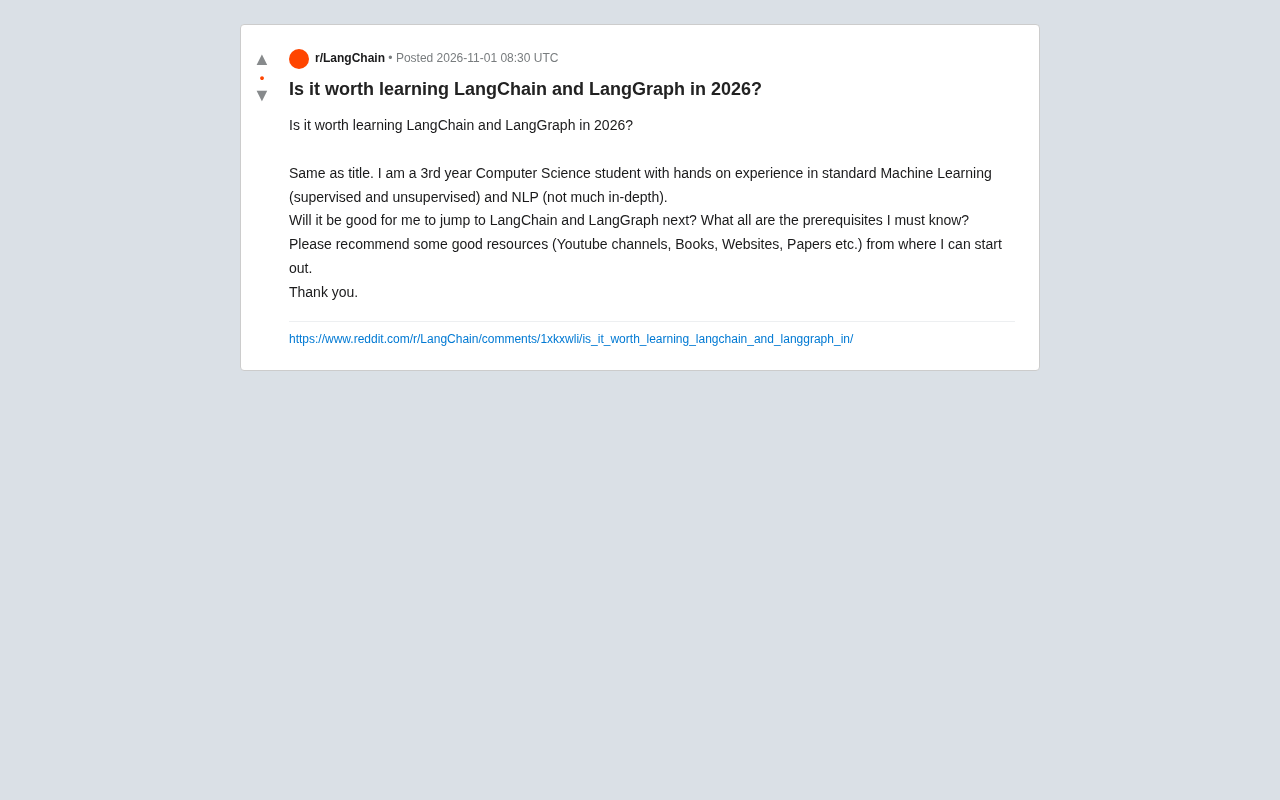
I recently came across a question on Reddit: a third-year computer science student with standard hands-on experience in machine learning (supervised and unsupervised) and natural language processing (NLP), but with limited depth, asked whether it's still worth learning LangChain and LangGraph in 2026, what prerequisite knowledge is needed, and what resources are recommended. This question is very representative—many beginners and career changers face similar confusion. This article will analyze it from three angles: technology trends, learning path, and resource recommendations.
The Value Proposition of LangChain and LangGraph
LangChain is a framework for building large language model (LLM) applications, offering abstractions for chaining calls, tool integration, memory management, and more. LangGraph focuses on building stateful, multi-step agent workflows, suitable for complex decision-making scenarios. The two play different roles in AI application development: LangChain simplifies LLM integration and orchestration, while LangGraph addresses complex control flow problems like loops and branching.
From the perspective of industry demand, as LLM applications become more widespread, mastering these tools can boost development efficiency, but they are not required for every role. For learners who want to quickly build prototypes or enter the field of AI application development, learning them is still valuable. However, frameworks iterate quickly, and core concepts matter more than specific APIs.
Stateful workflows are the key design that distinguishes LangGraph from LangChain's chain-based orchestration. In a traditional LangChain Chain, data flows along a predefined linear path, with each step's output directly becoming the next step's input, lacking global state management. LangGraph models an application as a graph: nodes represent computation steps (such as calling an LLM or executing a tool), edges define transition conditions, and the entire graph shares a State object that can be read, written, and accumulated. This design naturally supports loops (e.g., an agent repeatedly thinking-acting-observing), conditional branching (deciding the next step based on LLM output), and interruption/resumption (e.g., human approval nodes). Under the hood, it is inspired by the Pregel/BSP (bulk synchronous parallel) computation model, advancing in "supersteps" during execution, which facilitates debugging and persistent checkpoints. Therefore, LangGraph is better suited for agent-based applications requiring multi-turn reasoning, tool calls, and dynamic control flow, while LangChain's expression language (LCEL) excels at linear data pipelines.
Prerequisites and Learning Path
The asker already has a foundation in machine learning and NLP, which is a good starting point. It's recommended to supplement the following knowledge:
- Python programming: proficiency with functions, classes, and asynchronous programming.
- LLM fundamentals: understanding of the Transformer architecture, prompt engineering, embeddings, and vector databases.
- APIs and web development: familiarity with RESTful APIs, FastAPI, etc., for integration.
- Basic software engineering: version control, testing, modular design.
The learning path can follow: first master basic LLM concepts, then practice simple chains through LangChain's official documentation and tutorials, and then dive into LangGraph for state machines. Don't just memorize APIs—understand the design patterns.
Embeddings and vector databases are core components of retrieval-augmented generation (RAG), and understanding their principles is crucial for using LangChain. Embedding is the process of mapping text into high-dimensional dense vectors, so that semantically similar texts are closer in vector space, typically generated by models such as text-embedding-3-small and BGE. Vector databases (such as FAISS, Chroma, Pinecone, Weaviate) specifically store these vectors and support approximate nearest neighbor (ANN) search, with common algorithms including HNSW and IVF. In LangChain, Embeddings, VectorStore, and Retriever form a standard abstraction: documents are split, embedded, and stored; at query time, the question is first embedded and then used to retrieve the Top-K relevant chunks, which are assembled into the prompt and passed to the LLM. Learners should understand chunking strategies, similarity metrics (cosine/inner product), and the trade-off between recall and latency, rather than just calling the similarity_search interface.
Recommended Learning Resources
Based on common community recommendations, the following resources are worth checking out:
- Official documentation: The official LangChain and LangGraph documentation is the most authoritative starting point, including quick starts and examples.
- YouTube channels: such as the official "LangChain" channel, "AI Jason", "Sam Witteveen", etc., which offer hands-on demonstrations.
- Books: There is no authoritative book specifically on LangChain yet, but titles like Building LLM Apps can serve as references.
- Websites and courses: DeepLearning.AI's short courses, the LangChain official blog.
- Papers: Keep up with the latest research on arXiv about LLM agents and tool learning.
Community feedback generally suggests hands-on projects—for example, building a Q&A bot or an automated workflow—which is more effective than just reading tutorials.
LLM agents are the key background for understanding LangGraph's application scenarios. An agent refers to a system that uses an LLM as its reasoning engine and can autonomously decide which tools to call and iteratively execute tasks. Its typical loop is the ReAct pattern: the model outputs "thought" and "action", executes the tool, and feeds the observation back into the context, until a final answer is reached. Unlike fixed chains, an agent's control flow is dynamically generated by the model, thus requiring state tracking, tool description specifications, error handling, and termination conditions. Related research includes Toolformer, Reflexion, ReWOO, etc., focusing on tool learning, self-reflection, and planning decomposition. In practice, agents face risks such as hallucinated calls, infinite loops, and runaway costs. LangGraph's explicit graph structure and checkpoint mechanism are designed precisely to constrain and observe such behaviors. It's recommended to hand-write a simple ReAct loop before learning LangGraph, then compare it with the framework implementation to understand which engineering problems its abstractions solve.
Conclusion
Learning LangChain and LangGraph in 2026 is still worthwhile, especially for learners who want to quickly enter AI application development. However, be mindful of the frameworks' rapid evolution and focus on mastering core concepts and design principles rather than memorizing APIs. Combine with project practice and keep an eye on underlying technology developments to stay competitive.
For a CS student like the asker, it's recommended to solidify LLM fundamentals first, then build 1–2 complete projects with LangChain/LangGraph, and then dive deeper into specific directions based on interest.
One-line Summary
Learning LangChain and LangGraph in 2026 is still worthwhile, but focus on concepts over APIs and get hands-on.
Paragraph Summary
The article centers on a Reddit question from a third-year CS student about whether it's worth learning LangChain and LangGraph in 2026. The author notes that LangChain simplifies LLM integration and orchestration, while LangGraph focuses on stateful, multi-step agent workflows—the two play different roles in AI application development. Industry demand exists but is not required for all roles; frameworks iterate quickly, and core concepts matter more than specific APIs. For prerequisites, it's recommended to build on existing ML and NLP foundations by supplementing Python, LLM fundamentals (Transformers, prompt engineering, embeddings, and vector databases), APIs and web development, and software engineering skills. The learning path is to first master LLM concepts, then practice simple chains with official documentation, and then dive into LangGraph state machines. Recommended resources include official documentation, YouTube channels, DeepLearning.AI courses, and arXiv papers; the community widely emphasizes that building complete projects hands-on is more effective than just reading tutorials.
Related articles

VERS: Editing Activation Explanations to Halve Reasoning Model Tokens
VERS guides reasoning models by editing activation explanations, cutting 45.8% of tokens on GSM8K with only a 0.82 pp accuracy drop and transferring to larger models, but losing accuracy on competition problems.

Finding Errors Is Not Enough: Selective Model Escalation for Entity-Targeted Sentiment Analysis
This study explores selective model escalation for entity-targeted sentiment analysis, comparing data collection ordering, uncertainty-driven re-examination, and model routing—finding that minority-class priority only helps at very small data volumes, the oracle upper bound far exceeds actual gains, and escalation must be tailored to each dataset.
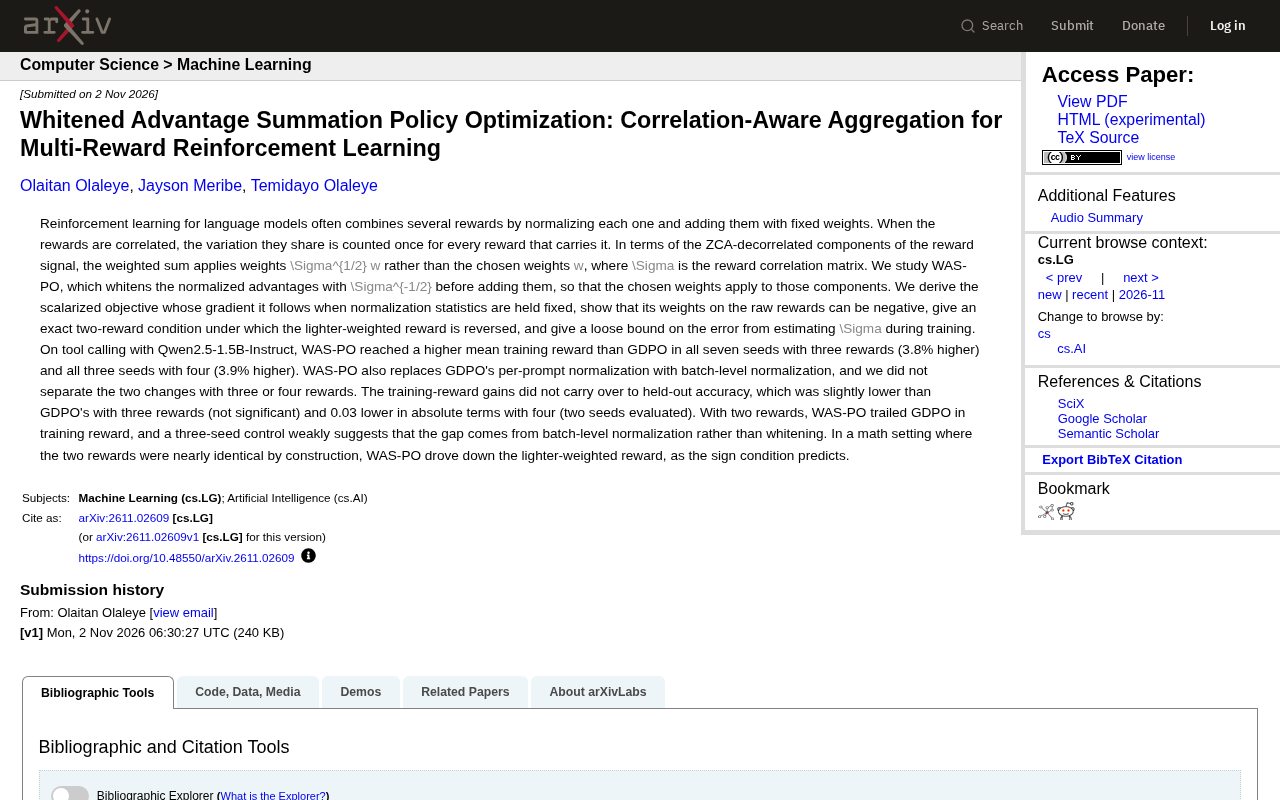
WAS-PO: Using Whitened Advantages to Solve the Correlation Trap in Multi-Reward Reinforcement Learning
WAS-PO paper proposes whitening advantages to correct correlation bias in multi-reward RL: when rewards are correlated, naive weighted summation effectively applies Σ^{1/2}w instead of w. Experiments show training reward improves steadily, but held-out accuracy does not improve in sync, and under two rewards it actually falls behind.