Is It Your Fault You Can't Use AI Agents Effectively? A Practical Guide to Overcoming AI Tool Anxiety

Struggling with AI Agents isn't a personal failure — product immaturity and inflated expectations are the real culprits.
Many people try AI Agents only to feel confused: the tools seem powerful but always fall just short in practice. The gap stems from three sources: most AI Agents are still early-stage products where errors compound across long task chains; users typically expect full automation that today's AI can't deliver; and social media's highlight-reel effect fuels a fear of falling behind. The article argues that struggling with AI reflects product and expectation mismatches, not user incompetence. The practical fix: start with small, frequent, well-defined tasks; learn to write structured prompts; choose tools based on actual needs rather than hype; and treat AI as a collaborative accelerator rather than a full replacement.
A Common Dilemma: Are You the Problem When AI Agents Fall Short?
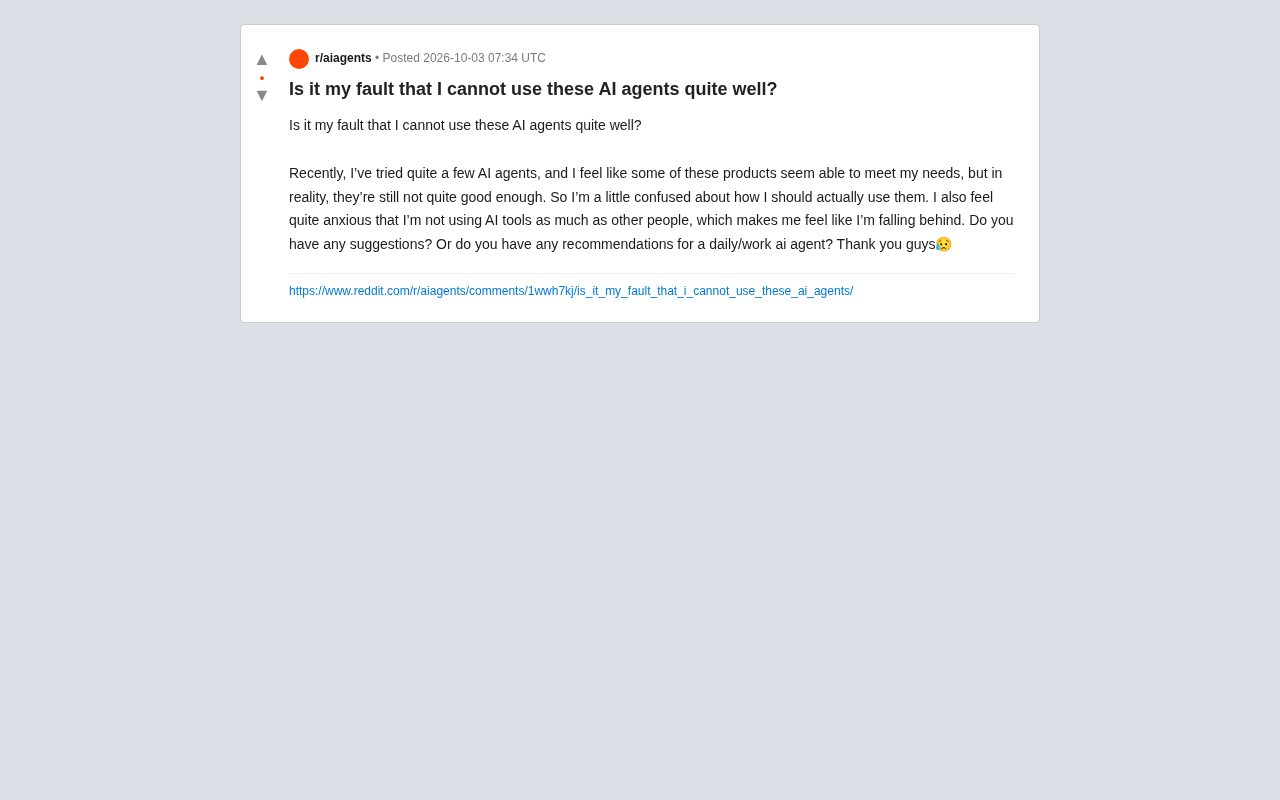
Recently, a particularly relatable question appeared on Reddit: a user had tried a number of AI Agent products that seemed to meet their needs on paper, but always fell just short in practice. What made it worse was watching others seemingly thrive with AI tools while they couldn't figure out the secret — leaving them with a strong sense of "falling behind."
This confusion is far from unique. As AI Agents continue to proliferate, "too many tools, no idea how to use them well" has become a genuine pain point for everyday users. The core issue isn't a lack of ability on the user's part — it's the current maturity of AI Agent products, the fit between tools and use cases, and the inflated expectations people bring to AI.
Why Do AI Agents Feel "Almost There But Not Quite"?
That frustrating "so close yet so far" experience has a few objective explanations.
Products Are Still in Early Stages
Most AI Agent products today are nowhere near the "full automation" level their marketing suggests. They look seamless in demo videos, but when faced with real-world tasks that have fuzzy boundaries and complex context, reliability issues quickly surface. The longer the task chain, the more errors compound — leading to a gap between "looks like it can do it" and "actually does it well."
From a technical standpoint, the core challenge for AI Agents is task chain reliability. Current mainstream agents typically rely on large language models (LLMs) as their "brain," using multi-step reasoning to plan and call external tools (such as search, code execution, and file operations). Each step carries a probability of failure. If a single step succeeds 90% of the time, a 10-step task has an overall success rate of roughly 35%. This mathematical reality explains why complexity and failure rate scale together. Agents also face inherent limitations like "hallucinations" (generating plausible-sounding but incorrect outputs) and context window constraints (forgetting earlier information in long tasks). These are boundaries of the underlying model's capabilities — not engineering failures or user errors.
Mismatched Expectations and Reality
Many people imagine AI Agents as an all-knowing assistant that can handle anything with a single sentence. In reality, today's AI is more like a new intern who needs clear instructions and well-defined boundaries. Hand it a vague, sprawling task and you'll almost always be disappointed. The people who genuinely get results are those who break tasks down into smaller pieces and provide rich context.
The Wrong Tool for the Job
Not every AI Agent is suited to your specific needs. Some excel at writing code, others at information retrieval, others at document processing. Chasing whatever product is trending, rather than starting from your actual needs, is a fast track to the awkward experience of having a flashy tool you never actually use.
Don't Stress: Struggling With AI Isn't Your Fault
The most telling emotion in the original post was that anxiety of "everyone else is using this — am I falling behind?" This mindset is extremely common in the current AI boom, but it's largely exaggerated.
What gets shared on social media is AI at its most polished — carefully curated success stories, not the constant trial and error that happens behind the scenes. The reality is that the vast majority of people are still figuring this out. Holding yourself to someone else's highlight reel as your own daily standard will only create unnecessary pressure.
Flip the perspective: struggling to get value from an AI tool means you're honestly evaluating whether it delivers real results, rather than being swept away by marketing hype. That critical mindset is actually the healthier approach.
How to Actually Make AI Agents Work for You
Rather than chasing the newest and hottest tools, build a pragmatic approach to using them.
Start With Small, Specific, High-Frequency Tasks
Don't begin by trying to use AI for a complex major project. Find a small task you do every day with a relatively fixed process — summarizing meeting notes, polishing an email, generating a code snippet — and let AI prove its value in a well-defined context. Accumulate small wins, and a productive habit will form naturally.
Learn to Communicate Clearly
The quality of an AI Agent's output is closely tied to the quality of your input. Take time to describe your needs clearly: what you want, what you don't want, what constraints apply, and what format you expect the output in. This ability to express requirements in a structured way is the real core skill for using AI effectively.
This structured approach is commonly known in the industry as Prompt Engineering. An effective prompt typically includes four elements: a role definition (telling the AI who it is and what background it has), a task description (what exactly needs to be done), constraints (format, length, things to avoid), and examples (one or two samples illustrating the style of output you expect). You don't need to learn complex techniques — just develop the habit of turning vague requests into specific instructions, and you'll see a significant improvement in output quality. Think of it like briefing a new colleague: the more context and clarity you provide, the better the result.
Choose Tools Based on Your Needs, Not the Hype
First identify your core use case — coding, writing, data analysis, or everyday task management — then look for well-regarded tools in that specific domain. It's far better to truly master one or two products than to dabble in ten.
Embrace "Human-AI Collaboration," Not "Full Delegation"
The most effective approach right now is treating AI as an accelerator, not a replacement. Let it produce first drafts, generate ideas, and handle repetitive work — while you retain critical judgment and final review. This collaborative model boosts efficiency while protecting you from AI's unreliability.
Closing Thoughts: The Tool Should Serve You, Not the Other Way Around
Back to the original question — is it really your fault if you can't get AI Agents to work well for you? The answer is no. Today's AI tools are far from perfect, and the gap between expectation and experience stems largely from the product's own limitations and socially amplified anxiety.
What truly matters is finding tools that fit your needs, adopting a pragmatic step-by-step approach, and staying clear-eyed: AI exists to serve you, not to demand that you accommodate an immature product. Let go of the fear of falling behind, focus on using AI to solve real problems in front of you, and that's how you actually take control of these tools.
Related articles

Workbuddy for Absolute Beginners: How a Desktop AI Agent Fits Into Real Workflows
A beginner's guide to the Workbuddy desktop AI agent: installation, claiming credits, file management, and building automated workflows—compared with CodeX for fit and cost, helping professionals shift from AI question-askers to AI managers.

OpenAI's New Agent Stack: Computer Use, Decisions API, and Ultra-Fast Workflows
OpenAI Dev Day unveiled a new agent stack: Computer Use outperforms humans, Decisions API delivers ultra-low-latency classification via Luna, Agents API opens the same Computer Use capabilities, and GPT-6.1 Sol costs only one-seventh of Astra. Core updates, benchmark data, and developer insights.

Liang Wenfeng Open-Sources DeepInfo Inference Framework, Takes On U.S. Ban
DeepSeek open-sources its DeepInfo inference framework after its models, featuring GPU/CPU cross-pipelining, small-model prediction with large-model verification, and full Huawei Ascend and NVIDIA chip support—facing the U.S. federal ban head-on. This article analyzes its significance for AI deployment and open-source strategy.