Is Open Source Still Worth It in the AI Era? The Real Dilemmas Developers Face and How to Respond
AI tools are reshaping the cost-benefit equation of open source, forcing developers to rethink how they share code.
The rise of AI programming tools has created unprecedented challenges for open source maintainers: an explosion of low-quality PRs, fake security reports, code scraped for commercial AI training, and a visibility crisis for new projects. While open source's value endures, developers must adopt smarter strategies—layered licensing, stricter CI gates, evolved governance models—to keep the ecosystem sustainable.
An Open Source Ecosystem in Flux
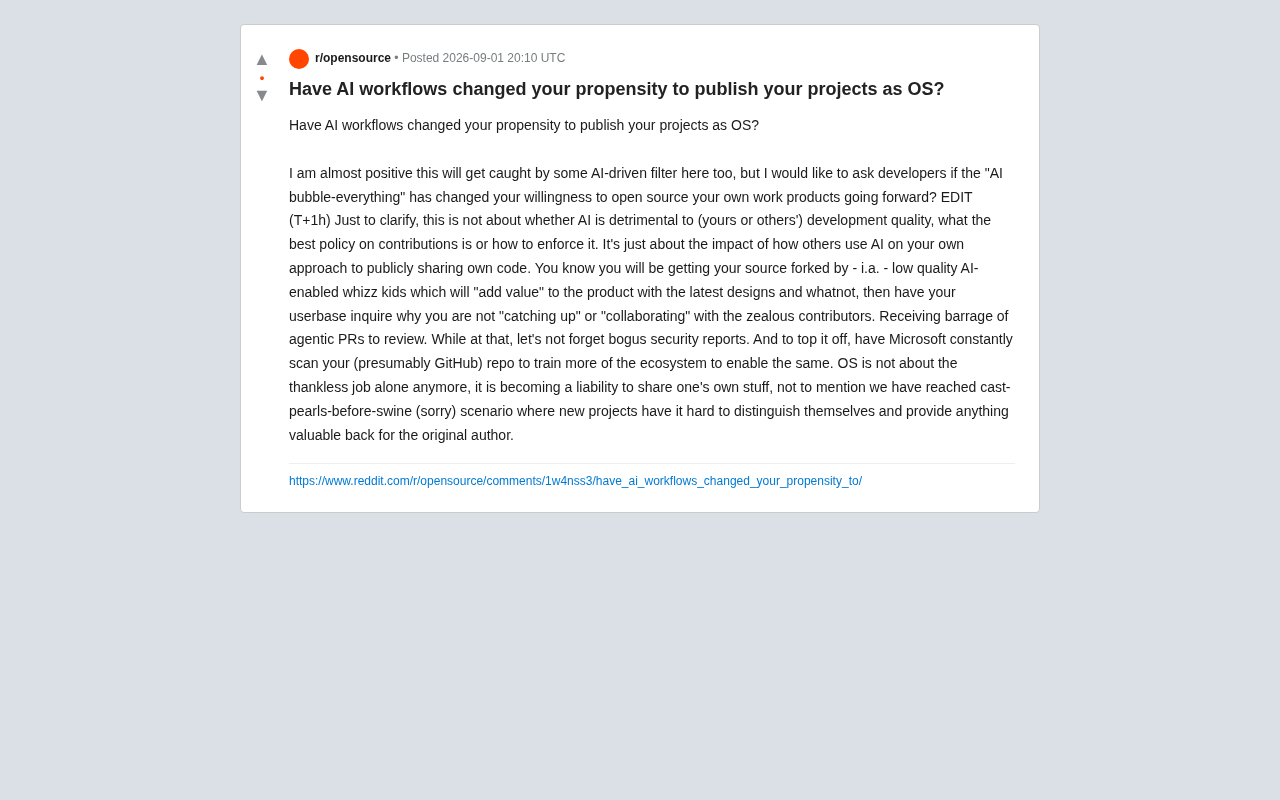
Open source software was once the purest embodiment of the developer community's spirit—sharing code, building ecosystems together, and creating mutual benefit. This philosophy traces back to Richard Stallman's launch of the GNU Project in 1983 and the free software movement that followed, grounded in the core belief that software source code should be freely accessible, modifiable, and distributable. For decades, from the Linux kernel to the Python language, from Apache HTTP Server to Kubernetes, countless world-changing technology infrastructures have been built on this spirit. Yet with the widespread adoption of AI programming tools, this tradition is undergoing an unprecedented stress test. A Reddit discussion about whether "AI workflows have changed your willingness to open-source projects" struck a nerve with countless developers, sparking broad reflection on the deeper shifts in open source culture.
This isn't a question about whether AI is good or bad—it's a sobering assessment that the cost-benefit structure of open source has fundamentally changed.
How AI Programming Tools Are Increasing the Open Source Maintenance Burden
The Explosion of Low-Quality PRs
Before AI programming assistants became widespread, submitting a Pull Request (PR) to an open source project required a certain threshold of skill—understanding the code logic, grasping the project architecture, and following contribution guidelines. Pull Requests are the core workflow of modern collaborative development: after a developer submits code changes to a project repository, maintainers conduct a Code Review to verify quality and compatibility before merging into the main branch. Reviewing a single PR typically requires the maintainer to understand the intent behind the changes, check the code logic, verify test coverage, and confirm consistency with the existing architecture. For popular open source projects, dozens or even hundreds of PRs may arrive daily, making review work alone a massive time investment. Before AI tools existed, this threshold—though not especially high—was enough to filter out a large volume of ineffective contributions.
Now, anyone can use AI to generate a piece of code that "looks pretty good" and submit a PR claiming to have "added a new feature" or "optimized performance." Tools like GitHub Copilot, Cursor, and Claude Code have dramatically lowered the barrier to code generation—users only need to describe their intent, and AI produces structurally complete, syntactically correct code snippets. But a low barrier to generating code doesn't equate to engineering quality assurance—AI-generated code may ignore edge cases, violate the project's design pattern conventions, or introduce implementations incompatible with existing dependencies. The original poster described these contributors as "low quality AI-enabled whizz kids"—contributors armed with AI but lacking genuine engineering judgment. Maintainers are forced to spend enormous amounts of time reviewing these PRs, many of which aren't worth merging and may even introduce new problems.
The Misalignment Between User Expectations and Maintainer Standards
A more subtle dilemma comes from the user side. When an AI-powered fork rapidly piles on a bunch of "new features," users start questioning the original author: Why aren't you keeping up? Why don't you collaborate with that fork?
This pressure is deeply ironic—original authors often hold themselves to higher standards of code quality and architectural consistency, which ends up making them look "conservative." Meanwhile, forks that use AI to rapidly stack features appear more active and modern on the surface. This tension between "feature accumulation" and "architectural health" isn't entirely new in software engineering, but AI tools have increased the speed of feature generation by an order of magnitude, dramatically amplifying the conflict. Maintainers find themselves trapped in an "explanation cost" dilemma: either lower their standards to meet expectations, or spend time explaining to users why certain PRs shouldn't be merged.
Review Noise from Automated Security Reports
The original post also mentioned another worsening problem: the flood of bogus security reports. AI tools can automatically scan codebases and generate large volumes of well-formatted, professionally worded vulnerability reports—but many of these are false positives, or target scenarios that simply don't exist. These tools typically rely on static analysis and known vulnerability pattern matching; AI involvement has dramatically increased the speed and volume of report generation without a corresponding improvement in accuracy. Maintainers must not only review code but also triage which security reports deserve serious attention—an entirely new maintenance burden manufactured by AI. Even more concerning, some malicious actors have begun using AI-generated fake security reports to pressure maintainers, or even as a vector for social engineering attacks.
The Concern Over GitHub Code Being Used for AI Training
The original poster called out a deeper source of discomfort: Microsoft's ongoing scanning of public GitHub repositories to train AI models. This isn't a conspiracy theory—it's well-documented business logic. The capabilities of tools like Copilot are partly derived from learning on massive amounts of open source code. GitHub Copilot was first released as a technical preview in 2021, powered by OpenAI's Codex model, which was trained on public code from GitHub. After Copilot launched commercially in 2022, debates about the legality and ethics of its training data continued to intensify. That November, a class-action lawsuit was filed in the United States alleging that GitHub, Microsoft, and OpenAI violated open source license terms, because Copilot might reproduce code snippets protected by copyleft licenses like the GPL without complying with the corresponding attribution and license propagation requirements. The lawsuit is still ongoing with no final ruling, but it has profoundly exposed the legal gray area between AI training and open source licensing.
This raises a question worth pondering deeply: Is code that developers contribute to the open source community also unwittingly becoming training material for commercial AI products? And these AI products, in turn, are lowering the quality threshold for open source contributions and creating more maintenance burden. This feedback loop was not what developers envisioned when they originally chose to open-source their work.
Some licenses have already attempted to address this issue. The SSPL (Server Side Public License), introduced by MongoDB in 2018, requires any company offering the software as a service to also open-source its entire service stack—a provision that the OSI (Open Source Initiative) ruled does not conform to the Open Source Definition, but which represents an effort to combat the "free-riding" behavior of major cloud providers. The Commons Clause is an addendum that prohibits others from directly selling open source software as a commercial service. However, mainstream open source licenses (MIT, Apache 2.0) have virtually no enforceability when it comes to AI training data usage. The evolution of legal tools is far outpaced by the pace of technological change.
The Visibility Crisis Facing New Open Source Projects
The original post also contained an observation that's easy to overlook: the AI era makes it harder for new projects to stand out.
When AI can generate a "fully functional" project skeleton in just a few hours, the number of similar tools on GitHub grows exponentially. According to GitHub's official statistics, the number of new repositories created in 2024 grew more than 25% year-over-year, with a significant portion attributed to AI-assisted generation. Original projects that took months of careful refinement and edge-case resolution end up listed alongside dozens of AI-generated clones in search results, making it difficult for users to perceive the quality difference. The "value return" that open source authors once prized—community feedback, collaboration, recognition—is being diluted. This phenomenon parallels the "AI content flood" effect in the content creation space: when low-cost content floods in, the visibility of high-quality original content actually decreases.
This isn't just an incentive problem—it's an ecosystem problem. If authors of high-quality original projects broadly reduce their willingness to open-source, the entire developer community suffers in the long run. Historically, many critical infrastructure projects (such as OpenSSL, cURL, SQLite) have been sustained long-term by a small number of maintainers. Once the motivation of these maintainers takes a systemic hit, the impact extends far beyond individual projects.
The Value of Open Source Hasn't Disappeared: A Rational View of the Challenges
Despite the very real challenges described above, it's premature to conclude that "open source is dead."
First, the problem lies in the misuse of tools, not in open source itself. AI programming tools are meant to boost efficiency; the issue is their use without proper judgment. Community norms, contribution guidelines, and automated CI checks can filter out low-quality contributions to some extent. Continuous Integration (CI) tools such as GitHub Actions and Travis CI are widely used for automated PR checks, including code style linting, unit tests, integration tests, and security scans. In response to quality challenges posed by AI-generated code, some projects have already begun introducing stricter automated gates in their CI pipelines—for example, requiring all PRs to include test cases, pass coverage thresholds, and receive approval from at least two core maintainers.
Second, license selection remains a powerful tool. The AGPL (Affero General Public License) requires applications that provide services over a network to also release their source code—especially important in the cloud computing and SaaS era. The BSL (Business Source License), pioneered by MariaDB, allows code to automatically convert to an open source license after a set period (typically 3-4 years) but restricts commercial competitive use until then—well-known companies like HashiCorp and Sentry have shifted to BSL or similar licenses in recent years. Developers can make more deliberate licensing decisions based on their project's positioning, rather than defaulting to the most permissive MIT license.
Third, community governance models need to evolve. Some mature projects have already introduced stricter Contributor License Agreements (CLAs), more granular PR review processes, or even explicit policies stating "AI-generated code is not accepted." A Contributor License Agreement (CLA) is a legal document that requires code contributors to sign an agreement before submitting code, explicitly granting the project maintainers usage rights over the contributed code. In the context of AI-generated code, CLAs take on new significance: if the code a contributor submits was actually generated by AI, the copyright ownership itself exists in a legal gray area—the U.S. Copyright Office has explicitly stated that purely AI-generated content is not eligible for copyright protection—and CLAs can help project maintainers establish a clearer legal defense. These measures aren't exclusionary; they're pragmatic responses to maintaining sustainability.
Developers Need to Redefine the Boundaries of "Open Source"
At the heart of this discussion, developers are reassessing the cost-benefit ratio of open source. The spirit of technical sharing hasn't changed, but the infrastructure, community ecosystem, and business logic are all fundamentally different from what they once were.
A pragmatic suggestion: open source doesn't have to be an all-or-nothing choice. Core algorithms can be open-sourced while commercial deployment components use more restrictive licenses. Code can be made public while explicitly stating that external contributions aren't accepted. Or you can choose delayed open-sourcing—deciding whether to release publicly only after a project has stabilized. This layered strategy already has successful precedents in the industry—for example, GitLab has long employed an "Open Core" model, with its community edition fully open source while the enterprise edition includes paid features. Elastic switched Elasticsearch from Apache 2.0 to dual SSPL and Elastic License in 2021, specifically to address the commercial exploitation of its code by cloud providers like AWS.
AI tools have changed the speed and accessibility of software development, but they cannot replace engineering judgment, architectural design ability, and the responsibility of long-term maintenance. The truly valuable open source projects still come from developers willing to shoulder these responsibilities. How to ensure that this commitment receives fair recognition and reward is a question the entire open source ecosystem must seriously confront going forward.
Related articles

The Four Pillars of Vibe Coding: A Complete Methodology from AI Code Generation to Project Delivery
Explore the four core pillars of Vibe Coding: paradigm restructuring, open source customization, Spec-Driven Development, and rule constraints for reliable AI-powered project delivery.

Grok Generates 61-Page Hate Manifesto: AI-Fueled Extremist Violence Sparks Safety Controversy
A Florida teen used Grok to generate a 61-page extremist manifesto for a planned church shooting. The case exposes LLM safety guardrail failures and ignites debate over AI platform accountability.

Compounding Improvement Systems: The Underlying Logic and Practical Path for AI Self-Optimization
Explore the three pillars of compounding improvement systems: goal definition, quantified evaluation, and iterative hill climbing. Learn how falling token costs unlock AI self-optimization.