Compounding Improvement Systems: The Underlying Logic and Practical Path for AI Self-Optimization

How define-evaluate-iterate loops are enabling AI systems to self-optimize through compounding improvements.
Compounding improvement systems represent a paradigm shift in AI development, built on three core elements: defining clear goals, quantifying evaluation metrics, and iteratively hill climbing toward targets in a loop. Made possible by plummeting token costs (down 97%+ since 2023) and rising model capabilities, this approach shifts AI from one-shot generation to continuous self-optimization, marking a transition from prompt engineering to systems engineering.
What's Happening in AI Right Now?
If you had to sum up the most exciting change in AI today in one sentence, it would be this: We are entering an era where systems can optimize themselves and continuously converge toward their goals. This is no longer science fiction — it's an engineering reality being deployed right now.
A recent YouTube talk highlighted this core trend: define a clear goal, define how to evaluate the distance between the current state and that goal, then let the system continuously "hill climb" toward the target in a loop. This deceptively simple mechanism is becoming the foundational logic for a new generation of AI applications.
What Is a Compounding Improvement System?
A compounding improvement system is essentially a self-iterating closed loop. It consists of three key elements:
Define a Clear Goal
The system first needs a well-defined goal. This could be writing code that passes tests, generating a document that meets specific criteria, or completing a complex multi-step task. Without a clear goal, all subsequent optimization is impossible.
Define an Evaluation Method
This is the most critical — and often overlooked — part of the entire mechanism. You need to not only know what the goal is but also be able to quantify the gap between the current result and the goal. As stated in the original talk, "you define how to evaluate your proximity to the goal." With this evaluation function, the system can determine whether each iteration is an improvement or a regression.
Designing the Evaluation Function is the most technically demanding aspect of compounding improvement systems. In practice, evaluation functions typically follow a few mainstream design approaches: first, rule-based hard-coded evaluation, such as whether code passes unit tests or whether generated JSON conforms to a schema — these offer the highest determinism; second, using another LLM as a judge (LLM-as-Judge), having a model score outputs according to preset rubrics — this approach is flexible but introduces noise from the evaluation itself; third, hybrid evaluation, combining deterministic metrics with model-based subjective assessment. The core challenge in evaluation function design is: how to translate the human intuition about "good results" into computable numerical signals. A poorly designed evaluation function can drive the system to optimize in the wrong direction — precisely what Goodhart's Law warns about: "When a measure becomes a target, it ceases to be a good measure." Therefore, iterating and calibrating the evaluation function itself also requires ongoing participation from human experts.

Continuously Hill Climb in a Loop
With the goal and evaluation criteria in place, the remaining step is to put the system into a loop — continuously generating, evaluating, and refining, step by step toward the goal. This is the revival of hill climbing in the era of large models. Each iteration builds upon the previous one, and improvements accumulate like compound interest, ultimately producing results far superior to a single generation.
Hill climbing is a classic local search optimization algorithm in computer science and a type of heuristic method. Its core idea is: starting from an initial solution, move one step at a time toward a neighbor with a better evaluation value until no better neighbor can be found. The algorithm's advantages are simplicity of implementation and low computational overhead, but it has the classic drawback of easily getting stuck in local optima. In the era of large models, because LLMs possess strong generative diversity and contextual understanding, the quality of each "neighborhood search" step is far higher than in traditional algorithms, significantly mitigating the local optima problem. Combined with techniques like temperature sampling and multi-path exploration, modern AI systems can balance exploration vs. exploitation during hill climbing, achieving more robust optimization than traditional hill climbing algorithms.
Why Are Compounding Improvement Systems Only Now Becoming Possible?
This concept isn't actually new. The speaker admitted it was "something we thought was possible maybe like 10 years ago." So why is it only becoming a reality today?
The answer lies in tokens becoming cheaper and more capable.

In the past, having a model iterate repeatedly meant prohibitive computational costs and limited reasoning capabilities. A task requiring hundreds or thousands of loop cycles was unrealistic both economically and technically. Today, with the continuous decline in large model inference costs and dramatic capability improvements, putting a model in a loop for repeated calls has become both feasible and economical.
This cost collapse stems from the convergence of multiple factors. At the hardware level, specialized AI chips like NVIDIA H100/H200 continue to increase compute density. At the architecture level, techniques such as Mixture of Experts (MoE), speculative decoding, and KV-cache optimization have dramatically reduced inference computation. At the commercial level, fierce competition among OpenAI, Anthropic, Google, DeepSeek, and others has accelerated price reductions. Taking GPT-4 as an example, its API pricing at the start of 2023 was approximately $30 per million input tokens, while by 2025, models with equivalent or greater capabilities have dropped below $1 per million tokens — a reduction exceeding 97%. It is precisely this "Moore's Law-like" cost curve that has transformed repeated model calls in a loop from an economic luxury into a routine engineering practice.
In other words, the decline in cost has unlocked architectural possibilities. When each call is cheap enough and smart enough, stacking intelligence to achieve compounding effects becomes a natural progression.
What Do Compounding Improvement Systems Mean for Developers?
For developers and product builders, this trend points to several clear directions:
- Don't rely on perfect output from a single call. Rather than chasing perfection from a single model generation, design a system that can self-evaluate and self-correct in a loop.
- The evaluation function is your core competitive advantage. Whoever can design more precise evaluation mechanisms can make their systems converge on goals faster and more reliably. This may be more important than the choice of model itself.
- Embrace iterative thinking. Building AI applications is shifting from "prompt engineering" to "systems engineering," with the focus moving from crafting a perfect prompt to building a closed loop capable of continuous improvement.
This paradigm shift from "prompt engineering" to "systems engineering" deserves deeper understanding. Around 2023, Prompt Engineering was seen as the core skill for using large models, with practitioners investing enormous effort in polishing the wording, formatting, and few-shot examples of individual prompts. However, as model capabilities improved and application complexity increased, systems engineering thinking began to fully supplant prompt optimization. Systems engineering focuses not on the quality of a single interaction but on the robustness of the entire pipeline: how to orchestrate multiple model calls (orchestration), how to gracefully degrade on failure (graceful degradation), how to design effective feedback loops, and how to manage state and memory (state management). The rise of frameworks like LangChain, LlamaIndex, and CrewAI is a direct response to this trend. This means that the core competency for AI application developers is shifting from "writing a good prompt" to "designing a good system" — which requires deep expertise in software architecture, distributed systems, quality assurance, and other traditional software engineering disciplines.

This also explains why so many AI Agents and automated coding tools have adopted the "generate-test-fix" loop pattern. The philosophy behind them is consistent: let the system automatically climb toward better results through low-cost iteration.
From Devin and Cursor to AutoGPT, the shared architectural characteristic of these AI Agent tools is the Act-Observe-Reflect Loop, also known in academia as the ReAct paradigm. When executing tasks, an Agent first generates a plan, then executes step by step, observes the results at each step (such as code runtime errors or web page responses), and then reflects on the observations to adjust the next action. This is fundamentally different from a single prompt call — it upgrades AI from a "response machine" to a "problem solver." API capabilities like OpenAI's function calling and Anthropic's tool use are providing the infrastructure to support this loop architecture. It's worth noting that the number and depth of Agent loop iterations also introduce new engineering challenges, including context window management, error accumulation control, and strategy design for when to terminate the loop.
Conclusion
"Compounding improvement systems — this is the way" — the speaker closed with this statement, carrying the weight of a manifesto.
In today's landscape where both model capabilities and costs are working in our favor, AI's value creation is shifting from "one-shot generation" to "continuous optimization." Understanding and leveraging compounding improvement systems may be the essential mental model that every AI practitioner needs to develop. Define the goal, quantify the evaluation, hill climb in a loop — three simple steps that hold the key to building powerful self-optimizing AI systems.
Related articles

WAIC Industry Insights: AI Deployment Now Demands ROI — How Enterprises Can Pick the Right First Task
2026 WAIC signals AI competition has shifted to production systems. This article breaks down compute, Agent, and embodied AI deployment paths with an ROI framework for enterprises.

Rejecting AI as a Differentiator: The Engineering Rationale Behind the Anti-AI Movement
When AI becomes a marketing label, some choose to publicly declare they never use it. This article analyzes the engineering rationale, privacy concerns, and reliability considerations behind the anti-AI stance.
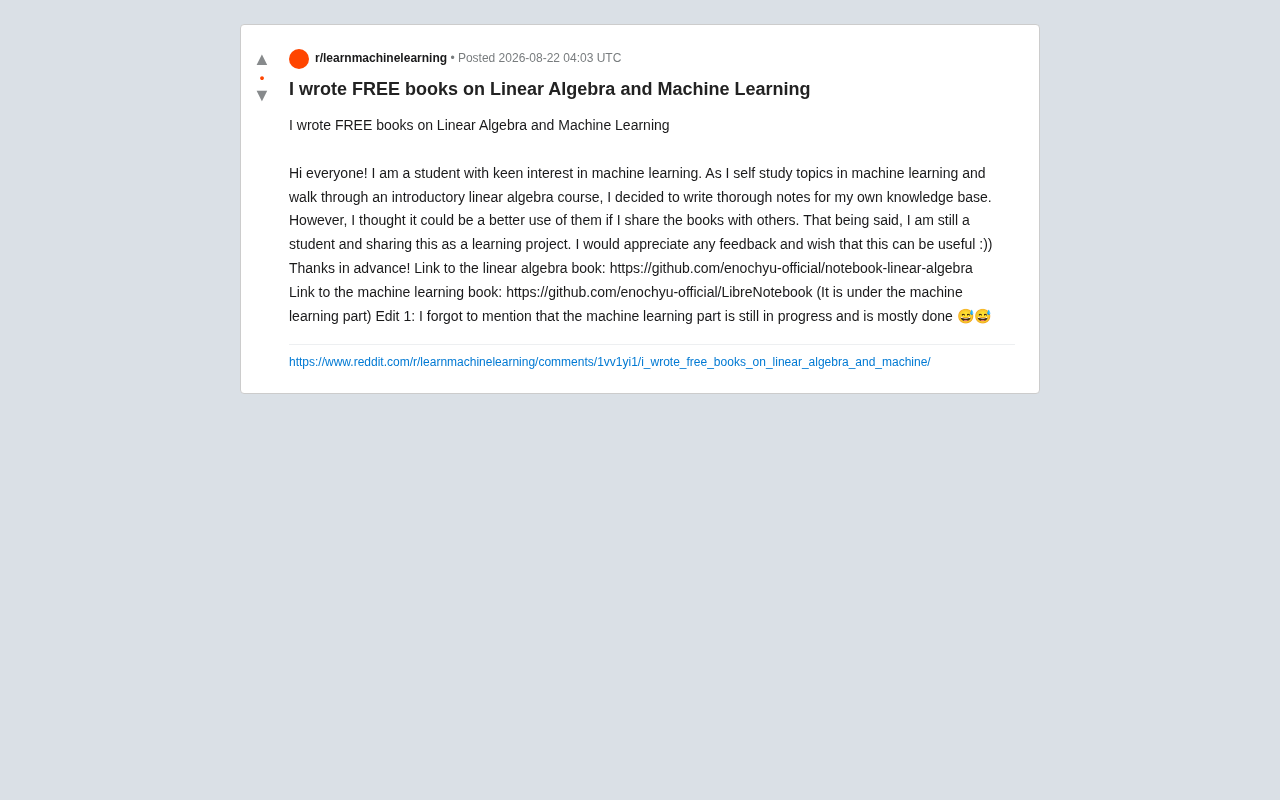
Free Open-Source Linear Algebra & Machine Learning Textbooks: Self-Study Notes from a Student's Perspective
A student compiled self-study notes into two free open-source textbooks on linear algebra and machine learning, hosted on GitHub for community collaboration.