Is Paid Independent RAG Evaluation Worth It? A Buyer's Real-World Experience Review

A Reddit post solicits paid experiences with independent RAG evaluation, revealing procurement motivations, deliverables, and value judgment frameworks.
The article analyzes a Reddit post soliciting paid experiences with independent RAG or chatbot evaluations. The post designs questions across six dimensions: trigger, budget, deliverables, value judgment, channels, and negotiation, outlining the complete chain of evaluation services from implicit needs to purchasable goods. The article notes that procurement motivation usually stems from internal lack of quantifiable scoring criteria; typical deliverables should include reproducible test sets, failure attribution, and improvement suggestions, not just a score report. Price ranges are affected by document scale, number of use cases, and human annotation, with channels mainly community attraction and acquaintance referrals. The core test of evaluation value is whether it changed release decisions or brought actionable improvements. Currently, public first-hand transaction data remains scarce.
Why Would Anyone Pay for RAG Evaluation?
In the process of deploying AI applications, there's an awkward reality: most teams can quickly build a document-based retrieval-augmented generation (RAG) assistant, but they struggle to articulate whether it's actually any good. Internal testing often stops at "it feels okay," lacking quantifiable benchmarks and adversarial testing. As a result, some teams are turning to external independent evaluation services.
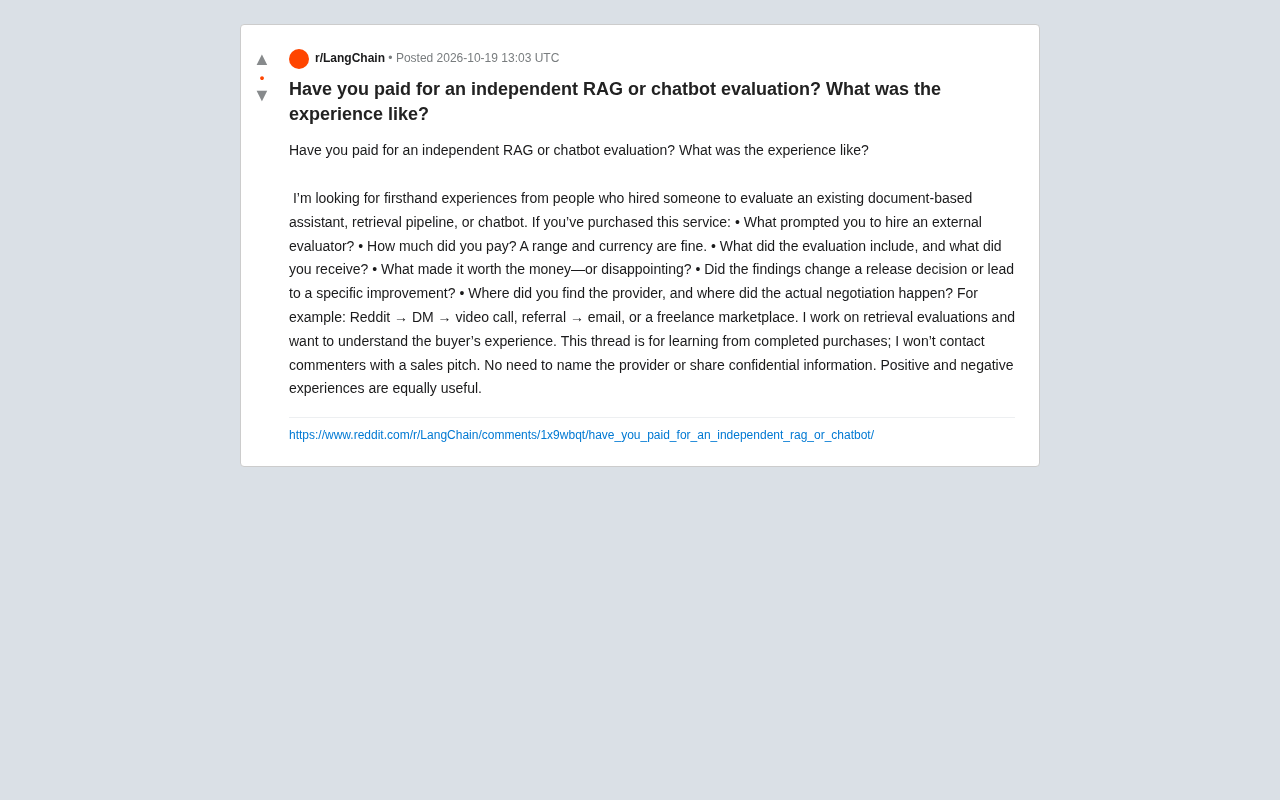
A practitioner in retrieval evaluation posted on Reddit, specifically collecting first-hand experiences from those who have "purchased independent RAG or chatbot evaluations." The post explicitly states no sales pitch, no contacting commenters—just wanting to know: what triggered the purchase? How much did it cost? What was delivered? What was worth the money and what was disappointing? This information is almost impossible to find systematically in public channels, so the question itself hits an information gap in RAG engineering deployment.
From the questions designed in the post, the asker cares about a complete purchasing chain: from trigger (why buy), budget (how much), deliverables (what you get), value judgment (worth it or not), to channels (where to find service providers, where to negotiate). These six dimensions are exactly the key links that turn evaluation services from "implicit needs" into "purchasable goods."
Evaluation Deliverables: What Buyers Actually Receive
Although the original post has not yet gathered many detailed replies from completed transactions, the questioning framework itself outlines the typical delivery format of independent evaluations. A complete RAG evaluation usually includes several layers: recall and ranking quality at the retrieval layer, faithfulness and relevance at the generation layer, end-to-end task completion rate, and adversarial test cases for specific business scenarios.
What buyers receive is often not just a score report, but a set of reproducible test sets, classified attribution of failure cases, and prioritized improvement suggestions. In the original post, "what the evaluation includes, what you received" is listed as two separate questions, indicating the asker realizes these two may not align—there's often a gap between the evaluation scope promised by service providers and the final deliverables, which is exactly the detail most worth recording in buyer experiences.
For document-based assistants, the difficulty of evaluation lies in the fact that the "correct answer" itself may not be unique. Independent evaluators need to first align business expectations with the buyer, then design scoring criteria—a process that itself consumes significant communication costs. This also explains why buyers are asked "what prompted you to hire an external evaluator"—inability to handle scoring criteria internally is often the real starting point for procurement.
Recall and ranking quality are two fundamental dimensions of retrieval evaluation. Recall measures "the proportion of all relevant documents that are actually retrieved by the system," which directly determines whether the generation layer can obtain sufficient information raw material; ranking quality focuses on the position distribution of relevant documents in the result list, with common metrics including MRR (Mean Reciprocal Rank) and NDCG (Normalized Discounted Cumulative Gain). For RAG systems, low recall usually means answers will have factual errors due to missing key context, while poor ranking quality allows the generation model to be distracted by irrelevant content. These two metrics need to be measured separately because their failure modes are different, and so are the remedies—the former relies on adjusting chunking strategies or embedding models, the latter on reranking mechanisms.
Faithfulness and relevance are core metrics for generation layer evaluation. Faithfulness measures whether the generated answer is entirely based on the retrieved context, rather than memory or hallucinations from the model's own parameters; relevance measures whether the answer truly addresses the user's question. These two metrics often trade off against each other: overemphasizing faithfulness leads to conservative answers that copy the original text, while overemphasizing relevance may introduce content not verified by retrieval. In independent evaluations, these two usually require human annotation or LLM-as-judge scoring, making evaluation costs higher and one of the important sources of price differences.
Price Ranges and Procurement Channels: A Murky Account
The original post only asks for "a range and currency" regarding price—this loose questioning approach indirectly reflects the lack of public pricing in the independent evaluation market. Quotes for RAG evaluation usually depend on document scale, number of test cases, whether human annotation is included, and delivery cycle, ranging from a few thousand to tens of thousands of RMB.
Procurement channels are equally fragmented. The example paths given in the post include "Reddit DM to video call," "referral to email," and "freelance platforms"—these three paths represent three ways of building trust: community content attraction, acquaintance endorsement, and platform guarantee. For services like evaluation that highly depend on professional judgment, buyers often rely more on the first two, because platform ratings can hardly reflect the evaluator's true depth of understanding of the RAG tech stack.
You may not have noticed that the post specifically distinguishes "where to find service providers" and "where actual negotiations take place." The separation of these two links indicates that many transactions start in public communities and conclude in private video communications—buyers need conversation to judge whether the other party truly understands retrieval evaluation, not just knows how to apply templates.
How Evaluation Conclusions Affect Release Decisions
The most practically valuable question in the original post is: "Did the evaluation findings change the release decision, or bring concrete improvements?" This touches the core value proposition of independent evaluation—it's not an archived report, but should be a decision input.
Ideally, evaluation conclusions can support three types of decisions: delaying release to fix retrieval recall defects, narrowing the scope of the initial launch scenario, or adjusting the generation layer's prompting strategy. But there's also a common disappointing experience: the report points out problems but doesn't provide actionable repair paths, leaving the team holding scores and not knowing what to do next. The original post solicits both positive and negative experiences side by side, precisely to restore the true distribution of this value judgment.
From the buyer's perspective, the cost-effectiveness of evaluation services doesn't depend on report thickness, but on "whether the problems found are specific enough and fixable enough." An evaluation that can pinpoint systematic failures of certain query types under specific document chunking strategies is far more valuable than a vague "overall accuracy 78%."
Adversarial test cases refer to query sets specifically designed to expose system weaknesses, such as questions containing ambiguous expressions, multi-hop reasoning, negative conditions, or contradictions with document content. Unlike regular test sets, the goal of adversarial cases is not to measure average performance, but to detect failure modes under boundary conditions. In RAG evaluation, such cases can reveal systematic blind spots in the retrieval layer for specific query types, or whether the generation layer produces hallucinations when context is insufficient. For teams purchasing evaluations, the quality of adversarial testing is often the key marker distinguishing "template-applying" service providers from evaluators who truly understand RAG, because designing effective adversarial cases requires deep understanding of both business scenarios and model behavior.
Consensus and Gaps from Multiple Perspectives
It should be noted that this topic is currently analyzed mainly based on the questioning framework of a single community post. The post itself has not yet presented many completed transaction replies, so specific data on price ranges, delivery quality distribution, channel conversion rates, etc., currently lacks multi-source cross-validation. The post explicitly promises not to sell to commenters, which helps improve the authenticity of replies, but sample size remains a key limitation in observing this market.
From an industry-wide perspective, RAG evaluation is moving from "internal side job" to "purchasable service," but pricing standards, delivery specifications, and effect attribution methods have not yet reached consensus. For teams considering purchasing evaluations, the six questions in the original post are themselves a good procurement checklist: first clarify the trigger, then specify deliverables, and finally use "whether it changed decisions" to test whether the money was well spent.
If you've had paid evaluation experience, the value of such public experience lies in making the market more transparent; if you're evaluating whether to buy, you might first ask yourself the questions in the post before deciding whether you need an external perspective.
One-line Summary
A Reddit post solicits paid experiences with independent RAG evaluation, revealing procurement motivations, deliverables, and value judgment frameworks.
Paragraph Summary
The article analyzes a Reddit post soliciting paid experiences with independent RAG or chatbot evaluations. The post designs questions across six dimensions: trigger, budget, deliverables, value judgment, channels, and negotiation, outlining the complete chain of evaluation services from implicit needs to purchasable goods. The article notes that procurement motivation usually stems from internal lack of quantifiable scoring criteria; typical deliverables should include reproducible test sets, failure attribution, and improvement suggestions, not just a score report. Price ranges are affected by document scale, number of use cases, and human annotation, with channels mainly community attraction and acquaintance referrals. The core test of evaluation value is whether it changed release decisions or brought actionable improvements. Currently, public first-hand transaction data remains scarce.
Related articles

"Black October": Did AI Uncover 3% of All Critical Vulnerabilities Ever?
A Reddit post claims 3% of all critical software vulnerabilities ever were found in the past month, dubbed 'Black October.' We break down the statistical issues, how AI-assisted code auditing accelerates discovery, and how developers should respond.

Microsoft Project Gecko: Using AI to Bridge Language Gaps for African Farmers
Microsoft's Project Gecko launches PharmaChat, letting African farmers ask questions in their native language and get precise video clips and farming book chapters via AI. The project also releases three interactive manuals to advance inclusive AI.

Musk's Space Dominance: How Starlink Throttling Undermines Ukraine's Defense
SpaceX's Starshield throttling disabled Ukraine's high-speed interceptor drones, exposing how Musk's private control over low Earth orbit communications affects battlefield dynamics and national security, and highlighting the risks of commercial space militarization and space governance dilemmas.