Is Programming Dead? A Practical Analysis of Three Vibe Coding Tools
Vibe coding turns developers from syntax typists into directors of agents—but judgment matters more than ever.
The article introduces Andrej Karpathy's concept of vibe coding, in which developers no longer hand-write syntax but set the vision, judge the output, and guide autonomous agents to do the implementation. It examines three tools: Lovable, which first generates a PRD and database schema, then builds a full-stack app and lets you click elements and rewrite them in natural language; Claude Code, which runs in the local terminal with file system and command-line access, reading logs, editing multiple files, running regression tests, and committing to git; and Manus, which extends beyond code to asynchronous background browser workflows for research and multi-app orchestration. It also stresses risks—hardcoded keys, architecture bloat, and unsupervised API loops—concluding that the barrier to writing code approaches zero while the value of judgment and review rises.
From "Typist" to "Director": What Is Vibe Coding?
If you've spent the past five years telling yourself "I have to learn Python, React, or JavaScript first before I can build software," you can officially stop now. The era of manually typing out syntax is coming to an end—we've entered the age of vibe coding.
Coined by the well-known AI researcher Andrej Karpathy, this term is more than just an internet meme. It describes a fundamental paradigm shift: you're no longer the "typist" translating human ideas into impenetrable programming syntax. Instead, you become an "executive director"—setting the vision, judging the output, and guiding an autonomous agent through the heavy lifting.
The video's creator points out that three recently matured tools have turned this concept from a Silicon Valley experiment into a mainstream phenomenon anyone can pick up. Each has a distinct role: one turns ideas into interactive web applications, one acts as an autonomous engineer in your local terminal, and one extends the task boundary from code to the entire realm of computer operation.
Lovable: From Idea to Deployable App in Ten Minutes
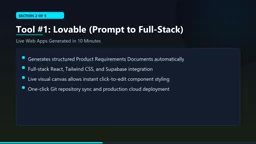
Most AI site-building tools of the past gave you static previews—pretty landing pages where clicking a button did nothing. What sets Lovable apart is that it combines an intuitive design canvas with a genuine full-stack architecture.
When you enter a prompt, Lovable doesn't just spit out code. It first generates a structured product requirements document, plans a relational database schema, configures authentication flows, and sets up state management in modern React and Tailwind CSS.
What's more important is the interaction model: while the build is in progress, you can operate the app live in your browser. If a button color is wrong, or the billing logic needs adjusting, you don't have to dig through dozens of CSS files—just click the element and type "change this card to glassmorphism and add a tooltip overlay comparing weekly profit," and Lovable instantly rewrites that component.
According to the video, within ten minutes you can have a production-grade app with GitHub sync and one-click deployment. This "click-describe-rewrite" feedback loop is the most typical vibe coding experience during the prototyping phase.
A product requirements document (PRD) is a standard deliverable in product development, typically written by a product manager to define target users, core features, interaction flows, and acceptance criteria. Lovable generating a PRD before writing any code essentially automates the "requirements gathering" step that a traditional team would handle. This step matters because large models, when lacking a structured spec, tend to generate code that looks complete but is logically fragmented; once the data model and page relationships are fixed first, the components generated afterward have consistent constraints to follow.
A database schema refers to the overall structural definition of tables, fields, types, primary and foreign keys, and indexes in a relational database. It determines how data is stored and related, and since later changes often involve data migration, it's an architectural decision best made as early as possible.
Tailwind CSS is an atomic CSS framework that describes styles by combining many fine-grained utility classes rather than writing separate stylesheets by hand. It makes AI-generated interface code more compact and easier to modify locally, which is one of the foundations for being able to precisely rewrite a single component after clicking an element.
Claude Code: An Autonomous Engineer in the Terminal
When you're dealing with a large, existing enterprise codebase on your local machine, tools like Lovable aren't enough. This is the battleground for Claude Code from Anthropic—which the video's creator describes as "terrifying to traditional software developers."
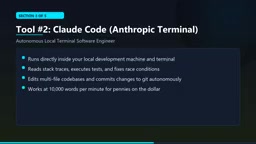
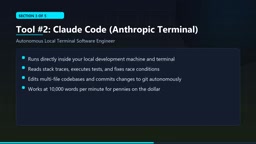
Unlike ChatGPT, which is confined to a browser tab and requires you to repeatedly copy and paste code, Claude Code is an autonomous agent that runs directly in your local terminal. It has full authorized access to the file system, git history, and command-line tools.
The process demonstrated in the video is worth a close look: Claude Code doesn't ask you to change line 42—instead it reads the error logs itself, traces the broken dependency, edits the multi-file architecture, runs regression tests in the background, confirms the fix works, and finally stages a clean git commit.
This is no longer an assistant offering suggestions, but an autonomous junior engineer—working, in the video's exaggerated phrasing, "at ten thousand words per minute and at a cost of a few cents." Note that this cost description is the video creator's subjective expression, not rigorous benchmark data.
The difference between an autonomous agent and an ordinary chat-style assistant lies in the "action loop": it can call tools, observe results, and adjust its next step based on feedback, rather than merely outputting text suggestions. In the Claude Code scenario, those tools are reading and writing files, executing shell commands, and querying git history. The so-called "full authorized access" means the agent has operating permissions close to those of the developer themselves—this is both the precondition for its autonomous troubleshooting and the reason that, if it misjudges, the impact is on a real local codebase. Version control and review mechanisms are therefore especially important.
Regression testing means re-running the existing test suite after code changes to confirm that new modifications haven't broken existing functionality. A git commit records a set of changes as a snapshot in version history, making it easy to trace back and roll back. Having the agent run tests itself and commit cleanly essentially bakes the engineering discipline of "verify after changing" into the automated workflow.
Manus: Pushing the Task Boundary Beyond Code
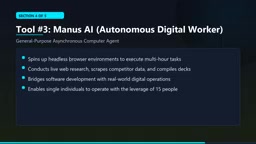
If the task goes beyond writing code—involving web research, booking, or orchestrating multiple apps—that's the domain of Manus AI. The video positions it at the frontier of general-purpose computer-operation agents: if you think of Claude Code as a development engineer, Manus is an entire operations team.
It accepts high-level goals, such as "find the top 50 B2B marketing agencies in California whose websites don't have AI customer service deployed, find the email of their head of operations, and generate a personalized proposal for each"—compound tasks of that sort. Manus's approach is to launch a background browser, navigate pages, handle interactive elements, and run background workflows asynchronously for hours without timing out or returning a generic answer.
The video creator's judgment is that by stringing these three tools together, one person today can achieve the technical output that two years ago required a fifteen-person software company. That comparison is clearly designed to be shareable, but the direction it points to—individual productivity dramatically amplified by agents—is consistent with industry observations.
An asynchronous background workflow means that after a task is submitted, you don't need to keep the session online; the agent runs continuously in the background and delivers results when done. The key difference from traditional conversational interaction is task duration and state management: hours of research involve many page navigations, retries after failures, and saving intermediate results, requiring an independent execution environment and state record rather than relying on the context window of a single request.
Multi-app orchestration refers to an agent coordinating across multiple systems to achieve a goal—for example, scraping information in a browser, writing to a spreadsheet, and invoking an email service. The new question this capability raises isn't "can it be done" but "at what point does a human need to confirm"—actions involving external sending, payment, or form submission usually need human review checkpoints.
Reality Check: Vibe Coding Doesn't Mean Turning Off Your Brain
The reminder in the second half of the video may be the most valuable part of the entire piece. Vibe coding doesn't mean you can completely stop thinking. If you don't understand the high-level architecture of what the agent is building, you'll face at least three types of risk:
- Security vulnerabilities: such as API keys hardcoded into the code.
- Architectural bloat: structural chaos that makes future updates nearly impossible.
- Runaway API loops: unsupervised calls that keep consuming tokens and burning hundreds of dollars while you sleep.
The author's conclusion is that the most successful vibe coders aren't the ones who write no code at all, but those who have mastered system design, verification, and security auditing. In other words, the tools have lowered the barrier to "writing" to nearly zero, but raised the value of "judgment" even higher.
Hardcoded API keys means writing access credentials directly into the source code rather than injecting them through environment variables or a secret management service. Once the code is committed to a public repository or synced to a third-party platform, the key is effectively leaked and could be used to run up charges or access sensitive data. This is a fairly common problem in AI-generated code, because models tend to make examples "just run."
Architectural bloat refers to continuously piling on features and dependencies without overall planning, leading to overlapping module responsibilities and deeper coupling. In the short term every requirement can be met, but in the long term any change may trigger a chain of failures.
A so-called runaway API loop is when an agent repeatedly calls paid interfaces without supervision and cannot terminate on its own—for example, retry logic with no upper limit, or a task goal that is itself unachievable. Corresponding safeguards include setting caps on call counts and costs, configuring timeouts and alerts for long tasks, and manually reviewing billing-related logic before deployment.
What This Means
The core change in vibe coding isn't "you don't need to learn programming," but a reorganization of the division of labor: syntax translation goes to the agent, while architectural decisions, quality verification, and risk control stay with humans. For individual developers, this is a window to rapidly push ideas into working products; for teams, the real dividing line will be who can establish review mechanisms for agent output.
The question posed at the end of the video is also worth answering for every practitioner: are you using vibe coding to build software, or are you still insisting on hand-writing every line?
Related articles

The Only Video on Bilibili That Explains Harness Engineering? A Practical Analysis of Enterprise Multi-Agent Collaboration
Analyzing Harness Engineering's core components for enterprise multi-agent collaboration: orchestration, state management, security isolation, and observability. Based on Bilibili tutorial material, discussing why interviewers are starting to probe engineering constraints and how to rationally view "the only one that explains it" tech content.

AI Agent Full-Stack Practical Course: Master Dual-Framework Development from 0 to 1
An analysis of the Bilibili AI Agent full-stack practical course: four stages covering basic concepts, LangChain deep dive, single-Agent practice, and CrewAI multi-agent advancement, with zero-config tools and open-source code, suitable for developers with programming foundations.

Hand-Writing Agents.md Significantly Improves AI Coding Stability
A Bilibili creator compares two real projects—a video editor and a card game—showing that hand-written Agents.md and design docs significantly boost AI coding stability, explains how Agents.md differs from skill injection, and offers practical document-driven development methods.