The Only Video on Bilibili That Explains Harness Engineering? A Practical Analysis of Enterprise Multi-Agent Collaboration
Harness Engineering is an engineering paradigm for multi-agent collaboration, centered on orchestration, state, isolation, and observability.
Using a Bilibili video with an exaggerated title but insufficient content as a starting point, this article points out that Harness Engineering lacks systematic Chinese-language coverage. It explains Harness's core value: constraining multiple agents within a controllable collaboration framework to solve error amplification, state tracking, and debugging cost issues. It breaks down key components—orchestration, state and context management, security isolation, and observability—and emphasizes the necessity of sandbox isolation in production. It also analyzes interview trends shifting from "can call APIs" to "understands engineering constraints," reminding readers to view "the only one that explains it" titles rationally and cross-validate with official docs and open-source implementations.
A Technical Topic Undermined by Its Title
Search for "Harness Engineering" on Bilibili and you'll notice a pattern: a tutorial titled "The Only Video That Thoroughly Explains Enterprise Multi-Agent Collaboration in Practice" turns out to be a livestream opening—the host is checking audio equipment, viewers are typing "1" in the chat, and then the topic drifts elsewhere. This isn't an isolated case but a common information mismatch in tech content communities: the title promises depth, but the content stays in the warm-up phase.
Yet this exposes a real need: Harness Engineering, as an engineering paradigm for multi-agent collaboration, genuinely lacks systematic Chinese-language coverage. Many developers know the term "multi-agent" but can't clearly explain how it differs from ordinary agent orchestration, let alone what problems must be solved for enterprise deployment. This article, based on the original video material and general knowledge of multi-agent engineering, attempts to clarify the matter.
What Problem Does Harness Actually Solve?
To understand Harness Engineering, you first need to understand the real situation of multi-agent systems in enterprises. A single agent has clear capability boundaries—it excels at completing a task within a limited context. But enterprise scenarios often require multiple agents to divide and collaborate: one for retrieval, one for reasoning, one for execution, one for validation. The problem is that collaboration between agents is not a simple function call.
Each agent has its own context window, its own toolset, its own failure modes. When chained together, errors amplify along the chain, state becomes hard to track, and debugging costs rise exponentially. This is where Harness's core value lies: it provides a "harness" (the original meaning of the word is horse tack) that constrains multiple agents within a controllable collaboration framework, making them pull in the same direction like horses in harness, rather than each running wild.
This metaphor is not just rhetorical. The difficulty of enterprise multi-agent collaboration has never been "can we make two agents talk to each other," but how to ensure the conversation happens within controlled boundaries, how to observe the running state of the entire chain, and how to quickly locate a failure when a link breaks. These are precisely the engineering questions that Harness engineering aims to answer.
Multi-Agent System refers to an architecture where multiple autonomous agents complete tasks through communication and collaboration. Compared with a single agent, a multi-agent system can decompose complex tasks, process in parallel, and cross-validate, but it also introduces inherent challenges of distributed systems: communication overhead, state consistency, fault propagation, and debugging complexity. Common multi-agent collaboration patterns in the industry include hierarchical (a coordinator agent assigns tasks to sub-agents), pipeline (agents process and pass results in sequence), and debate (multiple agents generate proposals and critique each other). Harness Engineering does not refer to any specific collaboration pattern but provides an engineering support layer for these patterns, ensuring the collaboration process is configurable, observable, and recoverable. Understanding this helps distinguish "multi-agent frameworks" (such as AutoGen, CrewAI) from "Harness engineering"—the former provides abstractions for inter-agent dialogue, while the latter focuses more on constraints and governance in production environments.
Core Components Breakdown: From "It Runs" to "It's Controllable"
Orchestration Layer: Defining Who Does What and When
Harness's orchestration layer is not a simple sequential executor. It needs to handle control flows such as conditional branching, parallel convergence, and loop retries, while assigning clear responsibility boundaries to each agent. A common misconception is to write orchestration as hardcoded processes—this is fine in a demo, but once the number of agents increases and task complexity rises, hardcoding becomes a maintenance nightmare. Mature Harness implementations decouple orchestration logic from agent implementation, making processes configurable and versionable.
State and Context Management
The most underestimated component in multi-agent collaboration is state management. Intermediate results produced by each agent, return values of tool calls, and traces of failed retries all need to be recorded and passed along. Harness needs a unified context protocol so that what agents pass between each other is not scattered strings but structured, traceable state objects. This directly determines whether you can review what happened when the system fails.
Observability and Security Isolation
One detail in the original material is worth noting: the host mentioned that a student was asked in an interview about preparation for "Sandbox aspects" and emphasized that "security isolation might be asked about." This is no coincidence. In enterprise multi-agent systems, agents may call external tools, access sensitive data, and execute code. A collaboration framework without sandbox isolation is unacceptable in production environments. Harness's observability component is responsible for recording each agent's input/output, latency, token consumption, and exceptions, allowing operations staff to see what happens inside the "black box."

Sandboxing in enterprise multi-agent systems generally refers to providing boundary control over resources and permissions for the agent's execution environment. Specific implementations include: using containers (such as Docker) or lightweight virtual machines to isolate file systems and network access; preventing agents from performing dangerous operations through capability restrictions (such as read-only file systems and restricted network egress); and using independent processes with timeouts and memory limits for code-execution tools. Sandboxing not only prevents malicious behavior but also limits the scope of failure impact—when an agent calls the wrong tool due to hallucination, the sandbox can prevent it from damaging shared state. In interviews, "security isolation" often appears alongside concepts such as "principle of least privilege" and "fault domain isolation," testing whether candidates have production-environment security awareness rather than merely being able to stitch APIs together.
Why Interviewers Are Starting to Ask About This
In the video, the host shows a screenshot of an interview question and mentions that a student was contacted by a foreign company for an interview, where HR specifically emphasized that "security isolation" might be probed. This signal is valuable: job requirements for enterprise multi-agent roles are shifting from "can call APIs" to "understands engineering constraints".
In the past, interviews asked "which agent frameworks have you used"; now they ask "how do you isolate your agents," "how do you roll back on failure," and "how do you handle context overflow." What these questions have in common is that they all point to the domain of Harness Engineering—not a matter of model capability but of systems engineering. For developers who want to enter this direction, understanding Harness's component design has more long-term value than memorizing the APIs of a few frameworks.
It should be noted that the discussion of interview trends in the original material comes from the host's personal observations. He mentioned having handled a large number of resume revisions and interview reviews, but the specific composition and statistical basis of this sample were not elaborated in the material. Therefore, these observations can serve as directional references but should not be treated as rigorous industry data.

Taking Claims Like "The Only One That Explains It" Rationally
Back to the title itself. "The only one on Bilibili that explains it clearly" is a typical content packaging strategy that exploits learners' anxiety—fear of missing out, fear of learning the wrong thing. But from the original material, the main body of this episode is the livestream opening and the introduction of interview topics; the technical details of Harness Engineering are not fully elaborated in the provided material.
This does not mean the topic lacks value. On the contrary, it shows that genuinely systematic Chinese-language material on Harness Engineering is still scarce. For developers, a more pragmatic approach is to treat such videos as demand signals rather than knowledge sources, read official documentation and open-source implementations with the question "what engineering components does multi-agent collaboration need," and then return to verify the views in the video. In technical learning, the stronger the certainty in a title, the more skepticism is warranted.
The engineering of multi-agent collaboration is still in its early stages, and concepts like Harness will continue to evolve. Grasping the unchanging core—"orchestration, state, isolation, observability"—is more reliable than chasing any "only tutorial."
One-line Summary
Harness Engineering is an engineering paradigm for multi-agent collaboration, centered on orchestration, state, isolation, and observability.
Paragraph Summary
Using a Bilibili video with an exaggerated title but insufficient content as a starting point, this article points out that Harness Engineering, as an engineering paradigm for multi-agent collaboration, lacks systematic Chinese-language coverage. It explains Harness's core value: constraining multiple agents within a controllable collaboration framework to solve problems of error amplification, hard-to-track state, and high debugging costs. It then breaks down the key components of enterprise multi-agent systems—orchestration layer, state and context management, security isolation, and observability—and emphasizes the necessity of sandbox isolation in production environments. The article also analyzes the signal of interview trends shifting from "can call APIs" to "understands engineering constraints," and reminds readers to view titles like "the only one that explains it" rationally, suggesting cross-validation with official documentation and open-source implementations.
Related articles

Cohere's Open-Source Critique and Anthropic's IPO on the Same Day: Coincidence or Strategy?
Reddit users spotted that Cohere's critique of open-source models was published the same day Anthropic filed for IPO, sparking debate over closed-source vendors' public comments and commercial motives.
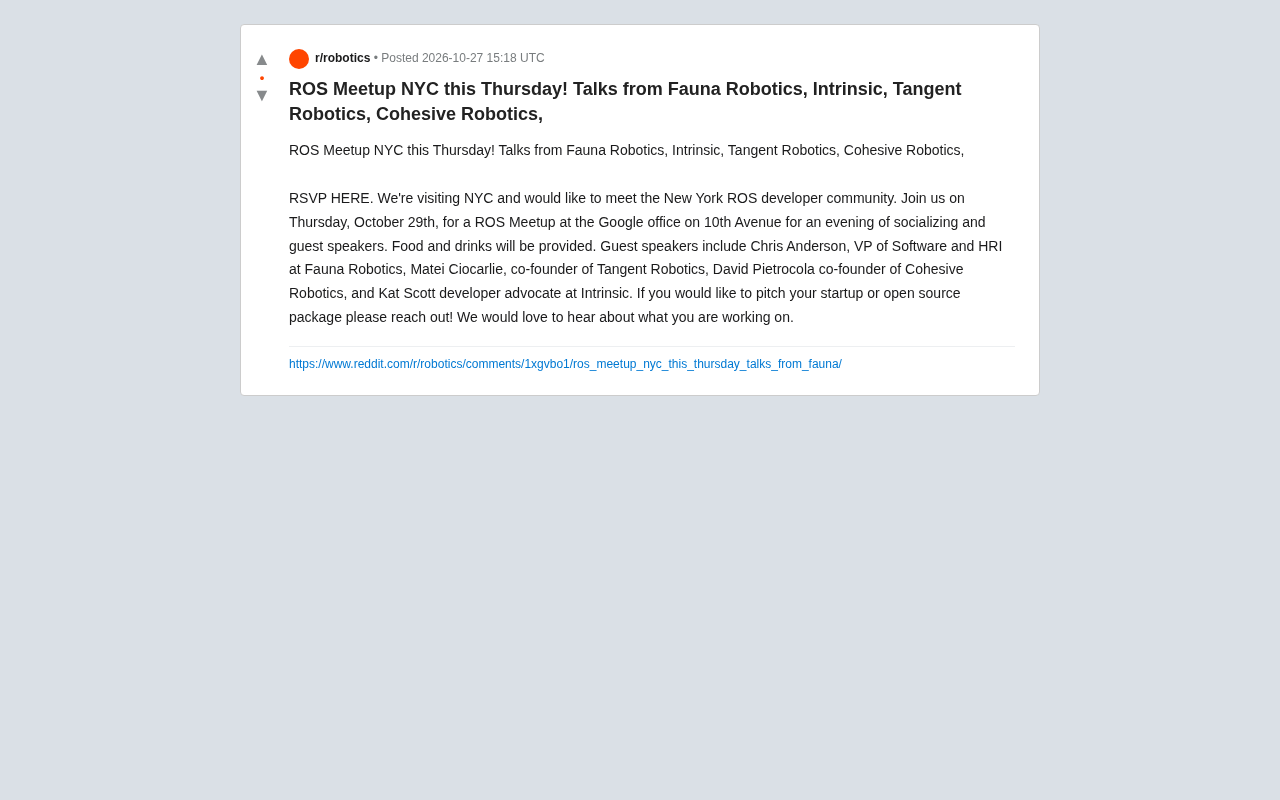
NYC ROS Developers Meetup: Talks from Four Robotics Companies
The NYC ROS developer meetup takes place Thursday at Google's office, featuring talks from Fauna Robotics, Intrinsic, Tangent Robotics, and Cohesive Robotics. Free, with food, open RSVP and call for speakers.

Local AI King: The Compute Gap and Competitive Anxiety Behind 12M Tokens a Day
A Reddit developer jokes about being a local AI king using 12M tokens a day—then gets humbled by someone using 34M tokens per minute. Exploring the compute gap, token anxiety, and how developers balance local vs. cloud automation.