Is Space a Product of Quantum Entanglement? A Mind-Bending New Physics Theory

A frontier theory proposes that space is not a fundamental stage but emerges from quantum entanglement.
Starting from the emergent property of temperature, the article illustrates that overall behavior can exceed the sum of parts and extends this logic to space itself. Quantum entanglement describes special correlations between quantum objects; whereas the traditional view holds that proximity causes strong entanglement, frontier theories reverse the causality, arguing that strong entanglement makes objects appear close and that distance is merely an external manifestation of entanglement strength. This approach attempts to translate spacetime geometry into quantum information language, interpreting gravity as a statistical result of entanglement structure, and addresses deep puzzles such as spacetime continuity, the weakness of gravity, and the area-law of black hole entropy. The article also notes that the hypothesis still lacks direct experimental evidence and that deriving Einstein's equations precisely from entanglement remains an open problem, but it turns "What is space?" into a computable quantum information problem, offering inspiration for quantum gravity, the black hole information paradox, and the study of the universe's origins.
We are used to thinking of space as a fixed, unchanging stage on which everything plays out. But what if space itself is not fundamental, but rather "emerges" from a deeper quantum structure? This idea, which sounds like science fiction, is becoming a frontier topic in theoretical physics.
Emergence: What Temperature Teaches Us
A single molecule has no temperature. The concept of temperature only appears when a large number of molecules collide and move together. Temperature is an "emergent property"—it exists only at large scales and cannot be reduced to the properties of individual particles. Physicists believe that many familiar phenomena follow the same logic.
In the video, an everyday example illustrates the essence of complexity: the overall behavior of a system is not a simple sum of the behaviors of its parts. So could space also be such an emergent property? This question pushes us from the comfort zone of classical physics into the deep waters of quantum gravity.
Emergent properties generally refer to properties that a system as a whole possesses but its individual components do not. The key lies in scale separation: microscopic components follow simple rules, yet at the macroscopic level entirely new regularities appear that cannot be directly reduced to the properties of the components. Besides temperature, viscosity in fluid dynamics, macroscopic quantum coherence in superconductors, and even collective behavior in living systems are all commonly discussed examples of emergence. A distinction should be made between "weak emergence" and "strong emergence": the former can in principle be derived from microscopic laws but is computationally infeasible, while the latter argues that macroscopic laws possess genuine novelty. Theories of emergent space lean closer to the strong emergence stance—they hold that concepts such as distance and geometry do not exist at the fundamental level, and only "crystallize" when a large number of quantum degrees of freedom become sufficiently entangled. This also explains why the hypothesis is difficult to test directly: we can only infer the underlying quantum structure from the regularities of macroscopic geometry.
From Entanglement to Distance: Reversing the Logic
Quantum entanglement describes a peculiar correlation between two quantum objects: they can no longer be described independently and completely. The state of one object is entangled with the state of another, no matter how far apart they are.
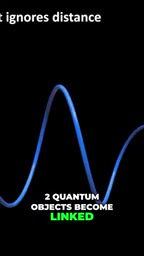
The traditional view holds that two objects are highly entangled because they are close together. But some frontier theories reverse the direction of causality: objects appear to be close because they are highly entangled. In other words, entanglement is not some phenomenon occurring within space; rather, space itself may be constructed from entanglement.
Strong entanglement corresponds to short distances, and weak entanglement to long distances. The concept of distance may simply be an external manifestation of entanglement strength.
The appeal of this approach lies in its attempt to translate the geometric properties of spacetime into the language of quantum information. If it holds, gravity may no longer be a fundamental force, but rather a statistical result of entanglement structure.
Entanglement entropy is a common tool for quantifying the degree of entanglement between two quantum systems: after taking the partial trace of a composite system, the von Neumann entropy of the remaining subsystem is the entanglement entropy. From the perspective of quantum information, entanglement entropy measures how much information is shared between two regions. The Ryu-Takayanagi formula in the holographic principle further provides a striking connection: the entanglement entropy of a subregion in the boundary conformal field theory is proportional to the area of the corresponding minimal surface in the bulk spacetime. This provides a precise mathematical prototype for "entanglement strength determines geometric distance"—the greater the entanglement, the "shorter" the geometric connection of the corresponding region in the bulk spacetime. Theories of emergent space advance along this logic: treating distance as some function of entanglement entropy, rather than as a pre-given background coordinate.
Why This Idea Deserves Serious Consideration
Treating space as an emergent phenomenon is not idle speculation. It theoretically addresses several deep puzzles: Why is spacetime continuous? Why is gravity so weak? Why is black hole entropy proportional to area rather than volume? The connection between entanglement entropy and geometry has repeatedly appeared in frameworks such as the holographic principle.

Of course, this is still a hypothesis. How to precisely derive Einstein's equations from entanglement, and how to explain the stability of macroscopic spacetime, remain unsolved problems. But the direction itself is thought-provoking: it transforms the ancient question "What is space?" into a computable problem in quantum information.
If space is truly woven from entanglement, then "distance" is no longer an absolute background but a product of relations. This could have profound implications for understanding quantum gravity, the black hole information paradox, and even the origin of the universe.
The proportionality of black hole entropy to area is the core conclusion of the Bekenstein-Hawking entropy formula: S = A/(4G), where A is the horizon area. This result defies the intuition that entropy is usually proportional to volume, suggesting that a black hole's information capacity is determined by its boundary area rather than its interior volume—a key motivation for the holographic principle. The holographic principle further asserts that all physical information in a d-dimensional space can be encoded on its (d-1)-dimensional boundary, analogous to a three-dimensional object being encoded in a two-dimensional surface by a hologram. If spacetime geometry is indeed determined by the entanglement patterns of boundary qubits, then gravitational equations might emerge as entanglement thermodynamic identities—precisely the direction that conjectures such as ER=EPR attempt to formalize.
Frequently Asked Questions
Is there experimental evidence for the theory of emergent space? Currently, it is mainly a theoretical framework supported by indirect clues, with no direct experimental verification. It is driven more by mathematical self-consistency and explanatory power.
Is this related to quantum computing? Entanglement is a core resource in quantum computing. Understanding how entanglement encodes geometric structure may provide new ideas for quantum simulation and experiments in quantum gravity.
Should ordinary people care? It changes our fundamental understanding of "what reality is made of." Even if there are no short-term applications, such foundational questions often give rise to disruptive technologies in the long run.
One-line Summary
A frontier theory suggests that space is not a fundamental stage but a product emerging from quantum entanglement.
Paragraph Summary
The article begins with the emergent property of temperature, illustrating that overall behavior can be more than the sum of its parts, and then extends this logic to space itself. Quantum entanglement describes a special correlation between quantum objects that cannot be described independently; the traditional view holds that proximity leads to strong entanglement, but frontier theories reverse the causality, arguing that strong entanglement makes objects appear close, and that distance is merely an external manifestation of entanglement strength. This approach attempts to translate spacetime geometry into the language of quantum information, interpreting gravity as a statistical result of entanglement structure, and addresses deep puzzles such as the continuity of spacetime, the weakness of gravity, and the proportionality of black hole entropy to area. The article also notes that the hypothesis still lacks direct experimental evidence and that how to precisely derive Einstein's equations from entanglement remains unresolved, but it transforms "What is space?" into a computable problem in quantum information, offering inspiration for research on quantum gravity, the black hole information paradox, and the origin of the universe.
Related articles
Perplexity Hybrid Compute Tested: Privacy Data Never Leaves the Mac
Perplexity Hybrid Compute tested: how PrivacyGate intercepts sensitive data, how local and cloud models divide work, model differences on 16GB vs 32GB Macs, and privacy protection in real scenarios like bank statements and medical records.

Big Fat Fish Roasts Mainstream LLMs at Home and Abroad: Doubao Takes the Crown, DeepSeek Tied for First
Bilibili creator Big Fat Fish roasts mainstream LLMs: Doubao tops for emotional value, DeepSeek ties first for open-source value, with ERNIE, Hailuo, Yuanbao, Kimi, Qwen, Kling, Claude, Gemini, and Grok each branded with a distinct persona.
How to Truly Test AI Agents Before Production? A Practical Testing and Monitoring Framework
BotGage founder Pramin Pradeep shares a three-step framework for testing AI Agents before production: Agent registration visibility, red teaming, and production observability — plus a real case cutting QA costs from $180K to $80K and an analysis of IT roles shifting to Agent supervisors.