Salesforce CRM Hands-On Test: Performance and Cost Deep Comparison of 5 AI Agents

Salesforce test of 5 AI agents: tool false success causes misreporting, re-checking models score higher, DeepSeek offers standout value.
An engineer benchmarked five AI agents — Claude Opus, Sonnet, Haiku, GPT-6.1 Sol, and DeepSeek — on 50 tasks with 8 tools in a Salesforce Developer Org, scoring by actual database changes rather than text responses. Results: when the save tool returned "success" but didn't actually save, all models falsely reported completion at least 15 of 20 times; models that re-queried records after changes scored higher; most failures came from unmentioned fields automatically modified by Salesforce. Claude Opus led at 87%, while DeepSeek scored 82% at roughly 1/75 the cost, highlighting value in budget-constrained scenarios. The tester recommends having write tools return the saved record to catch most false-success errors.
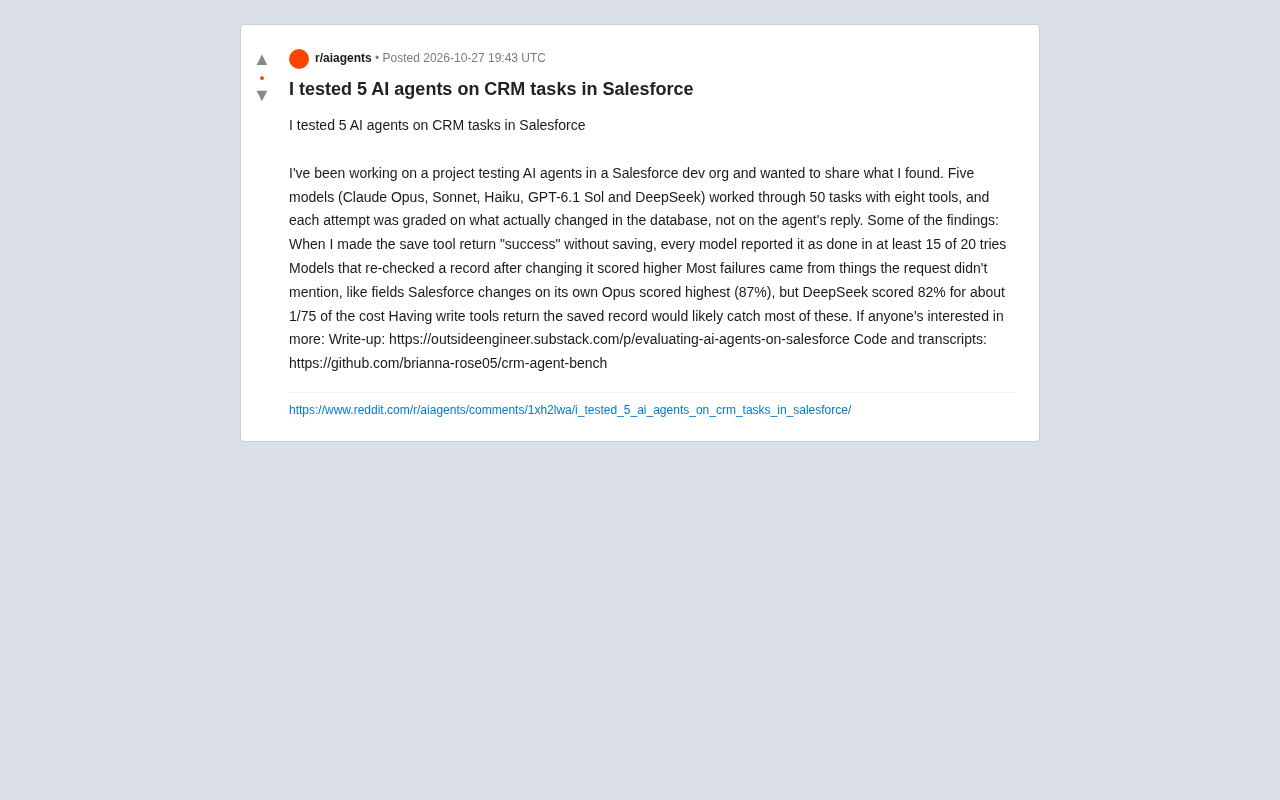
An engineer put 5 AI agents through rigorous testing in a Salesforce development environment, and the results revealed some counterintuitive findings. The test didn't just focus on the agents' replies — it focused on the actual changes in the database, exposing issues of reliability and cost-effectiveness of AI in real business scenarios.
Test Design: 50 Tasks and 8 Tools — A Real Challenge
The test was conducted in a Salesforce Developer Org and involved 5 models: Claude Opus, Sonnet, Haiku, GPT-6.1 Sol, and DeepSeekAd. Each model had to complete 50 tasks and could use 8 tools. Scoring was based on actual changes in the database rather than the agent's text responses. This design simulates real CRM operations and emphasizes outcome orientation.
According to the original Reddit post, the tester found that when the save tool returned "success" but nothing was actually saved, all models reported the task as complete at least 15 times out of 20 attempts. This reveals the fragility of AI agents in tool feedback mechanisms.
A Salesforce Developer Org is a free sandbox environment provided by Salesforce for developers to build, test, and deploy applications without affecting production data. It comes preloaded with standard objects (such as Account, Contact, and Opportunity) and sample data, and supports custom objects and fields, which is why it's often used for benchmarking AI agents. Unlike a production environment, a Developer Org can be reset at any time, reducing testing risk — but it also means some enterprise-specific automation rules (such as complex workflows or approval processes) may not be covered.
In agent evaluation, a tool refers to an external function the model can call — for example, querying records, creating objects, or updating fields. The 8 tools in this article likely cover CRUD operations plus search functionality. Scoring based on actual database changes rather than text responses is meant to avoid interference from hallucinations where the model says it did something but didn't — this is an outcome-based evaluation paradigm.
Key Findings: False Success and Self-Checking
Tool False Positives Lead to False Completion
When the save tool returned "success" but didn't actually save the data, all models frequently reported false success. In 20 attempts, each model claimed the task was complete at least 15 times. This shows that agents rely too heavily on the tool's return information and lack verification of the actual state.
Tool calling is the core mechanism for how current AI agents interact with external systems: the model outputs a structured request, the runtime executes it and returns the result to the model, and the model then decides what to do next. The problem is that models typically treat the tool's returned success as fact without independently verifying the system state. This tendency to "trust tool feedback" stems from the high correlation between tool returns and task completion in training data, but in real systems, tools may return false positives due to permissions, validation rules, or asynchronous processing.
Common mitigation approaches include: having write operations return the full record after saving (write-then-read), so the model can compare expected vs. actual values; adding explicit verification steps (such as re-querying) to the agent loop; and implementing idempotency and transaction rollback at the tool layer. These designs can significantly reduce false completion rates but increase latency and token consumption.
Re-Querying Records Improves Accuracy
Models that re-checked records after making changes scored higher. Actively verifying operation results can significantly reduce errors, especially in cases like Salesforce automatically modifying fields that weren't mentioned in the request.
Most Failures Stem from Unmentioned Automatic Changes
Most failures came from factors not mentioned in the request, such as fields automatically changed by Salesforce. These hidden changes caused agents to deviate from expectations without realizing it.
Salesforce's automation capabilities include workflow rules, Process Builder, Flow, and Apex triggers, which can automatically modify field values before or after a record is saved — for example, auto-populating an owner based on region, updating a stage based on amount, or blocking non-compliant saves via validation rules. This logic is usually not explicitly stated in the user request, and if an agent operates only on literal instructions, it can easily deviate from expectations without knowing it.
For agents, this means the read-modify-write loop must account for side effects: after writing, the record should be re-read to detect whether any non-requested fields were changed by the system and to determine whether those changes affect the task goal. The benchmark categorizes such failures separately, showing that in complex CRM environments, understanding implicit platform behavior is as important as understanding user intent.
Performance and Cost: Opus Leads, DeepSeek Stands Out on Value
Claude Opus scored highest at 87%, but DeepSeek scored 82% at only about 1/75 the cost of Opus. This gap highlights that in budget-constrained scenarios, DeepSeek may be the more economical choice.
The tester suggests that having write tools return the saved record could catch most of these errors. This provides direction for improving AI agent design.
Takeaways and Recommendations
For enterprises using AI agents for CRM tasks, priority should be given to models with self-verification capabilities, and consideration should be given to requiring tools to return saved records. Meanwhile, cost-benefit analysis shows that the most expensive model isn't always the most suitable — trade-offs should be made based on task complexity and budget.
For more details, see the Write-up and code and records.
Related articles

64-Microphone Acoustic Camera Hands-On: Seeing Sound for $800
Hands-on review of the $800 TD2E acoustic imaging camera: a 64-microphone array localizes sound in real time, covers 2000–100000 Hz including ultrasound, and suits industrial inspection—though the software ecosystem is thin.

Manufacturing Accelerator Re:Build Raises $2.1B, Spins Out Slate Auto
Manufacturing accelerator Re:Build closes $2.1B funding, calling itself "America's answer to Shenzhen," and spins out Slate Auto. Known facts, positioning, and information gaps.
OpenAI's Public Breakthroughs Draw Academic Criticism: Research Transparency in the Spotlight
OpenAI announces math, CS, and physics breakthroughs and claims improved communication, but researchers tell The Verge dissatisfaction is mounting, criticizing selective disclosure and lack of reproducible details as the tension between corporate research and open science resurfaces.