LangGraph in Production: The Pain of Silent API Changes

Silent external API changes can make LangGraph agents look fine while producing semantic errors—semantic-layer defenses are needed.
The article examines the risk of LangGraph agents encountering silent external API changes in production. When third-party APIs adjust default values, field meanings, or response behavior, HTTP 200 and schema validation still pass, but the agent keeps reasoning on incorrect semantics, creating hard-to-detect silent failures. It analyzes the limits of monitoring, contract testing, and log tracing, and proposes semantic-layer business validation, regression testing with shadow mode, business metric monitoring, and API provider change notifications. Community cases show the risk is widespread, so teams should build defenses proactively.
Introduction: When API Changes Silently Break Your Agent
In AI application development, LangChain and LangGraph have become popular frameworks for building complex agent workflows. However, once these agents are deployed to production, a hidden threat is often overlooked: silent changes to external APIs. Recently, a developer on Reddit raised this issue, sparking discussion about the stability of LangGraph agents in production environments.
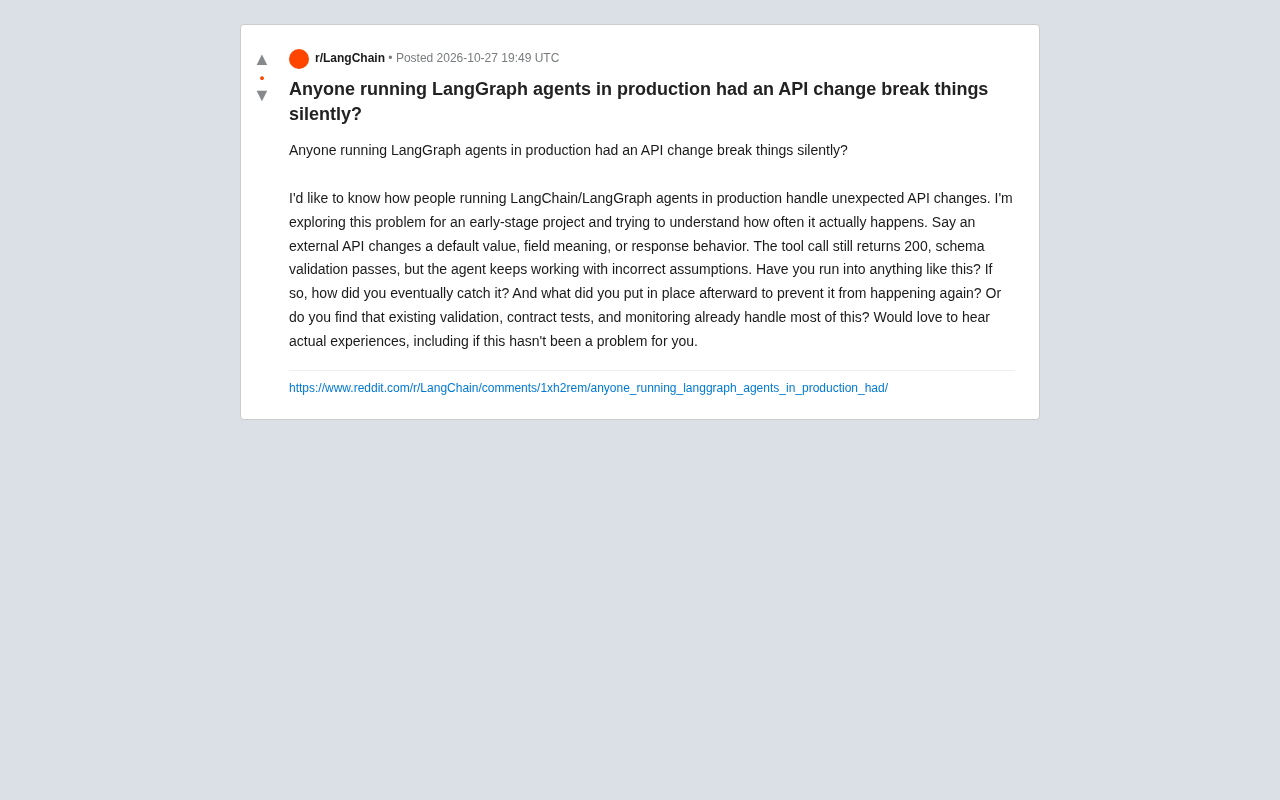
The scenario this developer described is very typical: an external API changes a default value, the meaning of a field, or its response behavior, but the tool call still returns a 200 status code and schema validation still passes—yet the agent continues working based on incorrect assumptions. This kind of "silent failure" is often hard to detect until it causes serious consequences.
The Nature of the Problem: Why Silent Changes Are So Dangerous
The Illusion of Normalcy
In traditional software development, API changes usually come with version number updates or documentation, allowing developers to adjust in time. But in agent systems, because the LLM's reasoning process is opaque, even if a tool call returns 200, the agent may continue executing based on outdated or incorrect semantic understanding. For example, an API field originally meant "user ID" but after the change means "session ID," and the agent may still use it as a user identifier, causing data confusion.
This problem is hidden because all technical-level checks—HTTP status codes, JSON schema validation, and even unit tests—may pass. Only semantic validation at the business logic level can detect the anomaly, and that is precisely the blind spot of current monitoring systems.
Contract Testing is a testing approach oriented toward service boundaries. Its core idea is to have the consumer (here, the agent) and the provider (the external API) agree on an explicit "contract" regarding the structure of requests and responses, and to verify in each side's CI pipeline that they comply with that contract, thereby avoiding incompatibilities that only surface during integration. Common implementations include Pact, Spring Cloud Contract, and others. It excels at catching structural breakage such as added or removed fields, type changes, and adjustments to required fields, with low verification cost and fast feedback. But its blind spot is also obvious: a contract usually describes only "what it looks like," not "what the value means." When an API keeps the same schema and only changes default values, enum semantics, or timestamp time zones, contract tests still pass. Therefore, in agent scenarios, contract testing should be regarded as the first line of structural defense rather than a guarantee of semantic correctness, and it needs to be used together with assertions about business rules.
Real Cases in Production
Although the original post did not provide specific cases, similar problems are not uncommon in developer communities. According to some practitioners, they have encountered third-party services adjusting default page sizes, changing timestamp formats, or even changing the meaning of error codes. These changes are usually not highlighted in API documentation and do not trigger version number changes, but they are enough to make an agent's output deviate from expectations.
How to Detect Silent Changes: The Limits of Existing Approaches
Shortcomings of Monitoring and Alerting
Most teams rely on monitoring metrics (such as request success rate, latency, and error rate) that cannot capture semantic-level changes. Even if the agent returns a seemingly reasonable result, it may already have deviated from the business goal. For example, for an agent that queries order status, if the API changes the "shipped" status code from "shipped" to "dispatched" and the agent's mapping logic is not updated, it may misclassify the order as "unknown status."
Agent Observability differs from traditional APM in that it focuses not only on the latency and error rate of the call chain, but also on the input context, tool selection, parameter construction, and final decision of each LLM inference. A common practice is to generate a traceable trace for each agent run, stringing "user intent → planning steps → tool calls → observed results → next decision" into a replayable timeline, along with metadata such as token usage, retry counts, and tool return summaries. Only with tracing at this granularity can statistics be made on "decision distribution drift": for example, time-series changes in metrics such as the proportion of a certain type of tool call, the frequency of a certain enum value, and the average number of tool call rounds. This is exactly the infrastructure needed to detect semantic-level silent changes—without structured traces, anomalies in business metrics can only be exposed through user complaints. LangSmith, OpenTelemetry's LLM semantic conventions, and others are practices in this direction.
Coverage of Contract Testing
Contract testing can verify whether an API's request and response structures meet expectations, but it usually does not check the business meaning of fields. If the API schema has not changed and only default values or behavior have changed, contract testing cannot detect it. Therefore, relying solely on contract testing is not enough to prevent silent changes.
Limitations of Logs and Tracing
Although detailed logs can record the input and output of each tool call, manually reviewing logs is unrealistic. Automated anomaly detection requires defining what "normal" behavior is, and the flexibility of agents makes it difficult to define a normal range.
Building a Defense System: Prevention and Detection Strategies
Semantic-Layer Validation
After a tool call returns, add a layer of business logic validation. For example, for key fields, check whether their values are within a reasonable range or comply with business rules. This requires defining explicit semantic constraints for each tool and enforcing them in the agent workflow. Although this increases development costs, it is necessary for core business scenarios.
Regular Regression Testing and Shadow Mode
Establish a regression test suite for external APIs, run it regularly, and compare results. A more advanced approach is Shadow Mode, which copies production traffic to a test environment, processes it with a new version of the agent, and compares output differences to detect semantic changes in time.
Shadow Mode is a low-risk online validation method: copy real production traffic (or a sample of it) and send it simultaneously to a new version of the agent or a newly configured toolchain, but only record its output without actually applying it. Then compare the shadow output with the output of the online main process item by item, and analyze the difference rate, difference distribution, and its correlation with business metrics. Compared with offline regression testing, shadow mode uses the real distribution and real external dependencies, and can expose long-tail scenarios that are difficult to construct in a test set; compared with direct canary releases, it does not affect real users. Key points for implementation include: deduplicating requests and handling idempotency to avoid doubling pressure or side effects on third-party APIs; masking sensitive data; and setting acceptable thresholds for differences and integrating alerting. Shadow mode is especially suitable for detecting problems such as external API behavior drift, where "the structure has not changed but the semantics have."
Proactive Monitoring and Alerting
In addition to technical metrics, business metrics should also be monitored. For example, if an agent's decision distribution suddenly changes (such as an abnormal frequency of a certain state), it may mean that the underlying API behavior has changed. Setting reasonable thresholds and alerts can help teams respond quickly.
Establish Communication Channels with API Providers
As much as possible, maintain communication with external API providers and subscribe to their change notifications. Although this cannot completely avoid problems, it can provide advance notice of major changes.
Community Views: Are Existing Practices Sufficient?
In the discussion of the original post, some developers said that through strict code review and integration testing they have been able to handle most API changes. But more people believe that for agent systems that depend on many third-party services, silent changes are a real risk that requires dedicated countermeasures.
One practitioner mentioned: "We once had a map API change its default zoom level, which caused all outputs from our route planning agent to be offset, but we did not discover it until users complained." This highlights the potential impact of silent changes.
Conclusion: Proactive Defense Rather Than Reactive Response
For production teams running LangGraph agents, silent changes to external APIs are a challenge that cannot be ignored. Relying solely on traditional monitoring and testing methods is not enough; additional validation and monitoring mechanisms must be established at the semantic level. Although this increases complexity, it is crucial for ensuring agent reliability and business continuity.
As the original poster asked, is this problem widespread? Judging from community feedback, it is indeed an issue worth attention. Building a defense system early is more cost-effective than fixing things afterward.
One-line Summary
Silent changes to external APIs make LangGraph agents appear normal while making semantic errors, requiring semantic-layer defenses.
Paragraph Summary
The article examines the risk of LangGraph agents encountering silent changes to external APIs in production. The author points out that when third-party APIs adjust default values, field meanings, or response behavior, HTTP 200 and schema validation still pass, but the agent continues reasoning based on incorrect semantics, creating hard-to-detect "silent failures." The article analyzes the limitations of existing monitoring metrics, contract testing, and log tracing: they cover only structure and availability, not the business meaning of fields. It therefore proposes four types of defense strategies: adding semantic-layer business validation after tool returns, regular regression testing with shadow mode output comparison, monitoring business metrics and anomalies in decision distribution, and establishing change notification channels with API providers. Real cases in community discussions show that this risk is widespread, and teams should proactively build a defense system rather than remediate afterward.
Related articles

64-Microphone Acoustic Camera Hands-On: Seeing Sound for $800
Hands-on review of the $800 TD2E acoustic imaging camera: a 64-microphone array localizes sound in real time, covers 2000–100000 Hz including ultrasound, and suits industrial inspection—though the software ecosystem is thin.

Manufacturing Accelerator Re:Build Raises $2.1B, Spins Out Slate Auto
Manufacturing accelerator Re:Build closes $2.1B funding, calling itself "America's answer to Shenzhen," and spins out Slate Auto. Known facts, positioning, and information gaps.
OpenAI's Public Breakthroughs Draw Academic Criticism: Research Transparency in the Spotlight
OpenAI announces math, CS, and physics breakthroughs and claims improved communication, but researchers tell The Verge dissatisfaction is mounting, criticizing selective disclosure and lack of reproducible details as the tension between corporate research and open science resurfaces.